

Erdogan: Normalized ties with Israel would benefit region
Turkish president says renewing diplomatic relations with Jewish state possible if Mavi Marmara casualties compensated, Gaza blockade lifted
 Add ToI as a Preferred Source on Google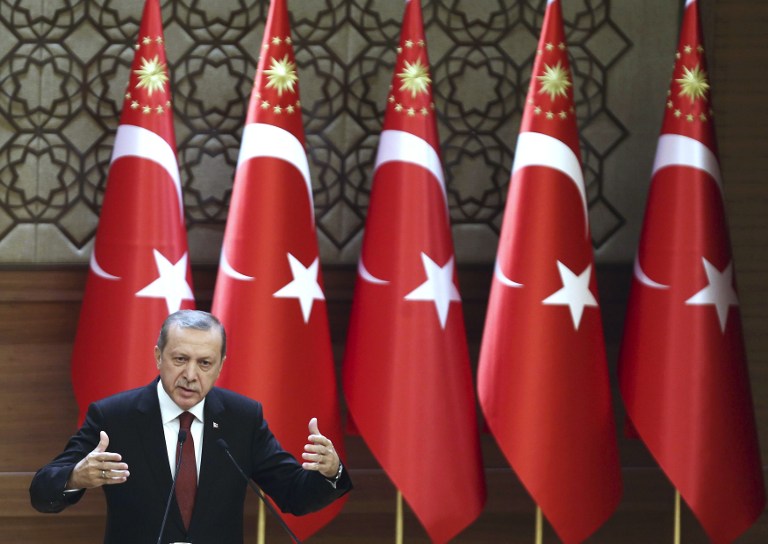
Turkish President Recep Tayyip Erdogan has signaled a possible warming of relations with Israel, saying the entire region would have much to gain from normalized ties.
Relations between former allies Turkey and Israel broke down in 2010 after an Israeli naval raid on a Gaza-bound flotilla killed 10 Turkish citizens. Turkey has become the strongest critic of Israeli actions in Gaza, and reconciliation efforts between the two have repeatedly failed.
Erdogan told journalists during a flight back from Turkmenistan that “normalization with Israel” was possible if the sides can reach a compensation deal for the raid’s victims and if Israel lifts a blockade against Palestinians. His words were reported by Yeni Safak newspaper on Monday.
“We had three (conditions); an apology — which happened; compensation — which did not happen, and the lifting of the embargo on Palestine,” Yeni Safak quoted Erdogan as saying. “If the compensation issue and the lifting of the embargo are achieved then we can enter a process of normalization.”
“There is so much that we, Israel, Palestine and the region can gain from such a normalization process. The region is in need of this,” Erdogan said.
On November 30, Erdogan had told an Israel Radio reporter that he thought he’d be able to “fix ties” with the Jewish state. Erdogan was speaking to reporters at the United Nations conference on climate change, near Paris. But his security detail shoved the journalists away before the Turkish president could elaborate on the details of his plan.
Frosty for years, relations between Israel and Turkey deteriorated considerably after Israeli commandos boarded the Turkish-flagged Mavi Marmara, the largest ship in a May 2010 aid flotilla bound for the Gaza Strip. The boarding took place in international waters after the Israel Navy asked the ships to sail to Ashdod, where their cargo would be unloaded and transferred to Gaza by land after undergoing a security inspection.
The activists on board refused; nine Turks were killed and seven Israel Defense Forces soldiers were wounded in violence that erupted when the Israeli troops were attacked with clubs and iron bars as they boarded the vessel, and opened fire on their assailants. A tenth activist died of his wounds in 2014, after four years in a coma.
The incident triggered a major diplomatic crisis between Ankara and Jerusalem.
Ankara expelled the Israeli ambassador, demanded a formal apology and compensation and an end to the naval blockade on the Gaza Strip, which is ruled by the Islamist Palestinian terror group Hamas. Erdogan is a strong supporter of Hamas, and rejects the notion that it is a terrorist organization.
Talks on compensation began in 2013 after Israel extended a formal apology to Turkey in a breakthrough brokered by US President Barack Obama.
The Israeli government reportedly presented a deal to pay compensation to the families of the victims, but an agreement has not yet been forthcoming. Turkey said in June that it was holding talks with Israel over a deal to reconcile the two former allies.






The Times of Israel Community.