

Iraq spirals downward
Prime Minister Nouri Maliki regarded by Sunni observers as prime culprit
 Add ToI as a Preferred Source on Google
Elhanan Miller is the former Arab affairs reporter for The Times of Israel
As Hezbollah buries its casualties from fighting in Syria, violence in Iraq continues to dominate the headlines of Arab-c-language dailies on Tuesday.
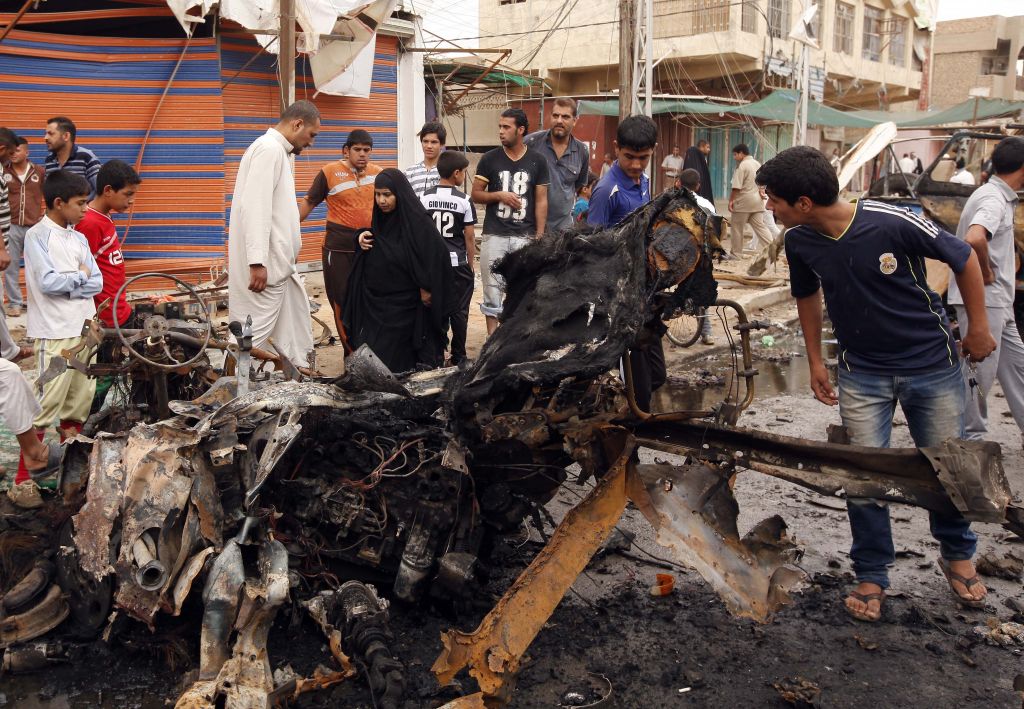
“A series of explosions in Iraq causes hundreds of dead and injured,” reads the headline of Saudi-owned daily A-Sharq Al-Awsat, displaying a photo of a mangled car in the Kemaliyah neighborhood of Baghdad with bystanders surveying the damage.
The daily reports that Prime Minister Nuri Al-Maliki has changed the country’s security plans and dismissed high-ranking security officials.
London-based daily Al-Quds Al-Arabi calls the series of attacks in Iraq “the worst wave of sectarian violence since the withdrawal of the Marines.”
The daily reports that the explosions took place in Shiite-majority areas across Iraq Monday. The total number of victims in explosions over the past week has reached 200.
“Tension between Shiites who govern Iraq and the Sunni minority has reached a point which some fear marks the beginning of a return to a nationwide internal conflict,” reports Al-Quds Al-Arabi.
Meanwhile, London-based daily Al-Hayat leads its Iraq coverage by reporting that armed Sunni tribesmen in the Anbar province have fulfilled their threat of confronting Iraq’s security forces, causing an atmosphere of chaos which allowed for Monday’s terror attacks.
Iraq’s Sunni religious leadership was also deeply skeptical of Maliki, accusing him of Shiite sectarian bias and loyalty to Iran.
Dubai-based news channel Al-Arabiya quotes Iraq’s Chief Mufti Rafi’ Al-Rifa’i as saying that Maliki has no control over policy and is taking his orders directly from Iran. Rifa’i was referring to efforts by Sunni religious leader Abdul Malik Sa’adi to negotiate a ceasefire in Iraq’s northern and western provinces, which have witnessed sectarian clashes over the past weeks.
Saudi news website Elaph focuses on a political crisis between Maliki and parliament speaker Osama Njeifi, who convened an emergency parliamentary session on Tuesday to discuss the security deterioration. Maliki called on his ministers to boycott the session, claiming it would only worsen sectarian tensions in the country.
“Car bombs detonate the new Iraq,” reads the lead editorial in Al-Quds Al-Arabi.
“When the Agence France-Press reassembles a special unit to count the number of dead and injured in Iraq… this means a return — even if a gradual one — to the bloodiest days in the country’s history in 2006 and 2007, when the number of victims reached thousands a month,” reads the editorial.
“Prime Minister Nouri Al-Maliki bears the primary responsibility for these explosions and their victims, firstly because he is head of state and secondly for his failure to curb the escalating sectarian tension, which is only at its start. He relied on security solutions and refused dialogue with his opponents, especially in the Anbar province which is the main scene of protests against his regime.”
Battle of Qusayr continues
Meanwhile, in the Syrian town of Qusayr near the border with Lebanon, fighting continues between military forces backed by Hezbollah and anti-Assad oppositionists.
Qatari news station Al-Jazeera shows footage of the heavy fighting in Qusayr, with combatants shooting from machine guns mounted on pickup trucks. The station reports Assad calling the battle “crucial” for the Syrian regime, and adds that it is crucial for Hezbollah as well. Thirty-six Hezbollah fighters were reportedly killed over the past two days, and 130 injured.
Meanwhile, Al-Hayat columnist Jihad Khazen eggs Syria on to attack Israel in response to its recent strike against military targets near Damascus.
“[Syria] does not need an Israeli strike to respond to. Syria must only beware of killing civilians, but if it did so it would be completely justified in showering the Dimona reactor or the refinery in Haifa with hundreds of missiles, or a thousand if it has them. Israel can intercept one or two missiles, but the Iron Dome system’s reputation is greater than its effectiveness. It cannot stop a large number of missiles.”
—








The Times of Israel Community.