

Kerry: Deal with Iran must withstand world scrutiny
US secretary of state’s pledge comes as US and Islamic Republic wrap up round of nuclear talks in Switzerland
 Add ToI as a Preferred Source on Google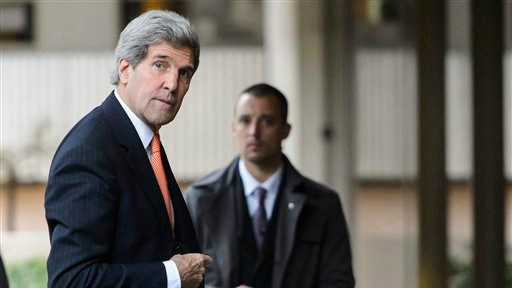
US Secretary of State John Kerry said Wednesday any final deal to curb Tehran’s nuclear program would have to withstand global scrutiny, as he wrapped up talks with his Iranian counterpart.
“The purpose is not to get any deal, it’s to get the right deal, one that can withstand scrutiny,” he told reporters in the Swiss lakeside town of Montreux, a day after Prime Minister Benjamin Netanyahu slammed an agreement he said would not stop Iran from getting a nuclear bomb.
The US and Iran concluded three days of intense nuclear negotiations Wednesday, but American officials said “tough challenges” remained as a March 31 deadline for a framework deal looms.
Ignoring a passionate plea from Israel’s leader to ditch their talks, Kerry and Iranian Foreign Minister Mohammad Javad Zarif pressed on at the negotiating table in the Swiss town.
But a senior US State Department official conceded the “bottom line here is that there is no deal to announce to anybody today.”
There had been “very intense hard work, some progress, but tough challenges yet to be resolved,” the official said.
In a dramatic speech to the US Congress on Tuesday, Netanyahu had called on the US administration to halt the talks which he warned “doesn’t block Iran’s path to the bomb. It paves Iran’s path to the bomb.”
He insisted the deal would leave Iran’s nuclear capability largely intact and would turn the Middle East into a “nuclear tinderbox.”
Israel itself is understood to have nuclear weapons but has never officially admitted to having such an arsenal.
The US knows that if there is a deal the “entire world will pore over every line, every word,” the senior US official told reporters.
Everyone from US President Barack Obama, to Kerry and the hundreds of people working on the deal was acutely aware of their responsibility to the world, the official said.
“The president believes profoundly that if we can reach an agreement, that will make the world a safer place,” the official said.
Kerry will now fly to Riyadh to brief US Gulf allies on the emerging deal and plans to meet in Paris on Saturday with his British, French and German counterparts.
Talks at political director level between the so-called P5+1 countries — the five members of the UN Security Council and Germany — and Iran will continue in Montreux on Thursday.
Despite the political drama around Netanyahu’s speech, US officials have shrugged off the address, saying it was nothing new.
“On the core issue, which is how to prevent Iran from obtaining a nuclear weapon which would make it far more dangerous, the prime minister did not offer any viable alternatives,” Obama said.
The Iranian foreign ministry denounced what it called Netanyahu’s “continuous lie-spreading about the goals and intentions behind Iran’s peaceful nuclear program.”
The growing rapprochement between the United States and its old foe Iran after more than three decades of enmity has however raised alarm not just in Israel, but also among US allies in the Gulf who remain wary of Iran’s bid to spread its influence in the Middle East.
In a rare admission on Tuesday, the US military’s top officer General Martin Dempsey said Iran’s help in an Iraqi military offensive to recapture the town of Tikrit could be “a positive thing” providing it did not fuel added sectarianism.
US officials said that there would now be a “robust schedule” of meetings as the March 31 deadline looms.
The next bilateral talks between Iran and the United States will be held on March 15, most likely in Geneva, although the venue has not been confirmed.
“Until you have all the pieces put in place, it’s the old Rubik’s Cube,” the State Department official said. “Until that last piece locks in place nothing is agreed until everything is agreed.”
US officials insist that even if there is a nuclear deal with Iran, that does not mean they will turn a blind eye to the other activities of the country, still branded by Washington as the number one state sponsor of terrorism.
“Regardless of what happens with the nuclear file, we will continue to confront aggressively Iranian expansion in the region, Iranian aggressiveness in the region,” another State Department official said.










The Times of Israel Community.