

State to shorten detention of Palestinians under 14 in non-security cases
Child detainees will be held for a maximum of 12 hours before seeing a judge, instead of the previous 24 hours
 Add ToI as a Preferred Source on Google
Jacob Magid is The Times of Israel's US bureau chief
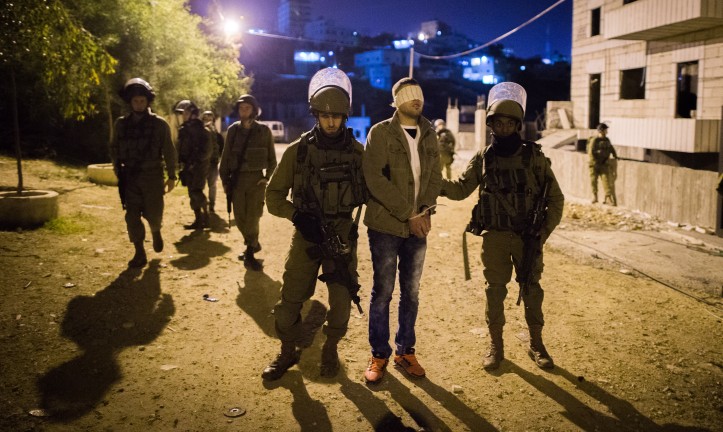
Attorney General Avichai Mandelblit informed the High Court of Justice on Thursday that the state will shorten the incarceration time of young Palestinian prisoners detained by Israeli forces in the West Bank for non-security related offenses.
Under the new directive, Palestinian minors under the age of 14 who are not suspected of security or terror offenses will be held by Israeli authorities for no longer than 12 hours, instead of the previous 24.
This stipulation refers to the maximum amount of time a detainee can be held in custody without being brought before a judge, who then decides whether to release or extend the suspect’s detention.
Adult detainees not suspected of security offenses will also see a drop in their incarceration times, though Mandelblit did not specify a definitive time framework.

Additionally, minors who were remanded into custody until the end of the legal proceedings against them will be freed after a period of 45 days, while adults will be released after 90 days.
The directive comes in response to two 2010 petitions filed to the High Court of Justice by the Association of Civil Liberties in Israel (ACRI) and the Palestinian Prisoners Club.
While the instruction would significantly decrease the detention periods for Palestinian prisoners, it will remain up to the commander of IDF forces in the West Bank to enforce the decision. The filing also specified that the IDF has until May 2018 to implement the directive.
ACRI attorney Raghad Jaraisy told The Times of Israel that prior to her organization’s 2010 High Court petition, there was no differentiation between minors and adults for Palestinians detained in the West Bank.
“Palestinians had to wait as long as eight days before seeing a judge,” she said.
Jaraisy added that the definitions for both general and security offenses are “vague,” pointing out that organizing a mass demonstration is considered a security offense.

Four years after her organization’s petition was lodged, new procedures were implemented for those Palestinians, but discrepancies remained. At present, adult Israeli citizens who have been arrested for either security offenses are required to be brought before a judge no longer than 24 hours after the initial detainment.
Palestinians in the West Bank, on the other hand, are only required to be brought before a judge 48 hours after an arrest for a regular offense and after 96 hours for a security offense. Palestinians between the ages of 12-14, until now, had to be brought before a judge within 24 hours.
Mandelblit’s directive seeks to remove such discrepancies, particularly with regard to minors. He explained in the directive that while the intention is to elevate the efficiency of legal proceedings, the conditions in the West Bank make it difficult to establish identical detention periods as those used for Israeli citizens.








The Times of Israel Community.