

Ya’alon accuses Bennett of politicizing summer conflict
Defense minister says that during campaign in Gaza some cabinet members should have been tongue-lashed
 Add ToI as a Preferred Source on Google
Stuart Winer is a breaking news editor at The Times of Israel.
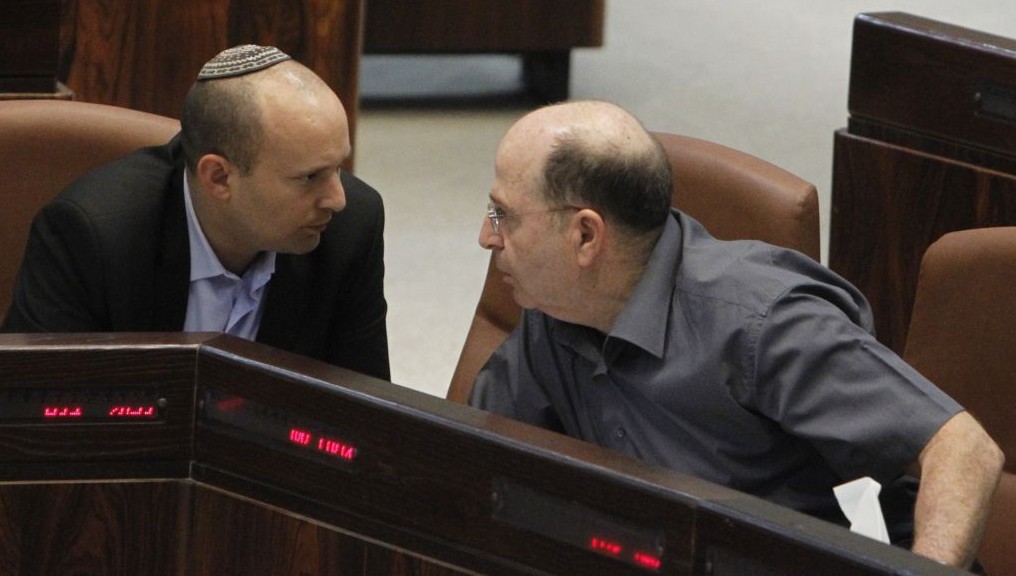
Defense Minister Moshe Ya’alon (Likud) took a swipe at Economy Minister Naftali Bennett on Tuesday, criticizing him for trying to make political hay from last year’s conflict in the Gaza Strip even as the fighting was still going on.
“Anyone who tries to gain political spin from a war is out of line as far as I am concerned,” said Ya’alon during an interview with Army Radio.
The defense minister was referring to criticism voiced by some cabinet ministers during Operation Protective Edge over how the campaign was being fought.
At the time, Bennett, who leads the Jewish Home party, argued that Prime Minister Benjamin Netanyahu, Ya’alon and the IDF were not being aggressive enough in their battle plans.
“Both the prime minister and I need to come out publicly with criticism of the behavior of some of the cabinet ministers during the campaign,” Ya’alon added.
The Jewish Home camp, in response, chastised Ya’alon for attacking Bennett while he is accompanying the prime minister in Washington, and noted that the defense minister had opposed focusing military efforts on destroying cross-border terror tunnels used by Hamas terrorists to infiltrate Israel.
“We aren’t going to deal with politics while the prime minister and the minister Bennett are on a national mission in the United States, and we call on the defense minister to behave accordingly,” the party said in a statement. “The [cabinet] vote by the defense minister to prevent the operation against the tunnels speaks for itself, but nonetheless is recommended to remain calm.”
Netanyahu was scheduled to speak to a joint session of Congress on Tuesday about his misgivings over an emerging deal between Western powers and Iran that, he insists won’t be enough to stop Tehran producing atomic weapons.
In the run-up to national elections the Likud and Jewish Home parties, natural coalition partners, have largely avoided attacking each other. The elections are to be held on March 17.
Ya’alon and Bennett, who is reportedly vying for the position of defense minister in the next government, have traded accusations over the handling of the tunnel threat. In February the State comptroller began an investigation into the matter.
Last September, Ya’alon lashed out at ministers for second-guessing the government’s management of the conflict with Hamas, revealing that he had disciplined a former officer who leaked information to Bennett about the network of cross-border tunnels that allowed Hamas gunmen to infiltrate Israel.
Israel initially balked at waging a ground war in Gaza, only sending in troops after some lawmakers insisted that infantry troops were needed to destroy the tunnel network.
Bennett, a member of the inner security cabinet, was an outspoken critic of how Ya’alon and Prime Minister Benjamin Netanyahu conducted the Gaza war.
The army ended the 50-day Operation Protective Edge in late August after saying it had destroyed all 31 cross-border tunnels dug for attacks against Israelis, but senior officers admitted at the time that “one or two” tunnels could have gone undetected.
More than 2,000 Palestinians were killed during the summer war, according to UN figures, which said most of them were civilians. Israel said some 1,000 of the fatalities were Hamas operatives and other gunmen, and blamed Hamas for all civilian casualties, arguing that the group attacked Israel from within residential areas.
Hamas and other terror groups fired over 4,500 rockets and projectiles at Israel, and staged several deadly attacks against IDF soldiers through cross-border tunnels. Seventy-three people on the Israeli side, most of them soldiers, were killed during the operation.
Times of Israel staff contributed to this report.










The Times of Israel Community.