

214 robots take the field at US national competition for Jewish schools
Center for Initiatives in Jewish Education hosts annual tournament in New York, highlighting the growing importance and challenges for STEM programs in Jewish education
 Add ToI as a Preferred Source on Google
Luke Tress is The Times of Israel's New York correspondent.
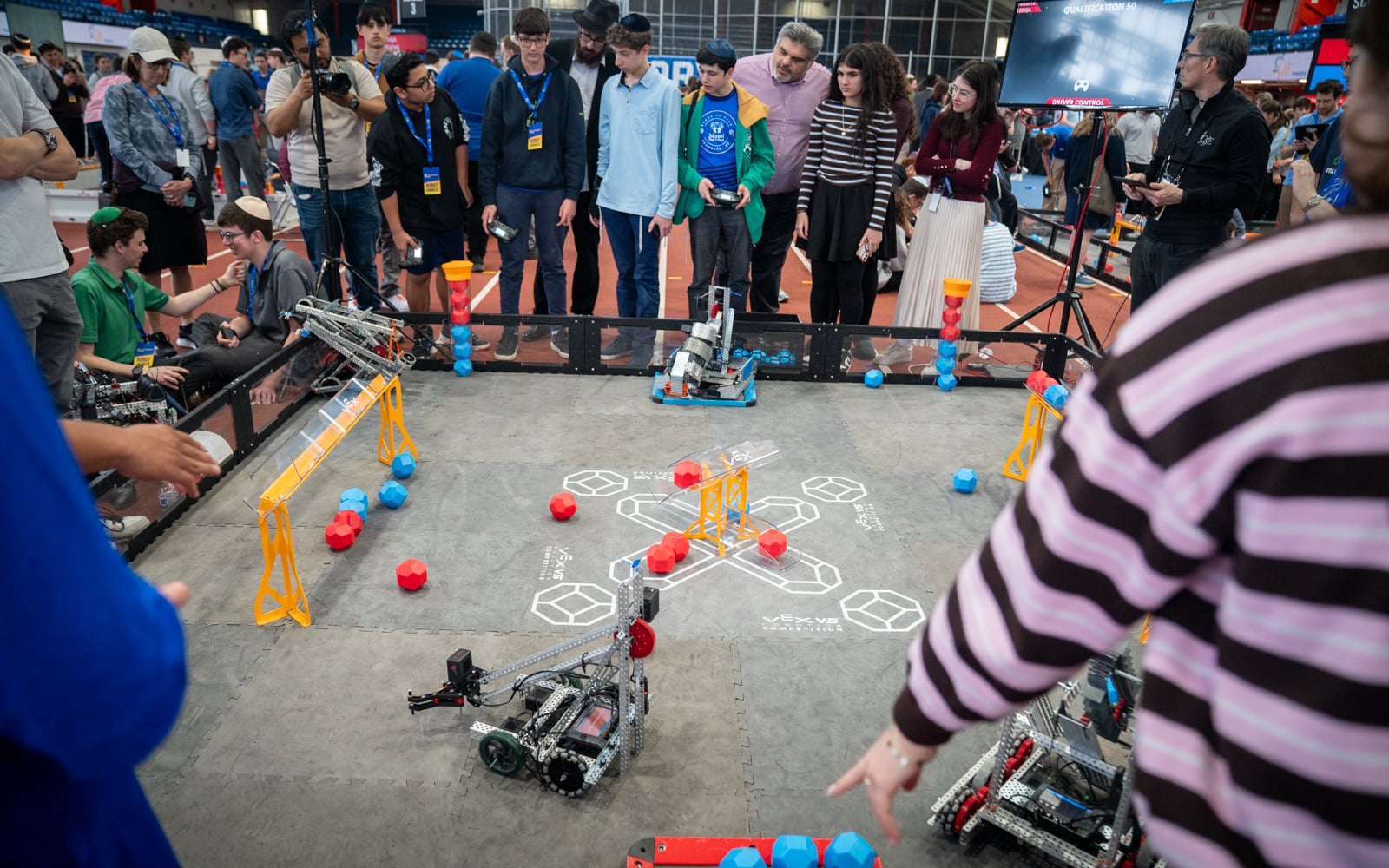
NEW YORK — The students crowded around the rink, shouting encouragement at the robots racing to scoop up red- and blue-colored balls.
As the scoreboard showed the clock winding down, the robots scooted to park in a designated spot for bonus points at the end of the round.
The referee shouted out the score — 45 points for the blue team to red team’s 15 — and commanded the contestants, “Take your robots,” as the clock hit zero. The blue team cheered.
The event was an annual robotics competition for Jewish students held by the Center for Initiatives in Jewish Education (CIJE), a nonprofit that boosts science, technology, engineering and math (STEM) programs in Jewish day schools, as the field becomes more of a priority — and faces challenges — in the expanding Jewish school system.
“They don’t realize that they’re learning because they’re having fun, but it’s so educational,” said Philip Brazil, the vice president of development at CIJE. “The amount that they’re learning on lift and power and measuring and coding and driving and teamwork, there’s so much there.”
CIJE saw a need for the tournaments five years ago because the mainstream robotics competitions often held events on Saturdays, so Shabbat-observant schools could not attend.
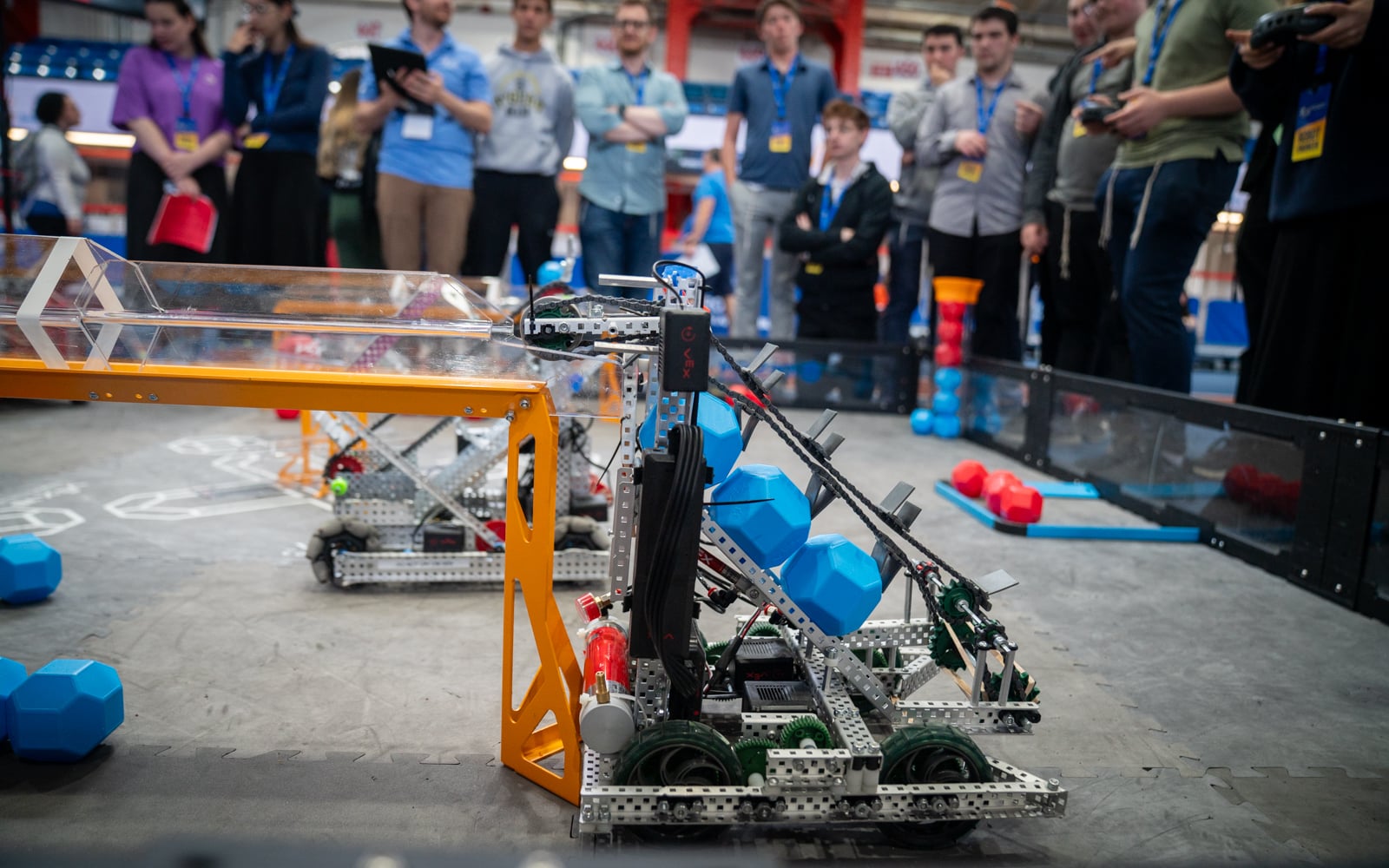
The competitions are modeled on and use technology from VEX Robotics, an educational program that holds tournaments for students around the US.
Robot mode
Wednesday’s event, called the CIJE VEX IQ & V5 Robotics Tournament, was the culmination of 17 smaller competitions throughout the year that were held around the US, Brazil said. The competitors make the robots throughout the school year, often rebuilding them repeatedly.
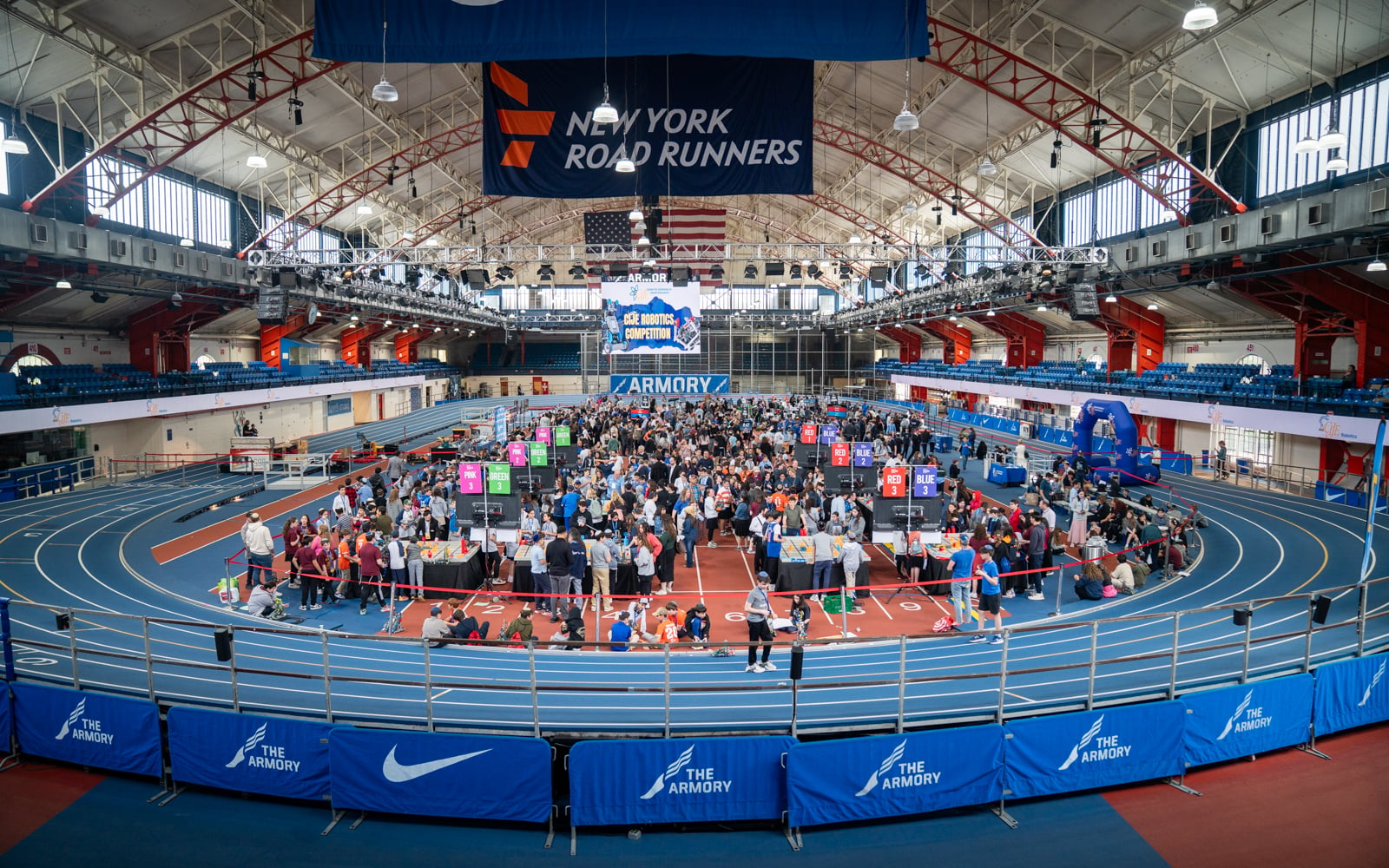
Around 1,100 students from 60 middle and high schools fielded 214 robots at the New York competition. Schools traveled to the event, held in Manhattan’s Nike Track and Field Center at the Armory, from New York, Connecticut, Florida, Texas, Maryland, Ohio and Georgia.
Fourteen students from the Modern Orthodox Brauser Maimonides Academy in Fort Lauderdale, Florida, brought five robots to the competition. The students in Florida woke at 4 a.m. to make the trip, while the team’s eighth graders cut a senior trip to Washington, DC, short to get to New York.
“It’s honestly crazy. I didn’t even know there were this many Jewish schools,” said 7th grader Ronen Lazar, whose robot, named the Cookie Monster, had met mixed success in its first three bouts. Other robots also had anthropomorphic touches — one was named “Webby” and another had “googly eyes” affixed to its front.
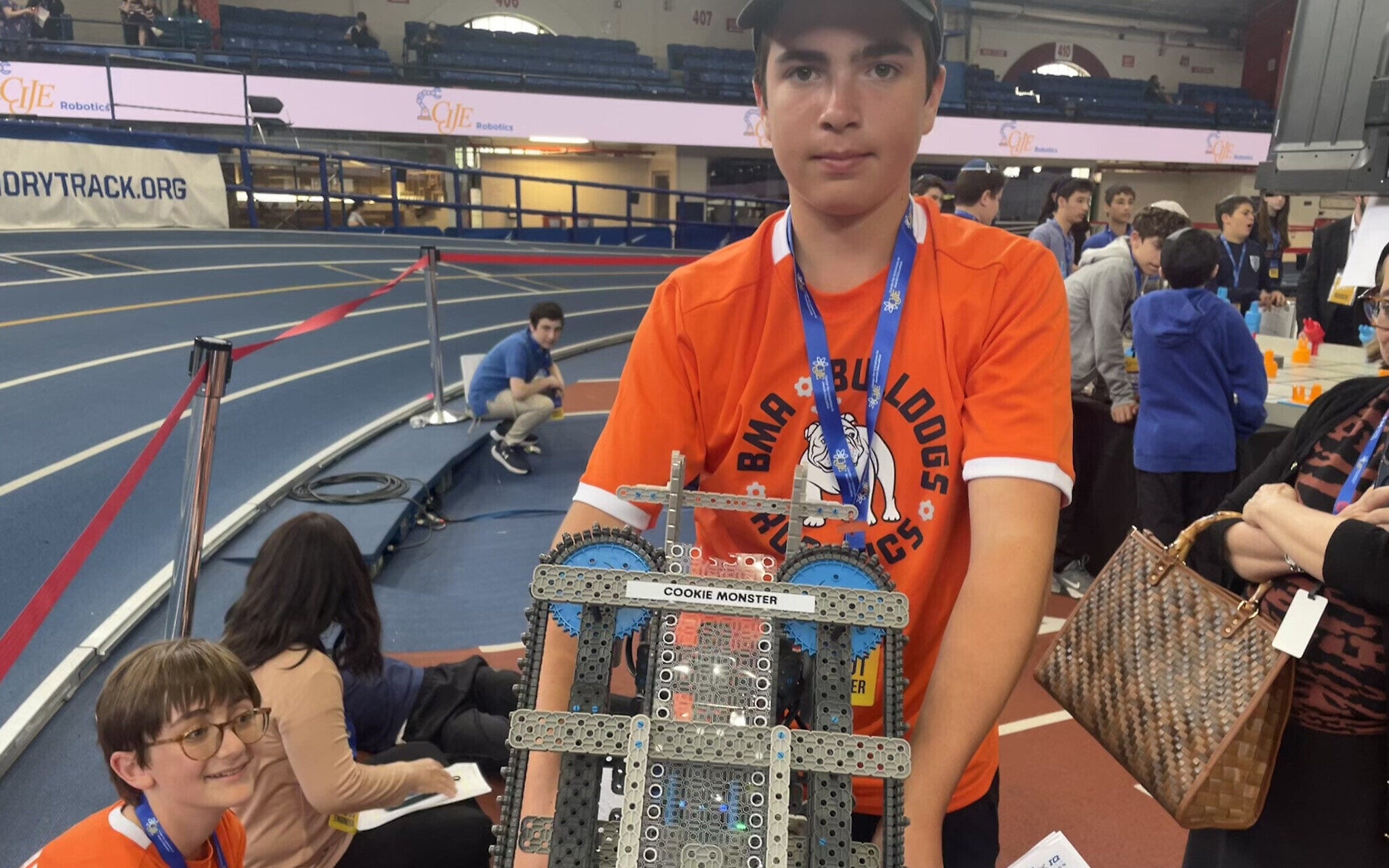
Lazar’s robotics coach, Hanna Shekhter, said the development process was more open-ended than most problems the students encounter at school. She shepherds the students but does not provide them solutions because “it’s important they work through frustrations,” she said.
“There’s no answers and they have to work through it. I see growth in critical thinking to figure it out on their own,” she said, adding that learning teamwork was central to the process. Shekhter’s 8th-grade students help incoming 6th graders, and at the competitions, teams from different schools are paired into alliances by random selection, compelling them to collaborate on the spot.
Academic studies have found that teaching students robotics has benefits compared to other subjects.
Lazar said his team had decided to ditch the suggested robotics models offered by CIJE to field something different.
“We got inspiration online, but there was no manual, so for months we tried perfecting and perfecting, and finally we got it to work well,” he said, also highlighting how the group had collaborated.
“There were people I wanted to be with this year that I wasn’t with on a team, and then you learn to work with people,” he said.
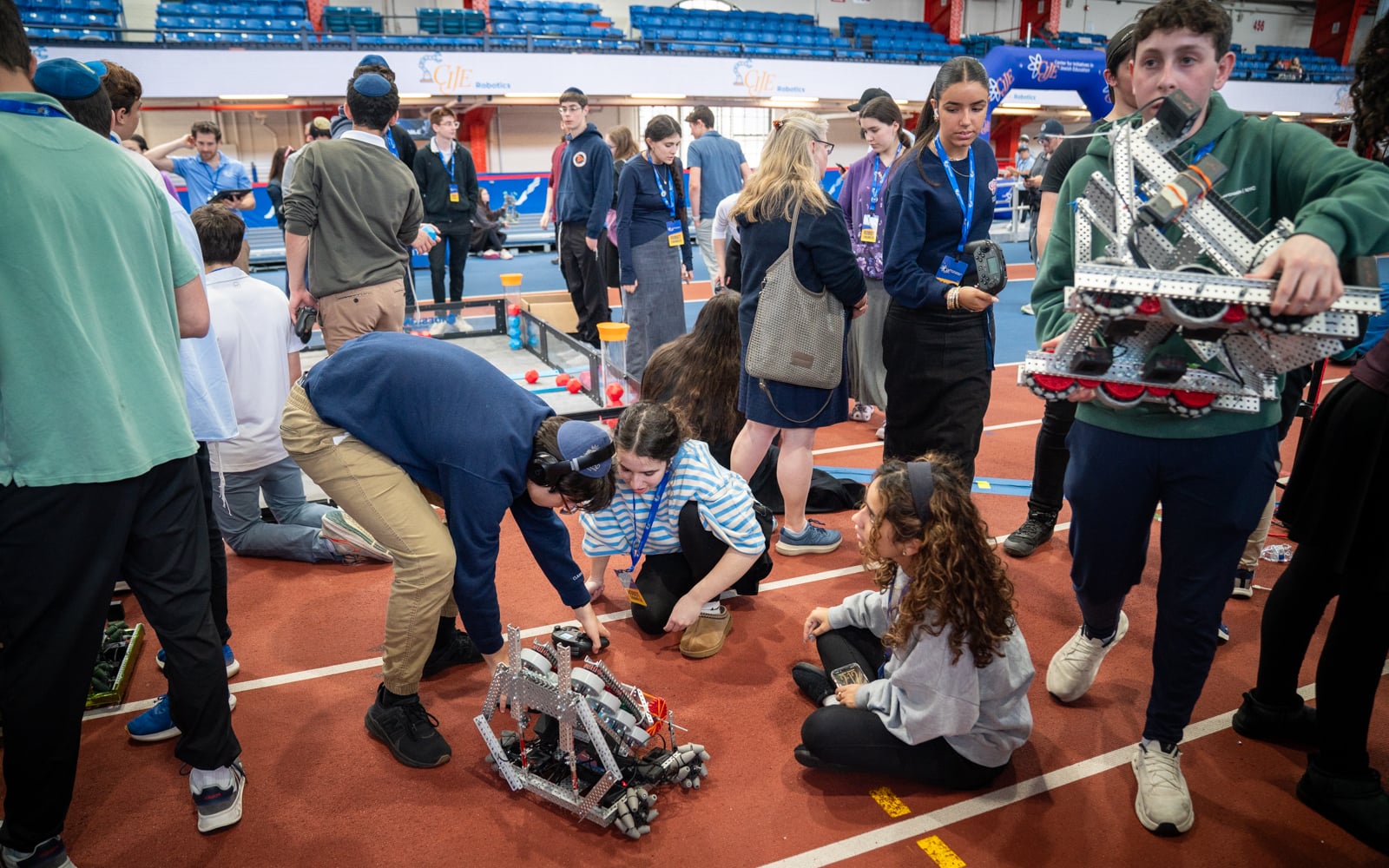
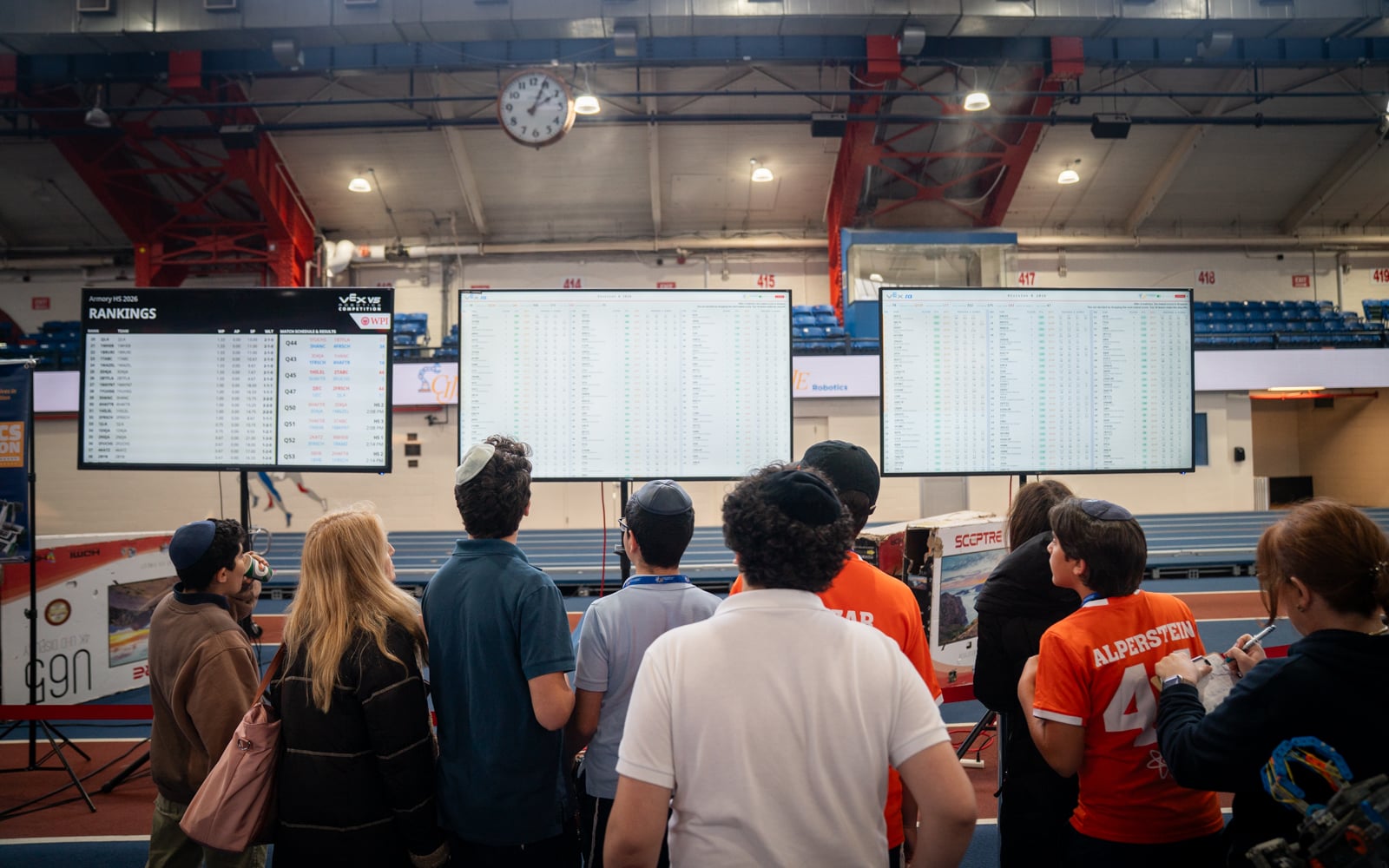
The atmosphere at the competition was frenetic. Students rushed to their rinks with their robots in hand, while others workshopped on tables strewn with metal and plastic, test drove their robots on the sidelines, or checked scoreboards for the latest rankings.
There were some minor mishaps during the bouts — a remote failing to immediately connect with a robot and a mechanical arm that broke off — but otherwise, the robots held together and kept moving.
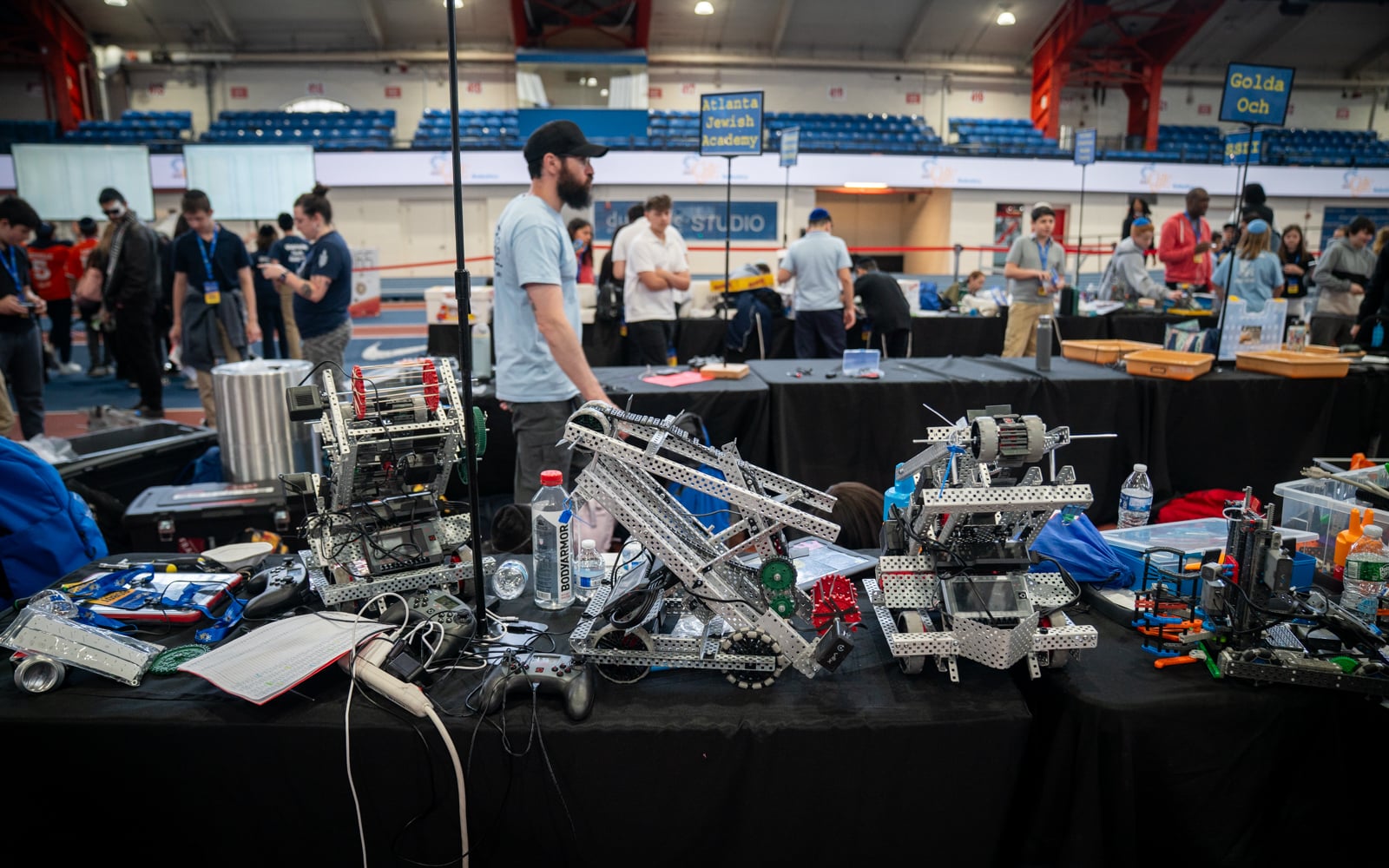
Held on a massive indoor track field, the feel was similar to a sports competition, which is part of the point, Brazil said, because the tournaments provide a competitive outlet to students who are less inclined to sports.
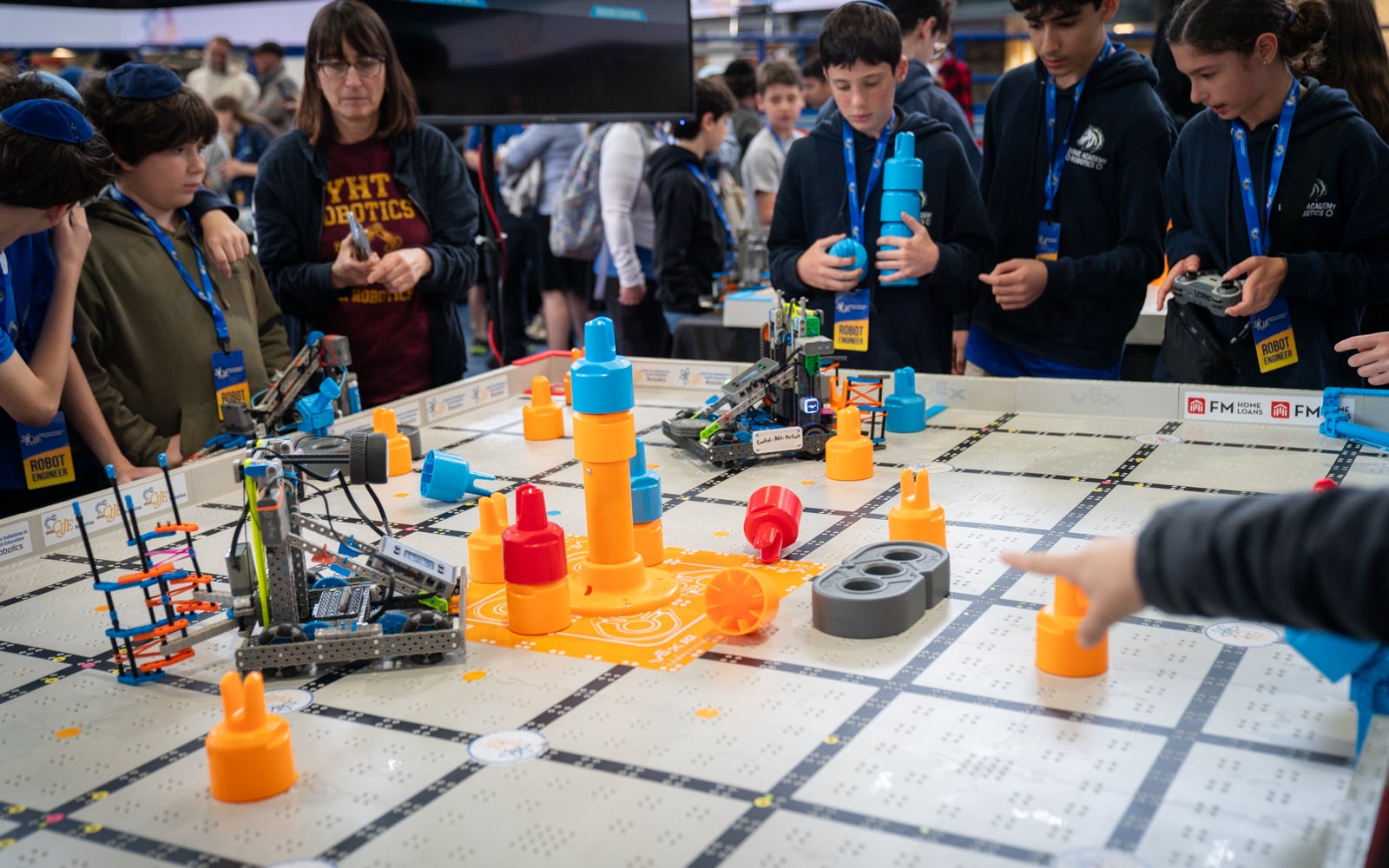
For middle schoolers, two teams, paired together for each bout, cooperated to achieve a joint score. Their robots stacked “pins,” cone-shaped plastic objects, to score points. At the start of the bout, the drivers shouted across the rink to the other team to ask about their robot’s strengths and work out a strategy.
In the high school division, four robots, randomly assigned to two teams, went head-to-head. Unlike the middle schoolers, the high school matches had winners and losers, the robots racking up points by scooping up balls and depositing them in “chutes,” clear tubes arrayed around the rink.
STEMming the tide
Sydney Altfield, the head of Teach Coalition, a Jewish group that advocates for non-public schools, said STEM education has been a growing priority, and a challenge, for Jewish schools.
Employing knowledgeable STEM teachers is costly, and Teach Coalition has been pushing for legislation to help nonpublic schools field those costs, Altfield said, citing a 2017 program passed in New York state to reimburse nonpublic schools for STEM programs that has helped cover costs.
“When we’re competing with the public schools for teachers, with benefits, with pay, with everything, STEM is probably the hardest thing for them to fill,” she said, adding that non-Jewish nonpublic schools face similar challenges.
The challenge comes as Jewish schools have seen a steady increase in enrollment in recent years, according to state-level data. In New York, Jewish schools grew by 4,537 students in the 2024-2025 school year, an increase of 2.7%, according to data compiled by Teach Coalition. Overall, attendance at non-Jewish nonpublic schools in New York has declined over the past decade, the data indicated.
Jewish educators have reported an increased interest in Jewish schools since the start of the Gaza war and ensuing surge in antisemitism in the US, but comprehensive national data for the post-war period is not yet available.
“Schools are in desperate need of robust, better STEM programs,” said Altfield, whose group is separate from CIJE. “The STEM field is always evolving and our students need to catch up to that. They need to be prepared for the future of the workforce that they’re going to enter into.”
Back at the arena, two high school teams faced off on a rink the size of a small bedroom.
“Drivers ready? Starting in 3-2-1. Go!” a referee said at the start of one match.
One of the robots lifted the balls with pincers on a mechanical arm, another sucked them onto a conveyor belt, and a third used a pair of wheels, rotating inward, to inhale the balls into its maw.
Other students crowded around, cheering and shouting advice — “Go for that one! Forty-five seconds!”
“Which robot did that?” a latecomer to the match said, seeing a chute chock-full of red balls.
The time elapsed, the referee counted points and declared a winner, and the victorious squad held their robot aloft as another team prepared to take the field in the next bout.










The Times of Israel Community.