

A swastika buckle, Hitler youth armbands and other Nazi memorabilia go on auction in the UK — on Yom Kippur
‘In no way do we wish to glorify the Nazi regime,’ says auctioneer. ‘I turned away a cosh used at Bergen Belsen and a book entitled Covenant with Death with horrific photos’
 Add ToI as a Preferred Source on Google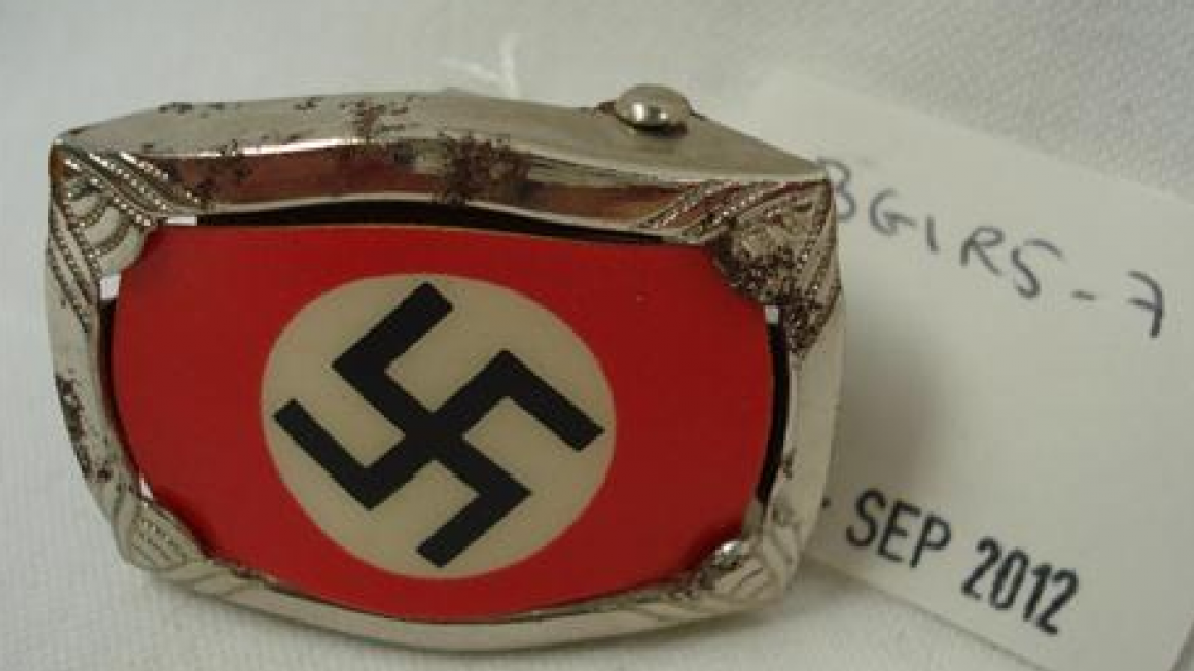
LONDON — As Jews on Wednesday mark Yom Kippur, the most solemn day of the calendar, a UK auction house will be selling off more than 200 chilling reminders of the cruelest regime in world history.
Two hundred lots of Nazi memorabilia are to be auctioned off by veteran auctioneers JP Humbert, based near the world-famous motor racing circuit Silverstone, in Northamptonshire north of London.
The three-day sale is set to start at 5:30 p.m. on Wednesday. A gruesome array of artifacts can be viewed in JP Humbert’s catalog, including Hitler youth armbands, a range of swastika-adorned flags, badges and crosses, SS crockery, “recent collections” of Nazi photos, cutlery from the Buchenwald concentration camp and cuffs belonging to the Totenkopf, an SS division originally formed from concentration camp guards. The collections’ origin is unknown, as auction houses do not disclose vendors’ (or buyers’) details.
The online, illustrated catalog lists the items succinctly, including their predicted sale price. The timing of the sale on Yom Kippur is apparently a bleak coincidence.
The sale of Nazi memorabilia in the UK is legal, and trade is booming, with some items selling for up to 40 times their estimated value. In March this year, the prize lot in a Bristol auction was a monogrammed silver plate presented to Adolf Hitler for his 50th birthday by Albert Speer. Amid reported applause in the saleroom, it sold to an anonymous UK bidder for £28,000 (about $45,000) plus £6,000 commission – far exceeding its initial £600-£800 estimate.
Following intervention from a local MP, the auction house gave part of its profits to the Holocaust Education Trust.
The managing director of JP Humbert, Jonathan Humbert, said the sale of such items serves to keep the public’s memory alive to atrocities committed by the Nazi regime.
“We hold international militaria sales three times a year and have been doing so for the past eight years. They are international, not specific to Nazi memorabilia,” he said. “This time, some 150 items unrelated to Germany were to be included but could not be cleared by probate at the last minute. These items are a small percentage of 25,000 other antiques and collectibles we sell each year.
“We do handle items sensitively and sensibly, and in no way do we wish to glorify the Nazi regime. This time, I have turned away items that I do not wish to be associated with: namely a cosh used at Bergen Belsen and a book entitled ‘Covenant with Death’ with horrific photos.
“As an auctioneer, it is not my place to make moral judgments, but part of what we do is to keep alive the worst element in human nature. If you keep these things alive in people’s consciousness — and don’t bury them — we can hope the terrible things will never happen again. No one is glorifying the SS or the Holocaust — far from it.”
Humbert said he will be donating a percentage of the proceeds from the sale of the Nazi artifacts to the Holocaust Educational Trust.
He said he makes every attempt to ensure that items are not sold to extremists or “nutters.” He believes it is not the auctioneer’s place to question motives.
“There is a story to tell by selling these items and we try and be sensitive, sensible and balanced,” he added. “We check things out as far as possible and do not handle the more macabre goods. But you have to be balanced — we sell Nazi memorabilia along with many other items from other places in the world. We cannot rewrite history, but we can keep it alive in the present and for the future.”
Tom Keane, who owns Chiswick Auctions, a long-established saleroom in West London, said, “A few years ago, we were invited to a house full of Nazi memorabilia for sale.” With a large contingent of Jewish people frequenting his auction house, he asked for their opinion. “All but one person said to go ahead and sell them,” Keane added. “Some 99% of them were sold in public auction to Jewish people and Russians.”
Keane turns away more gruesome items such as concentration camp uniforms. He believes that a ban on such sales would drive them underground and to more sinister parties.
JP Humbert is not the only auction house to be displaying and selling relics of the Nazi regime this Yom Kippur. In another sale, poised to start on Tuesday at 6 p.m., six lots of Nazi memorabilia are to be offered for public sale at High Road Auctions, based in the affluent West London suburb of Chiswick.
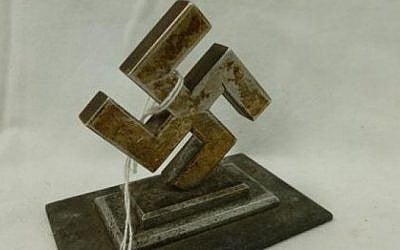
Items there include a German Nazi cast bronze eagle and swastika, with an estimated guide price of £60-£100, and a collection of World War II German items including a Hitler Youth arm band, with an estimated sale price of £250-£350.
Auctioneer Andrew Polnik defended the sale. “These articles are just a reminder of the terrible things that happened to both Jews and non-Jews during the war and should not be hidden. It’s out in the open. This is a new form of advertising — regardless of what happened to your family.” (This reporter had made no mention of her religion or racial origins.)
This week’s sales are the latest in a burgeoning trade in the grim artifacts, which has provoked outrage among some MPs and organizations, prompting them to call for a ban or controls on the sale of Nazi memorabilia.
The big three UK auction houses, Christie’s, Sotheby’s and since 2010, Bonhams, have outlawed the sale of such items. In 2001, online auction house eBay prohibited items that promote or glorify hatred, violence, and racial, sexual, or religious intolerance, singling out Nazi memorabilia. In Germany, France, Austria and Hungary, the sale of Nazi artifacts is illegal, considered incitement to racial hatred.

When told of the sales, Amir Ofek, press attaché at the Israeli Embassy in London, said: “There is only one reason, if one exists at all, to buy such items dating from the Nazi regime or from Jewish and other victims of that regime. The only legitimate reason for their sale and purchase is if such items are to form part of a ‘never again’ educational campaign.”
“However, if someone buys such an item because they think it ‘cool’ or for decoration, the embassy would condemn that in the strongest possible terms,” he added.
Museums such as the Imperial War Museum in London buy such artifacts as exhibits to educate the public in the horrors of the Holocaust and Nazi history. They also buy from public auctions. Other bona fide collectors may buy relics from the Nazi era as historical mementos.
But there are also extreme right-wing groups in the UK such as the neo-Nazi Combat 18 (C18), which advocate white supremacy. The 18 is taken from Adolf Hitler’s initials: A and H being the first and eighth letters of the alphabet. Its logo, featuring a skull and swastika, imitates that of the Totenkopf division of the SS. Groups such as C18 are avid collectors of Nazi memorabilia.
Following last March’s sale of Hitler’s plate, three MPs, led by Fabian Hamilton (Labour), urged ministers to “bring in immediate regulation and control of this abhorrent trade.” They condemned the sale then as “profiteering on items promoting and glorifying hatred and violence.”
Asked about this week’s sales, Hamilton said that banning the trade outright was problematic. “It’s very difficult to police this trade,” he said. “If people are buying the odd item out of pure historical interest, sold by someone who inherited an artifact or two, that’s understandable. I wouldn’t want to stop people from buying for a genuine motive. It’s not an easy dilemma. But there is a thriving trade ‘under the wire,’ mostly on Internet sites, where those involved have a strong interest in Nazism.
“However, we have to ask, not only where do these items come from, but who is going to profit from them?” he added. “If an individual is getting a large supply to sell, then the motive is purely money. Is someone earning vast sums of money of items which just profit from the death of so many people in such an appalling regime?”
Others also argue that sales of such memorabilia should not be prohibited by law, as long as the items are bought because of a genuine interest in military history.
“I have no objection [to these sales] per se,” said military historian and author Michael Yardley. “But it does strike me as strange to collect SS memorabilia. If there is an element of fetish about it, then that’s disturbing.
“From a historical perspective, these items are probably best left in museums. But private collections have been important historically too. There are some very knowledgeable collectors worldwide of such memorabilia,” he added. “But there is a difference between SS and other German militaria. It is hard to justify the collection of SS memorabilia to satisfy personal need and role-playing — this is the disturbing element and these collectors should be harshly criticized for doing so.”









The Times of Israel Community.