

Democracy, Qatar-style
Arabs newspapers celebrate the smooth transfer of power in Qatar, saying the son will continue the path of his father
- See more Times of Israel on Google - add us as a Preferred Source
Elhanan Miller is the former Arab affairs reporter for The Times of Israel
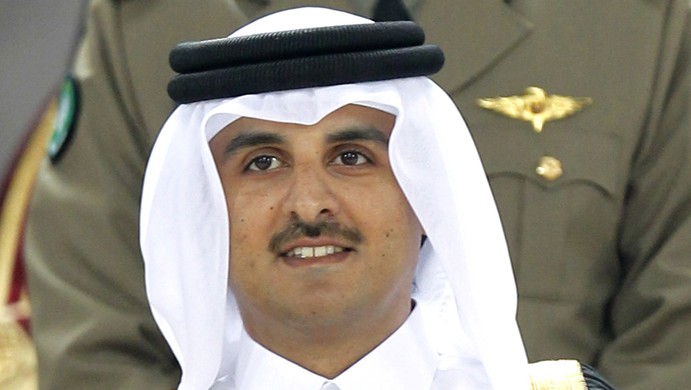
The appointment of Sheikh Tamim bin Hamad al Thani as ruler of Qatar continues to feature high in Arab headlines on Wednesday, alongside news of a harsh condemnation by Saudi Arabia’s foreign minister of the situation in Syria.
“Qatar is in the hands of Tamim bin Hamad,” reads the headline of London-based daily Al-Hayat, reporting a smooth transfer of power from father to son.
The daily quotes experts in London and the Gulf who predict that Tamim will “complete the moves to renew Qatar, give Qataris a new dose of democracy and form a government dominated by young people.”
With the type of uncritical coverage reserved only for similar monarchies, Saudi-owned daily A-Sharq Al-Awsat features an image of Tamim standing next to his father and receiving a pledge of allegiance from his country’s senior officials on Tuesday. It focuses on the congratulations sent to Qatar by the king of Saudi Arabia.
Praising the previous ruler, Sheikh Hamad, the daily reports that during his 18 years in office he succeeded in turning Qatar into “one of the fastest-developing countries. Also, during his tenure Qatar became a modern country after he enshrined its regional and global standing. It has attained great economic success.”
Needless to say, Doha-based Al-Jazeera continues to cover the transition of power as breaking news, with a large banner across the top of its website reporting that Tamim will deliver a speech to the nation later on Wednesday.
In stark contrast, London-based daily Al-Quds Al-Arabi, an Arab nationalist newspaper deeply critical of the region’s monarchies, provides no news coverage of the event on its front page, save an editorial titled “Qatar’s supreme leader embarrasses the Gulf.”
“Forgoing power is not common practice in Arab countries, and especially not in the Gulf region, where kings and princes stay seated on their thrones in a state of complete physical and mental debilitation until their deaths,” writes the editor in a scathing tacit critique of octogenarian-ruled Saudi Arabia.
“Sheikh Hamad bin Khalifa will be like the ‘Supreme Guide’ of his country; not managing the daily affairs of his country as he did in the past, but remaining — according to many analysts — the final arbiter, even if behind the scenes, just as it is in other regimes, most notably the Iranian.”
According to Al-Hayat columnist Khaled Dakhil, the events of the Arab Spring had an indirect effect on Sheikh Hamad’s decision to resign.
“The question remains: why did Sheikh Hamad step back? and why at this time? Since the idea of resigning dates back more than three years, one can say that the Arab Spring was not the first and foremost reason behind the decision. At the same time, the Spring’s events, and the leading role Qatar played in supporting the revolutions in this Spring, played an important role in bringing the decision to fruition and pushing the emir to implement it.”
‘Syria is occupied territory’
An unusually harsh statement by Saudi foreign minister Saud Al-Faisal during a joint press conference with US Secretary of State John Kerry Tuesday is also making headlines in Arab news.
Faisal said Syria that considering Hezbollah’s participation in fighting alongside the Assad regime, and Iran’s support from afar, Syria was “occupied land” subjected to “foreign invasion.”
“Yes, Syria is occupied land,” reads the headline of an op-ed by columnist Tareq Homayed in A-Sharq Al-Awsat, who describes the Syrian conflict in stark sectarian terms.
“What is taking place today under Assad refutes any attempt to defend this criminal regime or justify its crimes; whether [these attempts come from] the Russians, Iran, or those allied with Iran including Iraq’s Nuri Al-Maliki,” writes Homayed.
“The Syrian reality is that foreign fighters loyal to Iran are flocking to the country, including the Revolutionary Guard, the Quds Force, as well as Hezbollah fighters, Iraqi Shiite militias and unfortunately also other Shiites from across the region. They are all heading to Syria at Assad’s behest, in order to support his regime. The security of Damascus is at the hands of the Iranians, specifically those of [Quds Force chief] Qassem Soleimani who is said not to leave the Syrian capital.”
—



The Times of Israel Community.