

El Salvador elects new president of Palestinian descent
Former San Salvador mayor Nayib Bukele takes 53.78% of vote, upending Central American country’s two-party system
 Add ToI as a Preferred Source on Google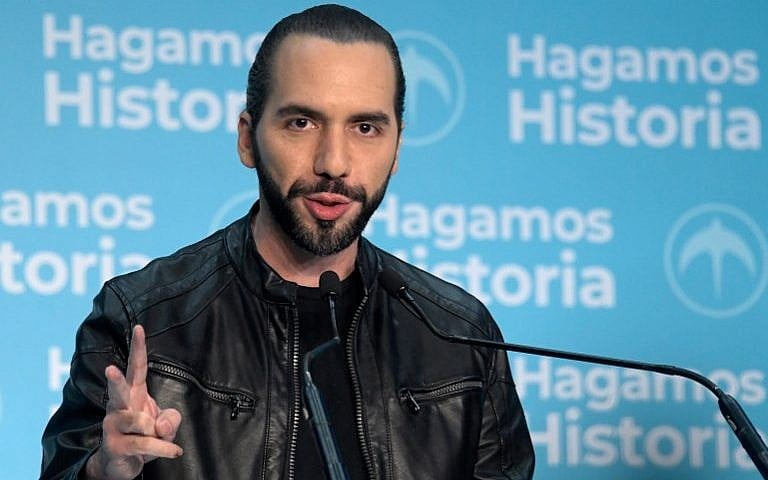
SAN SALVADOR, El Salvador (AFP) — Nayib Bukele, former San Salvador mayor, was on Sunday elected president of El Salvador — crushing a two-party system in place since civil war ended in 1992.
With his sharp beard and youthful wardrobe — jeans, leather jackets and often a baseball cap — the 37-year-old put opponents from the country’s two largest parties out of style.
The Salvadoran election authority awarded him 53.78 percent of votes with 87.67 percent counted — while Carlos Calleja of the right-wing Nationalist Republican Alliance (ARENA) won 31.62 percent, and Hugo Martinez of the leftist Farabundo Marti Front for National Liberation (FMLN) took 13.77 percent.
Bukele — a favorite in the polls throughout the campaign — ran for the small, conservative Grand Alliance for National Unity (GANA), which welcomed him after he was expelled from the FMLN, a party formed by demobilized guerrilla groups.

Nicknamed “the swallow” after his current party’s logo, Bukele — who is of Palestinian descent — first inherited affiliation to the FMLN from his family, which hid clandestine guerrilla leaders during the Salvadoran civil war.
In 2012, he was elected mayor of Nuevo Cuscatlan, a suburb of San Salvador, under the FMLN’s banner.
Three years later, he become mayor of the capital — and stayed in that position until 2018. However, following an altercation with a municipal councilor, he was expelled from the FMLN in 2017.
As he embarked on the road to the presidency, his renovation of the capital had already won the hearts of the Salvadoran youth — and he proved very effective on social media.

During his campaign, he targeted corruption among the old guard — and proclaimed “there is enough money” for all Salvadorans “when nobody is stealing.”
But as president he faces several great challenges — among them the gang violence that has ravaged El Salvador.
And to address the country’s issues, he will first need to form an alliance with the right-wing opposition that dominates congress.









The Times of Israel Community.