

Immigration drill tests Israel’s readiness for en masse ingathering of exiled Jews
Learning from mistakes following Russian invasion of Ukraine, ministry simulates 10,000 immigrants inundating country over 2 weeks as it tries out newly formed plan for smoother absorption
 Add ToI as a Preferred Source on Google
Zev Stub is the Times of Israel's Diaspora Affairs correspondent.

The situation: a major antisemitic incident in a country with a large Jewish community has triggered a mass exodus by thousands of Jews fleeing to Israel. Hundreds of new immigrants arrive daily, seeking refuge and expecting to be swiftly absorbed and integrated into Israeli society.
While the scenario is unlikely to occur in the near-term by all indications, it’s far from out of the question, and enough of a worrying eventuality that Israel’s Immigration and Absorption Ministry is drilling for what to do if — or when — it does happen.
“This is an extreme scenario, but it’s not an apocalyptic one,” Immigration and Absorption Ministry Director General Avichai Kahana told The Times of Israel. “It’s a scenario that could happen anytime in the near future, and we want to be prepared.”
On Thursday, about 100 representatives of different government ministries, non-profit organizations, and essential services crowded into a small room at the National College for Israeli Resilience in Ramle for a day of role-playing and simulations to prepare for such a mass-immigration event.
The mission was to examine the country’s systemic readiness and prepare strategically for a situation where 800 people immigrate every day for two weeks in response to a state of emergency in their home country, bringing more than 10,000 people to Israel in a short span.
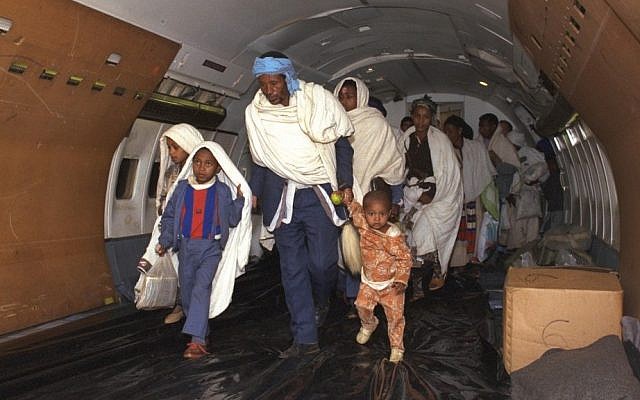
Israel already has real-time experience in dealing with such inflows. In 1991, the country airlifted over 14,000 people from Ethiopia in a day and a half.
More recently, some 75,000 immigrants arrived from Russia and Ukraine in the span of months after the war broke out in 2022.

“During that time, there were sometimes days when 1,500 people arrived,” Kahana said.
Thursday’s exercise was based on the lessons learned from that experience, which have in recent months been integrated into a ministry plan, dubbed “Raise the aliyah banner.”
Last year, the ministry began developing a playbook for how it would handle such a mass immigration event, and Thursday’s simulation represented the first time its conclusions were debated and challenged by the different organizations and bodies, Kahana explained.
With antisemitism a mounting concern for Jewish communities around the world, the Immigration and Absorption Ministry has been working to improve the country’s ability to attract and absorb rising numbers of new arrivals. Some 54,000 new immigrants have arrived in Israel since Hamas launched its war with Israel on October 7, 2023, according to ministry data, roughly on par with pre-COVID immigration totals.
“In most countries, people leave during a war, but in Israel, people come to help,” Immigration and Absorption Minister Ofir Sofer has been known to quip as he touts strong immigration figures, even if the reality is somewhat more complicated.

A massive terror attack, political upheaval or widespread unrest are just some of the possible triggers that could lead a country’s Jews to leave en masse, especially in places with weaker governance or less socioeconomic stability.
“We are imagining events in a country with a difficult economic situation, where the government won’t be able to protect its citizens,” Kahana said. “There are concrete large-scale threats to the Jewish community in numerous countries, and hardly a week goes by that a large-scale incident isn’t thwarted by security forces.”
All in the details
During Thursday’s exercise, members of different working teams analyzed different aspects of the plan to identify weak points and gaps between needs and realities. The drill involved planning for both helping evacuate emigrants from their home countries and absorbing them in Israel.
One team worked on a plan for a situation in which they had just 24 hours to organize flights out of an unnamed country for planeloads of fleeing Jews. Who would man those efforts? How would the Jewish community be mobilized in the effort, and how would potential emigrants be identified? How would food and medicine be provided? How would information be gathered and shared between different parties?
Effective collaboration on data collection and sharing was an especially sensitive point, Kahana noted.
“This is a point where we have repeatedly failed, including during the war in Gaza,” he said. “When people were evacuated to hotels after October 7, we didn’t have good information about who was in each hotel, or who was moving from place to place, because there was no effective communication between different authorities.”

Another team worked on a plan for taking in the new immigrants at the airport, processing them and dispatching them to absorption centers and hotels around the country. Staff would need to be dispatched with details about everyone’s needs, and budgetary systems would need to be in place to pay for it all seamlessly.
What if many of the arrivals had been injured in attacks? What about children who arrive without parents, or people with special needs? And what about the estimated five percent of arrivals who aren’t eligible to immigrate to Israel under the Law of Return?
A final exercise explored longer-term immigration issues after the initial few weeks, a challenge Israel has struggled with since it first welcomed fleeing immigrants as a fledgling state.
“This is the challenge that worries me most,” Kahana said. “Israel is good at handling emergencies when things are moving quickly and the adrenaline is flowing, but what happens after a few weeks, when people need to begin their new lives and the media is no longer there to cover it?”
In recent months, the Immigration and Absorption Ministry has launched a number of new initiatives to promote successful immigration, including a new plan announced last month to work with Israeli companies to provide employment for immigrants as soon as they arrive in the country.
Earlier this month, it also unveiled a new 0 percent income tax rate for immigrants arriving in 2026.
In February, the ministry announced a NIS 170 million ($46.4 million) program to improve integration, along with a reform designed to speed up the licensing process for new immigrants to work in their professional fields. More recently, it launched a new government program offering incentives to attract successful Jewish candidates with in-demand skills to immigrate to Israel.
Other initiatives, including expanding tax exemptions for immigrants who own businesses and offering personal assistance to potential olim throughout Europe, are also underway.

While most of these efforts have focused on making it attractive for immigrants from wealthy countries, Thursday’s emergency simulation served as a reminder that Israel’s immigrants often arrive under duress, with few resources and complicated needs.
“This type of scenario has a clear likelihood of happening, in light of the sharp increase in antisemitism in countries around the world, and we must be prepared for this,” Sofer said in a statement. “It is impossible to ignore the possibility that extreme scenarios will lead to rapid and massive immigration in the future. The State of Israel must be prepared to absorb and embrace them whenever needed.”










The Times of Israel Community.