

Even as Western aliyah picks up, new arrivals replace fewer than half of Israeli emigrants
With Russian-speakers no longer moving in high numbers, immigration is trending downward, but Americans, French and others are upping arrivals, spurred by October 7
 Add ToI as a Preferred Source on Google
Zev Stub is the Times of Israel's Diaspora Affairs correspondent.

Aboard a recent Nefesh B’Nefesh aliyah charter flight in mid-August, Immigration and Absorption Minister Ofir Sofer told The Times of Israel that immigration from Western countries had risen dramatically since the Hamas invasion of October 7, 2023, driven in large part by a resurgence in excitement for the Zionist cause. Emigration from some countries had tripled since 2023, Sofer said.
Those successes are indeed borne out by official data. However, overall immigration is down dramatically when looking beyond the West to also take in Russian-speaking countries, by far the largest contributor of new immigrants.
According to the Central Bureau of Statistics, just 11,314 people moved to Israel during the first seven months of 2025, a decline of about 42 percent from the same period in 2024 and about 60% less than in the first eight months of 2023, a year which saw a major spike in arrivals due to the war in Ukraine.
At the same time, Sergio Della Pergola, one of Israel’s most respected experts on Jewish demographics, says immigration rates are relatively average on a historical basis, but emerging migration trends show worrying signs for the country’s future.
So who is right, and why are there so many different takes?
To fathom what is really happening, let’s take a closer look at the data. Numbers quoted come from the CBS unless otherwise specified. Some numbers are rounded for simplicity.

Russian red herring
According to official CBS numbers, 2024 saw a drop of some 30% in immigration when compared to the year before, to about 32,800. However, as has been the situation for decades, the data from one country skews all the statistics.
“Since the 1990s, Russia has always been the dominant story in the immigration numbers,” Della Pergola explained.
To gain a better understanding of the current state of immigration to Israel, Della Pergola suggests considering Russian-speaking immigration and Western immigration as two distinct components of the overall aliyah picture. Though making up the lion’s share of new immigrants, the factors motivating Russian speakers to move to Israel, or stay home, are often quite distinct from those energizing Western aliyah, with each in the thrall of different trends.
“So if you want to understand what is happening with aliyah, you have to first understand why Russian aliyah has declined by half for each of the past two years,” he said.

In the decades before Russia invaded Ukraine in early 2022, the vast majority of new immigrants, or olim, typically came from Russia and the former Soviet Union, often accounting for as much as two-thirds of the total, Della Pergola said.
After the initial euphoria that followed the fall of Communism starting in 1989, an environment of growing political repression and economic uncertainty led to mass defections, in what Russian sociologists have termed the “fourth wave” of Russian emigration.
With middle-class Russian professionals desperate to move to whatever liberal countries would take them in, some used the path to Israeli citizenship created by the Law of Return, which grants eligibility to anyone with at least one Jewish grandparent, regardless of whether they themselves are considered Jewish. Nearly one million Russian-speakers are believed to have moved to Israel in the years immediately following the dissolution of the USSR, including many who made use of the so-called grandchild clause.

The pace of immigration from that part of the world fell off dramatically over the first two decades of the 2000s, especially as Russia’s economy stabilized, but immigration to Israel from the former USSR skyrocketed again once Russia invaded Ukraine in February 2022, as people from both countries sought a safe haven from the war zone.
In 2022, immigration soared from 28,000 a year earlier to over 74,000, as aliyah from Russia jumped from 7,700 to 45,000 and Ukrainian immigration rose from 3,100 to 15,000.
Immigration from Russia and the former Soviet Union, which includes Ukraine, Belarus, the Baltic states and other nearby republics, has slowed somewhat since then, but still looms large. Some 38,500 new immigrants arrived in 2023, about 22,000 in 2024, each representing about two-thirds of total immigration figures. In the first seven months of 2025, Israel absorbed 6,540 people from the former Soviet Union, a bit more than half of the global total.

But because factors motivating emigrants from Russian-speaking countries often differ radically from those of other immigrants — such as escaping war or economic opportunities rather than Zionism or antisemitism fears — understanding aliyah trends for the rest of the world requires putting the Russian-speaking figures to the side, Della Pergola said.
The West on board
After removing the former Soviet Union numbers, 2024 actually shows a 47% increase over the year before, with nearly 11,000 coming in 2024 compared to 7,500 in 2023. Israel is currently on pace to top 10,000 new immigrants from non-Russian-speaking countries in 2025, according to Della Pergola.
In the United States, immigration rose from about 3,000 in 2023 to 3,200 in 2024, according to the CBS, and aliyah organization Nefesh B’Nefesh has said it expects 2025 to end with as many as 4,000 moving from the US. The organization said it facilitated the arrival of more than 1,000 new immigrants in August alone, marking the busiest month in its 23-year history.
Nefesh B’Nefesh, which also deals with immigrants from Canada, says it experienced an 80% increase in inquiries about moving to Israel immediately following the October 7 attack. The group says the process of opening a file to actually making aliyah takes about 18 months on average, meaning that the spike in inquiries was seemingly only starting to be realized now.
About 47% of people who start working with an aliyah advisor eventually make aliyah, a Nefesh B’Nefesh spokesperson noted.

Making his way to Israel on the Nefesh B’Nefesh charter flight last month, new immigrant Josh Gottesman told The Times of Israel that after October 7, “that desire we’d always had to make aliyah got much stronger… We felt like, ‘How could we not be with our people at this time,'” he said.
In France, home to the largest Diaspora community outside of the US, aliyah numbers have risen steadily in recent years, from about 1,000 in 2023 to over 2,000 in 2024. Della Pergola believes the figure may break 3,000 in 2025.
In the United Kingdom, immigration rose from 372 in 2023 to 676 in 2024, with 2025 on pace to match or beat those figures. Canadian immigration has been stable, with between 270 and 300 immigrants each year.
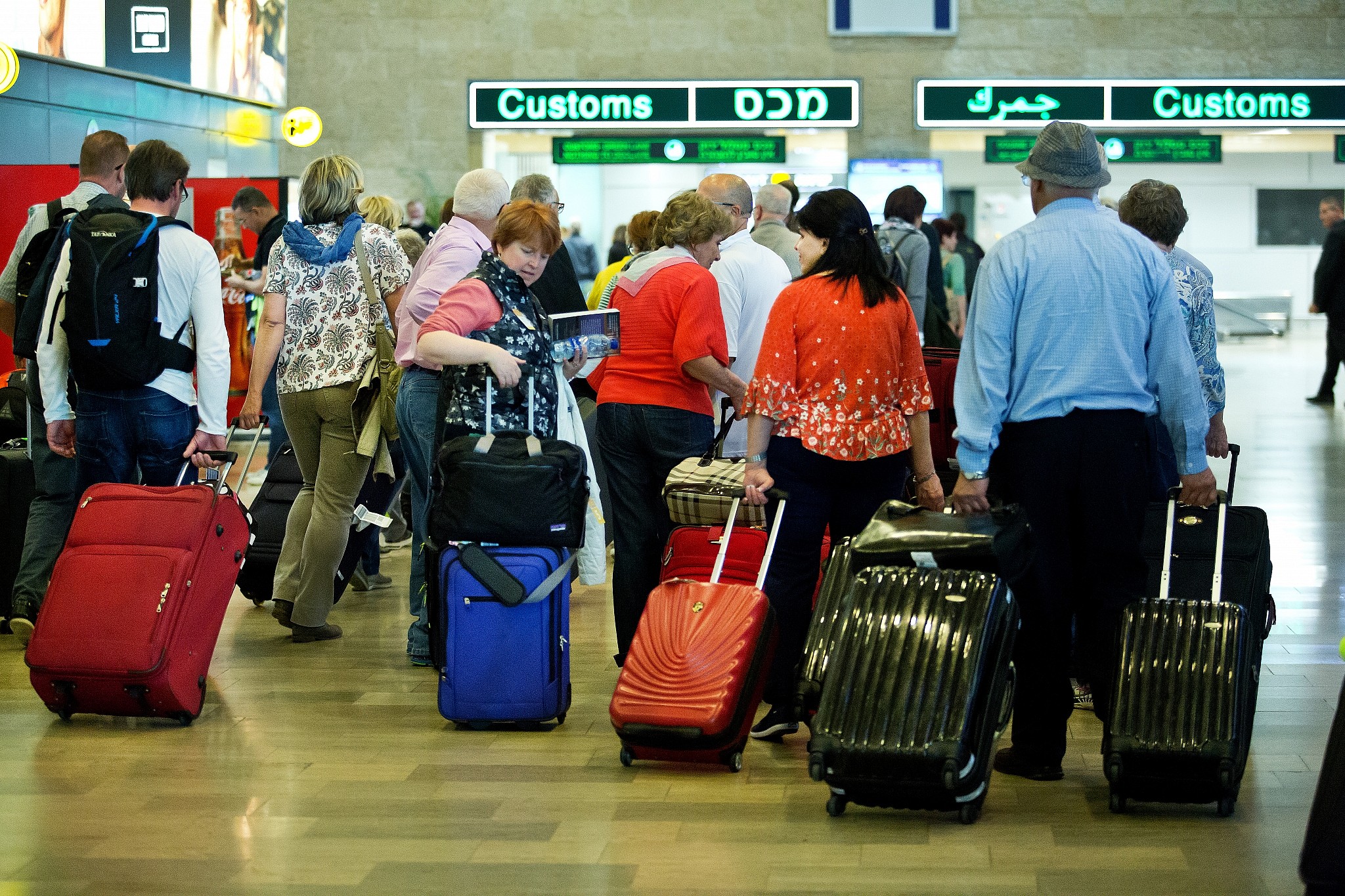
While October 7 may have been a spark, immigrants are motivated to leave for Israel by a variety of factors, Nefesh B’Nefesh and other organizations say. While some immigrants, particularly those from France, have said they moved to Israel to escape rising antisemitism, those from the US are generally driven by ideological beliefs, nudged by the events in Israel to take action and live the Zionist dream.
To Sofer, that is the real story of immigration at this point. “In most countries, people leave during a war, but in Israel, people come to help,” he has said numerous times.
It’s the economy, stupid
However, this story too is missing several important pieces of context, Della Pergola noted.
Firstly, he said, overall immigration levels aren’t particularly impressive on a historical basis, even if there are year-on-year improvements since the war started in 2023. In some cases, figures are only now starting to catch up to their pre-COVID levels, before the pandemic upended global trends.
If non-Russian immigration reaches 10,000 in 2025, it would make for “a very average year” in the broader scheme of things, Della Pergola said.
In the 15 years before the beginning of the coronavirus pandemic in 2020, immigration from countries outside the former Soviet Union tended to hover between 10,000 and 12,000 people per year, according to CBS data.
Even if 3,000 French Jews move to Israel this year, it will still be significantly lower than the nearly 4,000 a year who moved to Israel between 2014 and 2020, including 6,000 people who immigrated in 2016.
Immigration figures from the US are up from the 2010s, when they averaged around 2,500 a year. But rates from the world’s largest Diaspora community remain far and away the lowest in the world on a per-capita basis, Della Pergola noted.

With an estimated 7.5 million Jews in the US, “aliyah should be about 10 times as high as in France,” which has about 500,000 Jews, instead of being roughly equal, Della Pergola said.
In contrast, South Africa’s Jewish community has one of the highest rates of immigration to Israel, with about 300 out of its 50,000 Jews moving to Israel every year.
Though antisemitism and Zionist fervor may play a role, immigration from Western countries universally correlates with economic factors more than any other issue, Della Pergola said.

Even the big spike in French aliyah in 2015 and 2016, often attributed to rising antisemitic incidents such as the infamous Hyper Cacher attack, has to be understood in light of rising unemployment and economic uncertainty in France at the time, he said. It is possible that France’s mounting debt and political uncertainty may lead to more Jews leaving in the future, he added.
In other words, most immigration is driven more by a desire to improve one’s situation than purely ideological considerations. Or, as Israeli comedian Yohay Sponder recently joked, “It’s only really Zionism if you came from a better place than Israel.”
Down and out
Immigration to Israel may be down, but emigration from the country remains strong, with new arrivals not even replacing half of those who left last year.
Throughout the State of Israel’s history, there have almost always been more Jews moving to Israel than leaving it, with the exception of certain periods in the 1950s and 1980s, Della Pergola said. However, in 2024, a whopping 82,700 Israelis left the country, about 50,000 more than immigrated to Israel.
This net migration deficit is a trend that is expected to continue through 2025, even though official data won’t be available until the end of the year.
Many believe that Israel’s tense political and security climate in recent years is to blame for the mass exodus. A recent study by Lilach Lev Ari, a professor of sociology at Oranim College, found that nearly all of the Israelis she interviewed who moved to the United States since early 2023 mentioned either the government’s judicial overhaul plans, which led to unprecedented protests and salient fears for the future of the country’s democratic nature, or the current war as a factor leading them to emigrate from Israel.
“Traditionally, over the past several decades, most of the people who emigrated from Israel have been seeking things like upward mobility, success and education,” Lev Ari told The Times of Israel. “In contrast, the vast majority leaving in the last three years were primarily concerned with the political situation.”

According to Della Pergola, more than half of those leaving Israel are of Russian origin.
Of the roughly 200,000 new immigrants who arrived in Israel between 2019 and 2023, about 15% left the country in 2024, with most being immigrants from Russia, Georgia and Belarus, according to a study prepared by the Knesset Research and Information Center this year.
“This is something very interesting that has to be understood sociologically,” Della Pergola said. Most likely, many of the Russian immigrants never intended to stay for the long term, he suggested.
The statistician blamed the Immigration and Absorption Ministry and the Jewish Agency, which also facilitates aliyah from many places, for what he said were “disappointingly low” immigration numbers, especially in light of the prediction of a mass influx following October 7.
“At the root of this gap is a deep misunderstanding in Israel of Jewish life patterns and identities around the world,” Della Pergola charged.

The Jewish Agency responded that it works closely with Jewish communities in 65 countries around the globe to strengthen identity and connection to Israel.
“Aliyah is an essential growth engine for the State of Israel and the ongoing arrival of new olim boosts the resilience and rebuilding of our nation,” the Jewish Agency said.
Meanwhile, the Immigration and Absorption Ministry says it is stepping up efforts to pull more people in.
In February, it announced a NIS 170 million ($46.4 million) program to improve integration, along with a reform designed to speed up the licensing process for new immigrants to work in their professional fields. More recently, it launched a new government program offering incentives to attract successful Jews with in-demand skills to immigrate to Israel. Other initiatives, including expanding tax exemptions for immigrants who own businesses and offering personal assistance to potential olim throughout Europe, are also underway.
But Sofer admitted that such efforts were only complementary to various factors pushing immigrants away from their homes and to the Jewish homeland.
“The major waves of immigration aren’t dependent on our activities,” Sofer said. “It depends on economics, the war, antisemitism, and culture. We can’t compare aliyah from the former Soviet Union to aliyah from Western countries, where people are more comfortable. All we can do is try to minimize the bureaucracy, improve the aliyah process, and get out of the way.”










The Times of Israel Community.