

In Cairo, it’s students versus security
Syria’s fragmented opposition struggles to get its act together ahead of international conference
- See more Times of Israel on Google - add us as a Preferred Source
Violence in Egypt features prominently in Arab media Monday, alongside diplomatic efforts to arrange a summit on a peaceful solution to the Syrian crisis.
“Al-Azhar University has entered ‘the cycle of violence’ in Egypt,” reads the headline in the Saudi-owned A-Sharq Al-Awsat, reporting on clashes between pro-Brotherhood students and police that led to the injury of eight people including one police officer. A photo depicts students hurling stones at police near Al-Azhar University in eastern Cairo.
The headline in the London-based daily Al-Quds Al-Arabi reads, “Morsi’s resigning deputy prepares for mediation to solve the crisis; clashes between Muslim Brotherhood students and the police at Al-Azhar University.”
The paper reports that the Al-Azhar students, like many other university students across Egypt, have been protesting since the beginning of the academic year last week. The students, the newspaper explains, “demand that teaching be stopped at the university until the deposed president returns to rule, and until the what they call ‘the coup government’ is overthrown.”
The report, citing “anonymous, high-ranking sources,” claims that Mahmoud Maki, Morsi’s deputy who resigned last December, will assume the role of mediator between security forces and the students.
The London-based daily Al-Hayat features a photo of a young Egyptian protester setting fire to what seems to be a pile of wood at the entrance to Al-Azhar University on Sunday.
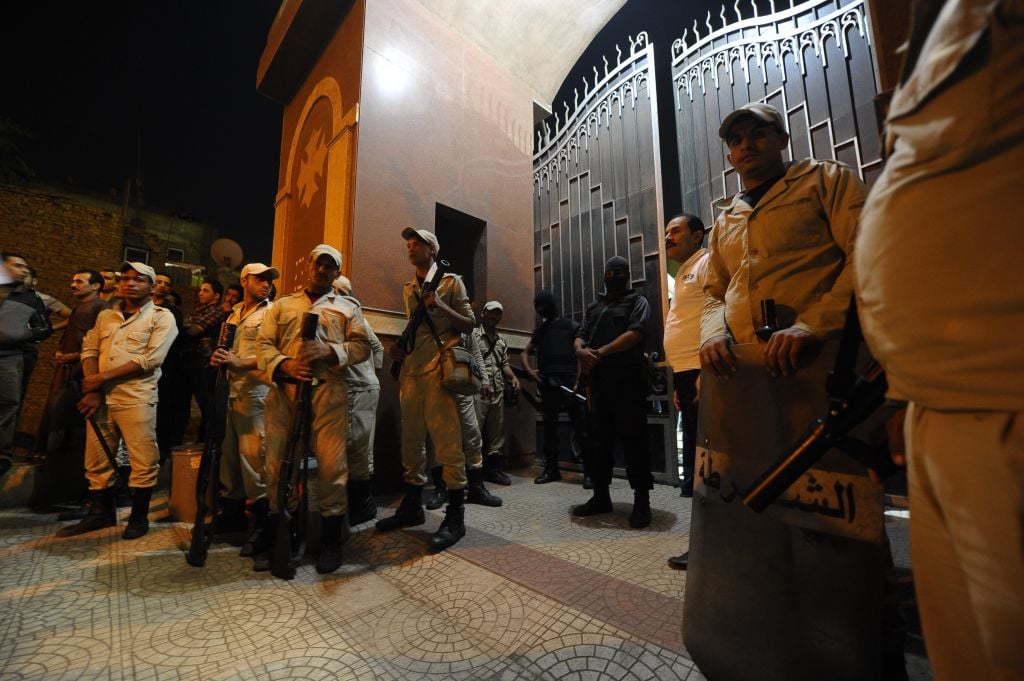
Meanwhile, Egyptian daily Al-Masri Al-Youm focuses on Sunday’s violent attack on the Church of Our Lady in the Cairo neighborhood of Al-Warak. “Three people killed, including one child, and 18 injured in armed attack on Warak church,” the headline says.
Al-Hayat cites the reaction of Sheikh Ahmad Al-Tayeb, the grand imam and president of Al-Azhar, condemning the attack as “incompatible with religion and morals.”
A ‘credible’ Syrian opposition?
All major Arab dailies analyze the press conference given by Arab League Secretary General Nabil Al-Arabi and UN special envoy to Syria Lakhdar Brahimi on Sunday concerning the coming “Geneva 2” conference. The newspapers highlight Brahimi’s skeptical comments concerning the summit.
Al-Quds Al-Arabi quotes Brahimi’s comments on the proposed peace conference next month, saying that it cannot happen without a “credible opposition that represents an important part of the Syrian people in opposition.”
Al-Jazeera highlights the disagreement between Brahimi and Al-Arabi concerning the date of “Geneva 2,” as well as the international pressure to hold the talks and the disagreements among the fragmented Syrian National Coalition.
In an Al-Quds Al-Arabi op-ed titled “Three conditions to salvage Geneva 2,” Lebanese writer Issam Nu’man links the conference to the nuclear negotiations between Iran and the US in Geneva.
Nu’man explains that it is “only rational and natural” for the US and Iran to discuss all the problematic issues, of which Syria is only one.
Nu’man views the US strategic interests in the region primarily as guarding Israel’s security. The different splits among the rebels, especially between the “Islamic Jihadists” and the Free Syrian Army on the ground, will not make the attempts for negotiation easier, Nu’man argues.
He sets forth three conditions to salvage the Geneva 2 conference.
“The first condition: the big players — internationally and regionally — have to agree on one vision and approach. The second condition, Nu’man argues, is an agreement between the big players (and the small players will follow) that a ceasefire is a precondition for the start of negotiations. The third condition is that the different Syrian sides must be able “to negotiate among themselves in complete independence.”
Nu’man ends the article by asserting that “Syria is the issue of Syrians and no one else.”





The Times of Israel Community.