

 From the Liveblog of
Monday, August 17, 2026
From the Liveblog of
Monday, August 17, 2026
At Likud polling site, party lawmakers publicly back Netanyahu’s control over list
 Add ToI as a Preferred Source on Google
Sam Sokol is a former political correspondent at The Times of Israel. He was previously a reporter for the Jerusalem Post, Jewish Telegraphic Agency and Haaretz. He is the author of "Putin’s Hybrid War and the Jews"
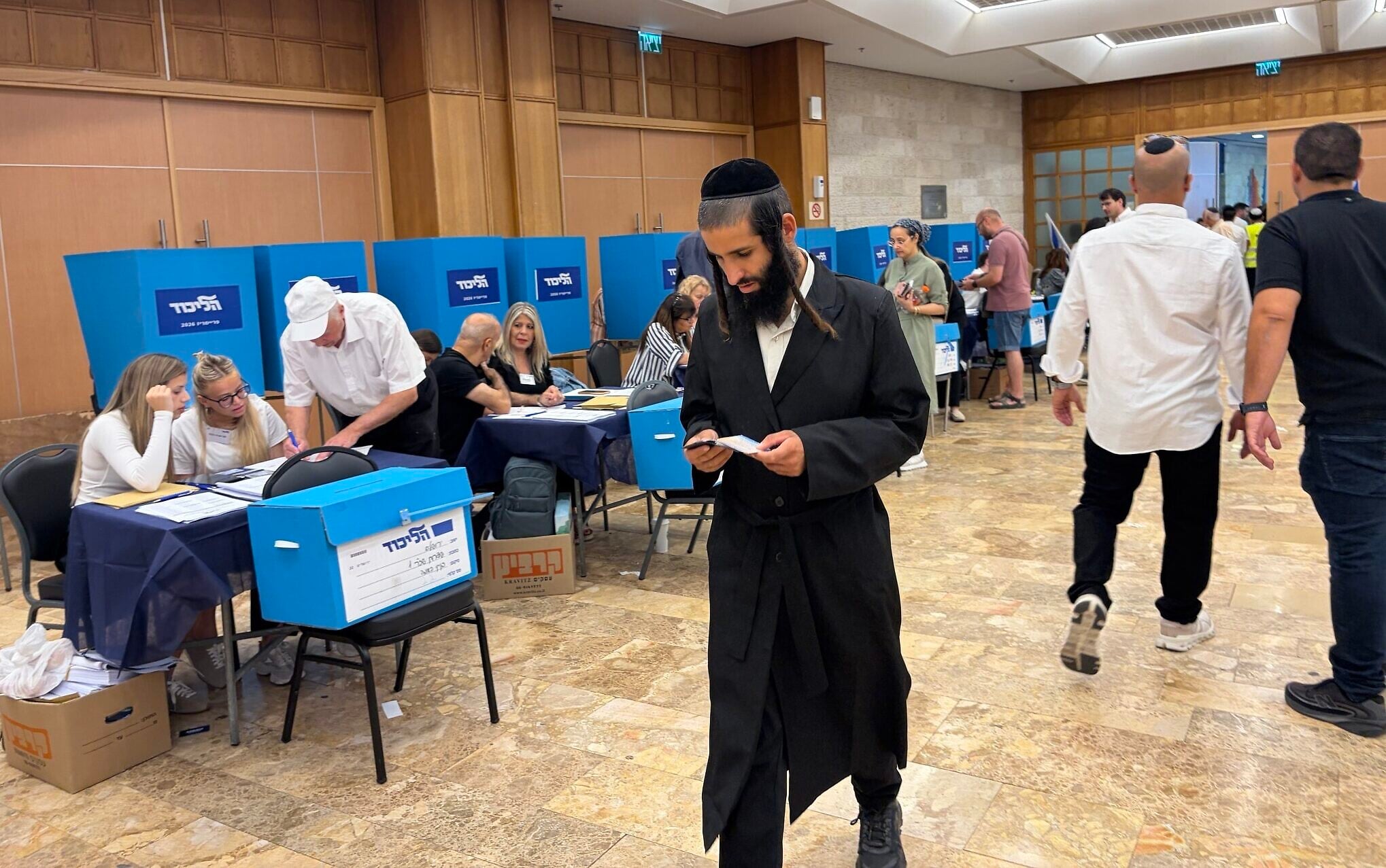
Likud members pack into Jerusalem’s International Convention Center, passing by a dense network of stands distributing campaign literature in support of individual candidates, in order to cast ballots in the party’s primary.
As campaign jingles blare on loudspeakers and activists hand out stickers, lawmakers and ministers circulate, shaking hands with voters and fielding questions from political reporters. Standing outside the convention center, one young woman wearing shiny blue and white pants walks on stilts, waving a flyer backing Justice Minister Yariv Levin.
Candidates are competing for a limited number of realistic spots on the list due to the fact that polls have consistently shown Likud getting 22-24 seats in the October 27 election, down from its current 32. Additionally, last month the Likud Central Committee significantly expanded Prime Minister Benjamin Netanyahu’s control over the party’s Knesset slate, granting him the power to place eight people of his choosing in reserved slots among the top 29 places on the list — a number subsequently expanded to nine.
Asked if he thinks giving the party leader so much control over its list harms its democratic nature, Energy Minister Eli Cohen tells The Times of Israel that “these are eight reserved spots out of the top 32 positions, meaning 75% were chosen democratically.”
Likewise, MK Amit Halevi describes the day as “a celebration of democracy” while MK Ariel Kallner says that giving the prime minister so many reserved seats “was also accepted in a democratic manner. The party central committee made this decision, and from here, we move forward.”
Last week, Channel 12 reported that Economy Minister Nir Barkat co-led a failed attempt to replace Netanyahu through a no-confidence vote immediately following Hamas’s October 7, 2023, attack. Asked about the tensions, a pro-Barkat activist manning his booth denies the reports, stating that “he always supported the prime minister and the prime minister supports him.”
Among the voters at the Jerusalem Convention Center on Monday are also members of Israel’s Haredi community. According to Channel 12, ultra-Orthodox activists ramped up the recruitment of Haredim ahead of the primary, estimating that 7,000 of Likud’s roughly 140,000 members are Haredi.
Speaking with The Times of Israel, one veteran Haredi Likud member said he would vote for whichever party in the upcoming national election that will be best in terms of “the wholeness of the Torah, the wholeness of the nation, and the wholeness of the Land of Israel.”










The Times of Israel Community.