

 From the Liveblog of
Sunday, April 19, 2020
From the Liveblog of
Sunday, April 19, 2020
Sobbing felafel store owner becomes face of pandemic’s economic toll
 Add ToI as a Preferred Source on Google
As Israeli business owners hit hard by the pandemic slowly reopen their shops, a sobbing felafel store owner tells Israeli television that he has been devastated financially from the crisis and can no longer feed his children.
“Look at my wallet, it’s empty,” Yuval Carmi of Ashdod tells Channel 13, pulling out his wallet. “I don’t have a shekel in my pocket.”
“I’m embarrassed, from my children, to tell them I have nothing I can buy for you. I have nothing to give them. I have nothing to give them to eat.”
“I don’t know what to do. I don’t know what to do. I don’t know what to do,” he says, crying and then apologizing for his tears.
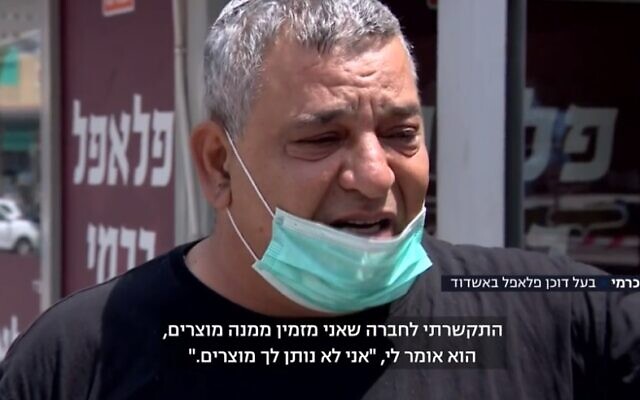
The TV report describes Carmi as the face of the economic devastation being wreaked in Israel by COVID-19, a man whose anguished pleas “within hours have turned him into the symbol of the economic collapse… a man who paid his taxes for years and provided honorably for himself and his family, and who, with his business in ruins, doesn’t understand why the state isn’t helping him.”
The TV station filmed him earlier in the day, and screens a longer story on him during the primetime news.
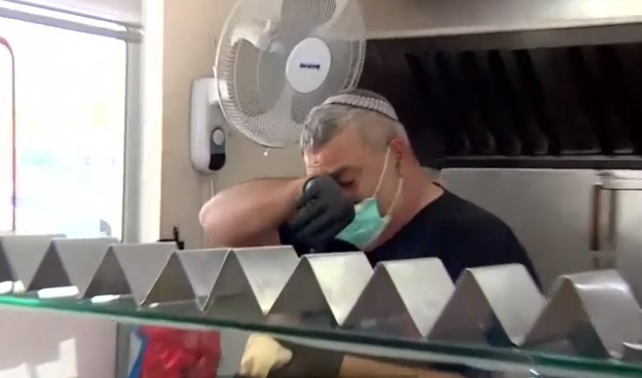
It says Carmi stood quietly when the TV station’s camera crew arrived, “and just asked to be allowed to tell his story.” As they started filming, Carmi reports that a customer had just arrived, but the police had prevented him from serving him, because falafel stands, like all restaurants are not allowed to serve customers but only to deliver food, “and I’m not set up to do deliveries.”
He says he reopened his small store this morning, believing that the newly eased COVID-19 restrictions meant he was allowed to do so, but that the police have told him he can only do deliveries. “It’s falafel,” he wails. “Falafel has to be eaten hot and fresh.”
He says he pays NIS 12,000 shekels (some $3,500) a month in rent, but now has no more money. When he tried to order from his suppliers after the Passover festival, he says, they refused to supply him. “I have a family, I have children at home, I don’t know what to do,” he says.
Carmi says he is not looking for handouts, but merely wants to earn an “honorable living.”
“I didn’t receive any money from the state. My whole life, I’ve paid national insurance, income tax. Everything, everything on time. I made an honorable living.”
Asked why doesn’t ask for a government-arranged loan, he says “it’s impossible to get hold of them.” From watching TV, “you’d think we’ve been given millions,” he says. “Not a shekel. Nothing. Nothing. I want to set myself on fire. I don’t know know what to do.
“I’m embarrassed to go home. Embarrassed to speak to my wife. What can I bring them? My daughter gave birth two months ago. I couldn’t even buy a present for the baby. What’s left for me in this country? What kind of a country is this?”
“I’m sorry for crying,” he then tells the reporter. “It’s not nice. It’s not nice for me to be seen crying like this…. I love this country. I’m 56 years old and I still do (IDF) reserve duty.”
He says he’s never had a check bounce, but now has debts of NIS 65,000 (some $18,500) having been required to close the store amid the pandemic.
He asks the TV crew to come into the store and eat some falafel. “By this stage, our whole crew was in tears,” the reporter says — “for Yuval and thousands like him, wondering why the state isn’t helping them in their hardest hour.”
She says people have been phoning the TV station since its first report on him went out earlier in the day, offering donations, but he doesn’t want to take them.
A second crew now interviews Carmi, who says “I thank the people of Israel but I don’t want donations. I just want to make an honorable living.”
The most moving call he’s had, he says, is from someone who saw him giving a group of soldiers at his stand free meals two months ago. “This person asked to pay for the meals. I told him, no. ‘It’s my mitzvah (good deed) to give free’.”
He urges the prime minister and the government to “take care of the small businesses.”
Over one million Israelis have registered for unemployment since the outbreak began. Netanyahu has highlighted loans and grants available for suffering businesses, but there has been a flood of criticism that the ostensible financial support is almost impossible to obtain.








The Times of Israel Community.