

On terror firma?
The US has concluded a deadly shooting in California was terror, but the extent of the link to the Islamic State, and whether Washington is doing enough, is still debatable
- See more Times of Israel on Google - add us as a Preferred Source
Joshua Davidovich is The Times of Israel's Deputy Editor
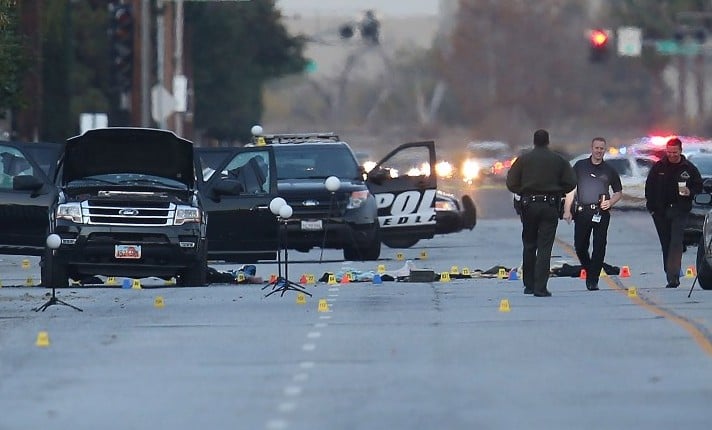
Four days after the massacre in San Bernardino, Israeli papers seem all too eager to report that the Americans have concluded officially it was a terror attack, with some taking hints at a connection to the Islamic State and running with them.
No paper does more so than Israel Hayom, which goes so far as to chide US President Barack Obama for his supposed refusal to tackle the Islamic State threat head-on, both in the words of Defense Minister Moshe Ya’alon, who accused Washington of doing less than Russia against the terror group, and in its own caustic tongue.
“The central problem is the refusal of the presidents to recognize the real problem,” editor Boaz Bismuth writes in the tabloid. “The battle against Islamic State is one big failure … And mostly, as the French dealt with last month, when you don’t actually defeat IS, it comes after you physically and spiritually. Physically, thanks to the refugees – and spiritually, because the spirit of IS invades the West.”
Despite Bismuth’s rage and his paper reporting that the shooting attack was an Islamic State plot, the fact remains that the FBI has only concluded that the two killers were radicalized and inspired by the Islamic State, and not necessarily part of a larger terror network.
That distinction is important but it may be lost Americans, who Haaretz commentator Amos Harel notes will likely react in a way they haven’t since 9/11.
“It will sharpen the focus on two highly sensitive political issues: the controversy over the unbearable ease with which weapons can be bought in America (over which the Democrats have been attacking the Republicans for their refusal to tighten controls) and the controversy over steps to be taken against Islamic terror (over which the Republicans accuse the Obama administration of laxity),” he writes. “In the background is a third highly charged issue, that of immigration policy, even though Farook, the male assailant in San Bernardino, was born in the United States. It can be assumed that anti-Muslim sentiment will again erupt on the right-wing margins of the political landscape, as happened in the United States after the September 11, 2001 attacks.
Even if most American are feeling angst about Muslims and terror and guns, at least one American is troubled by other problems, namely the lack of peace between Israel and Palestinians.
After a droopy-faced John Kerry spells out a less than utopian future for Israel should it fail to reach a deal, Yedioth Ahronoth terms his appearance at the Saban Forum “an address of despair.”
“This was a speech full of frustration, disappointment and depression,” Orly Azulay reports from the scene. “The things Kerry said weren’t new, but the aggressive tone made it what it was,” she adds before slightly misquoting him about the collapse of the Palestinian Authority.
Kerry likely would have been even more depressed had he heard about the death of Yossi Sarid, who on paper may have been a two-bit one-time minister but in life was a giant of the Israeli political and punditry scene.
A mensch in every sense of the word (this writer had the pleasure of wrestling with Sarid over edited translations of his singularly thickly layered and beautiful takes on the Israeli condition week after week), the former Meretz leader cum Haaretz commentator is remembered on front pages as a “courageous politician who stood up for what he believed in and did very unpolitician-like things, like refusing to compromise for a few extra votes.
“Yossi Sarid was a politician free of fear. His whole career he stood for and did what he believed in, without thinking about whether it was comfortable or the political damage it could do to his party or his camp,” writes Nahum Barnea in Yedioth. “He was cruel to the powerful – and to himself – but melted like butter for the weak.”
Haaretz’s Gideon Levy writes that he was close to Sarid when he got his own start in political activism, and saw a man who was destined for greatness.
“Modest in his lifestyle, with an impressive record of years of volunteering in Kiryat Shmona, Moshav Margaliot and Sderot; a backgammon partner to lifeguards at Tel Aviv’s Hilton Beach and a frequent traveler by bus or as a passenger in the tiny Subaru driven by Dorit, his wife. He dictated all his writings to her, to the end; he barely knew how to use a computer,” he writes. “But he recognized his own worth. There is no need to compare Sarid to today’s political dwarfs to realize his great stature. Even in an age of giants he had a respectable place and not only because of his rhetorical skills, which no one disputed, but because of his integrity and courage. He was one of the few that left his mark.”
The paper’s Yossi Verter notes that Sarid was no fan of “honey-laced eulogies,” which begs the question as to whether he still felt that way if the things being said were true, as argued by commentator Mordechai Gilat in Israel Hayom.
The writer, in a paper which doesn’t save many kind words for those of the dovish persuasion, writes that all the nice things said about Sarid are not just hagiographies to be nice to someone who passed.
“I know that after death there is a tendency to exaggerate, to embrace excess, to bombast. There is a tendency to idealize the deceased. To drift to places that don’t tell the whole truth,” he writes. “Not in the case of Yossi Sarid. He was first on every playing field he was on – in the government, in the Knesset, in the opposition, in Meretz, in the fight for peace. He was the real Zionist left, the indefatigable striver for peace, for human rights, for animal rights. A man of great stature.”



The Times of Israel Community.