

Paleolithic chic: 500,000 years ago, Israel’s ancient toolmakers had a taste for sparkle
Rare hand axes from the Sakhnin Valley show Homo erectus picked fossil- and crystal-rich stones for visual appeal, hinting at early symbolic thinking, new study suggests
 Add ToI as a Preferred Source on Google
Rossella Tercatin is The Times of Israel's archaeology and religions reporter.

Ancient humans who lived in northern Israel around 500,000 years ago intentionally selected special stones with fossilized animals or crystal formations to craft beautiful tools featuring them as decorations, a new study published in the peer-reviewed Tel Aviv Journal of the Institute of Archaeology of Tel Aviv University (TAU) on Tuesday has shown.
The study presents the results of a survey of the Sakhnin Valley in the Lower Galilee, where hundreds of Lower Paleolithic hand axes have been found, including some 15 that exhibit special features, TAU Prof. Ran Barkai, lead author of the paper, told The Times of Israel in a video interview.
According to Barkai, the number is especially remarkable, since only a handful of individual artifacts with this kind of characteristic had previously been unearthed worldwide.
Barkai believes that these tools prove that those ancient humans were interested in their tools not just for their functionality. Rather, they displayed a sense of aesthetic or symbolic belief system, as the special geological features remain visible in a prominent position at the center of each hand ax, suggesting that the knapping process was carried out in a way to highlight them.
The artifacts were discovered by chance by the co-author of the paper, Muataz Shalata, a resident of the Arab town of Sakhnin in northern Israel.
“Everybody thinks that all archaeological sites in Israel, at least those on the surface, have already been discovered and are well known,” Barkai said. “However, no one knew about Sahnin. Muataz, an autodidact nature lover, came across these distinctive stones and contacted the Israel Antiquities Authority, and then me.”
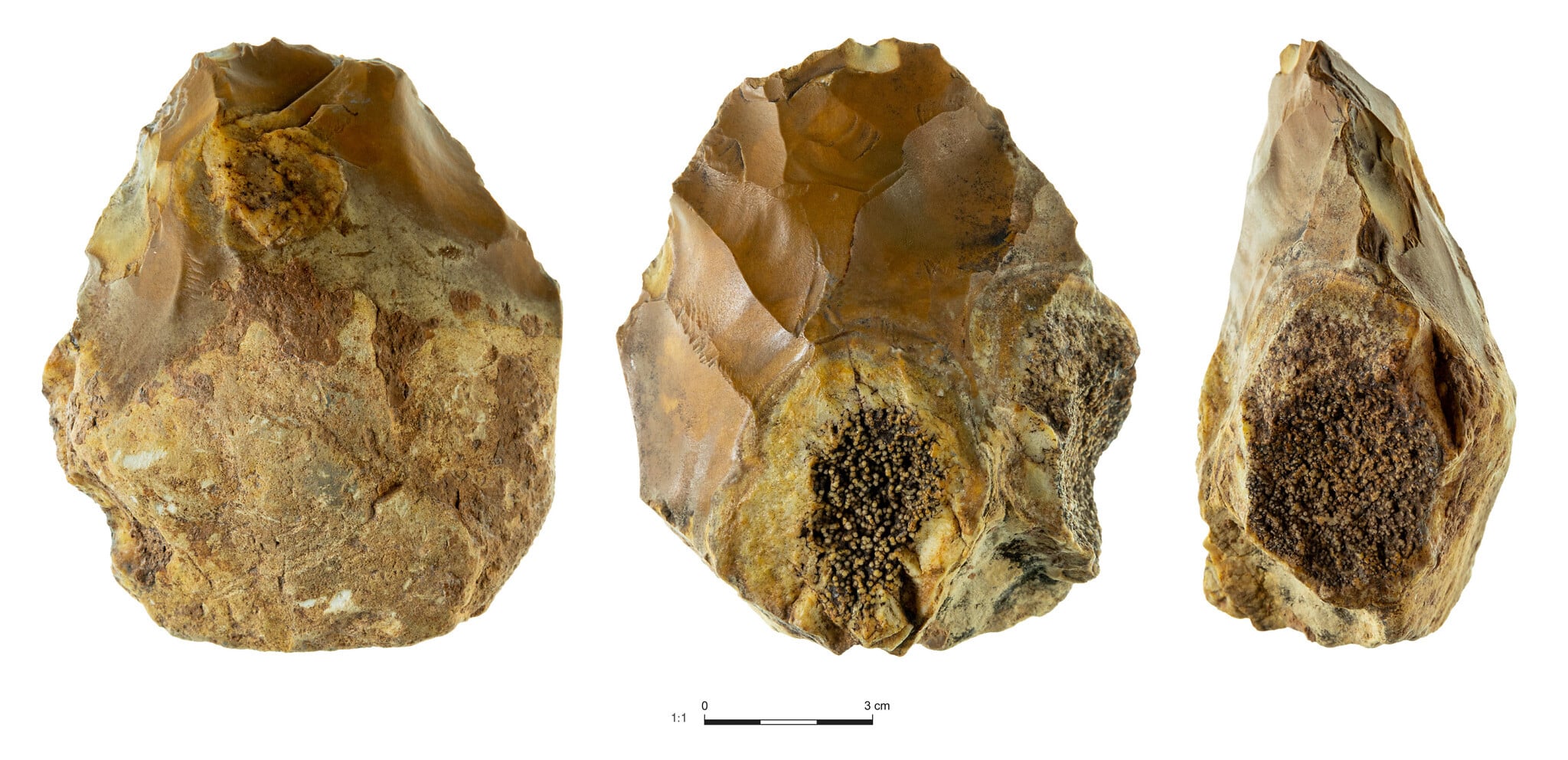
Barkai, one of Israel’s top experts in prehistoric archaeology, first visited Sakhnin in 2023. At first, he thought the site was interesting but in no way extraordinary.
“I have excavated several sites, and I have seen hundreds of hand axes,” he said, explaining that there are many locations featuring these artifacts in large numbers in Israel and across the world.
However, he soon noticed that the area has very special geological features, known as “geodes,” consisting of rounded, brain-like concretions containing sparkling crystals. Stones embedded with maritime fossils millions of years old are also common.
Barkai spotted several tools crafted around those special materials.
“Once I started to find hand axes that were shaped around fossils or interesting geological phenomena, this rang a bell, because it is really unusual and rare,” he said. “There are very few items around the world that bear fossil remains or special geological formations, and it is accepted [among scholars] that they are a testimony for some kind of esthetic or symbolic belief system.”

According to the archaeologist, ancient humans knew their environment very well and likely recognized the fossils or crystals as something from a distant past.
“We believe that for them they represented some kind of a connection to earlier entities or to the cosmos,” he said.
Because the hand axes were mostly found on the ground in cultivated fields and groves, it was not possible to date them based on archaeological context. Still, Barkai explained that their typology, along with that of other tools, clearly suggests they date back to around half a million years ago.
“We don’t have only hand axes, but the whole toolkit of items that are typical of the late Lower Paleolithic,” he said. “We know the prehistoric archaeology in our region quite well thanks to the density and depth of the findings, and we know that the combination of hand axes and a certain specific type of cores and other flint tools is typical of this period.”
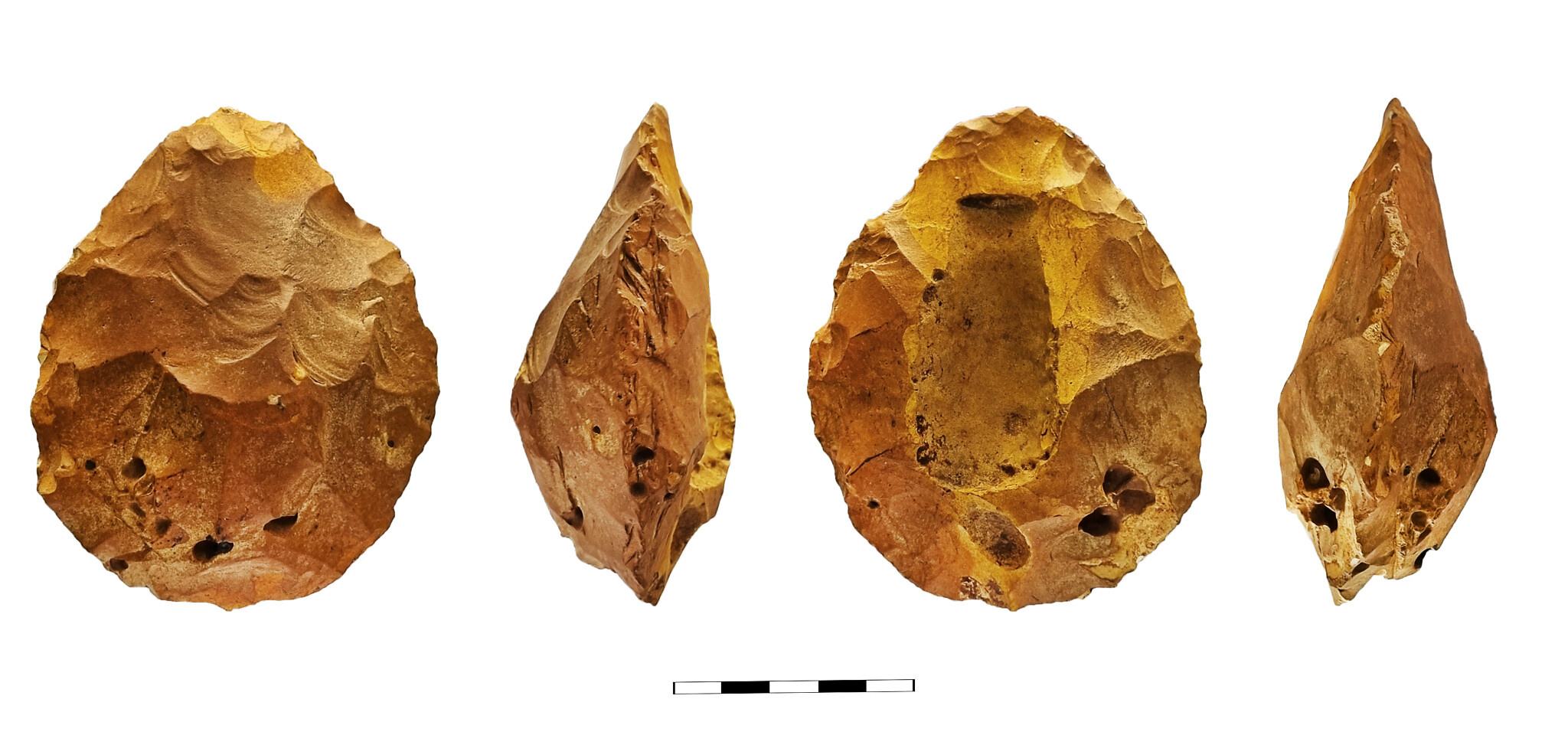
The Sakhnin Valley is located close to other Lower Paleolithic sites, such as Gesher Bnot Ya‘akov, the Tabun Cave, and Evron.
“Sakhnin sits exactly between the coastal plain sites and the Jordan Valley sites,” Barkai noted.
At the time, small bands of hunter-gatherers moved around the different locations. According to Barkai, they often followed the migration routes of elephants, which at the time were common in modern Israel and across Europe and Asia, as well as Africa, before they were hunted to extinction in many regions.
“Sakhnin is located on what is assumed to be the migration route of elephants, according to a recent study by French researchers, so it makes sense that early humans would pass through it,” the archaeologist said.

Hand axes are associated with Homo erectus, the ancestor of both Homo sapiens, or modern humans, and Neanderthals, who both appeared between 400,000 and 300,000 years ago.
“Homo erectus emerged in Africa about two million years ago and left Africa in several waves, reaching Europe and Asia,” Barkai explained. “Homo erectus was a very successful species in evolutionary terms. It prospered for almost 2 million years. Hand axes were very useful tools, and continued to be produced and used for over 1.5 million years.”
While their specific purpose has been the subject of academic debate, Barkai believes that hand axes were a crucial tool to butcher the meat of large game.
“Hand axes were mostly used to process large animals, mostly elephants,” he said. “We believe that the extinction of elephants and mammoths brought this change in human evolution as well. Homo erectus had to change and adapt to hunting and consuming smaller animals, and hand axes disappeared.”
In the future, Barkai hopes to secure the resources for a full excavation in the Sakhnin Valley, which could lead to further discoveries, including more precise or independent dating.
“If we are lucky and get the permit and funding, we plan to carry out a large-scale project to excavate and find more items from a clear context,” he said. “What we have now is a mixture of, most probably, several visits of early humans [to the site]. We believe that the valley was visited and occupied throughout a very long time.”










The Times of Israel Community.