

Senior US official pressured Oct. 7 victims to drop restitution case, lawsuit says
Case against prominent Palestinian-American businessman Bashar Masri — who denies wrongdoing — says he used unnamed government contact to encourage plaintiffs to drop legal claims
 Add ToI as a Preferred Source on Google
Luke Tress is The Times of Israel's New York correspondent.
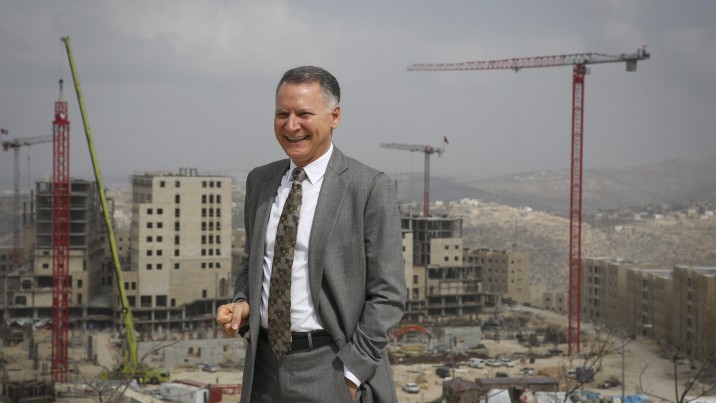
A senior US government official has pressured the families of victims of Hamas’s October 7, 2023, terror invasion to drop a lawsuit against a prominent Palestinian-American businessman who is accused of allowing the terror group to use his properties, according to a court filing last month.
The businessman, Bashar Masri, denies all allegations of wrongdoing.
The claim was made in an amended complaint filed in the case last month. The amended complaint did not indicate that any of the plaintiffs had dropped the case.
The lawsuit, filed last year, argued that Hamas deceived Israel ahead of the invasion by feigning an interest in developing Gaza, and claimed that Masri and his companies were “an integral part of that grand deception.”
“They owned and operated flagship properties in Gaza that they knowingly and deliberately integrated into Hamas’s terrorist infrastructure and that were crucial elements in Hamas’s attack plan on October 7,” the lawsuit said.
The plaintiffs were around 200 American victims of the October 7 attack and their family members, including the families of slain hostages Hersh Goldberg-Polin and Itay Chen, Yechiel Leiter, Israel’s ambassador to the US, whose son was killed in Gaza in November 2023, and prominent Israeli entrepreneur Eyal Waldman, whose daughter was killed on October 7.
Waldman used to be a close friend of Masri’s, with the pair’s friendship seen as a model in Israeli-Palestinian bridgebuilding. But Waldman now holds Masri partially responsible for his daughter’s death and has pledged to “ruin him.”
The lawsuit did not say that Masri knew about the October 7 attack, and admitted that some of his development projects appeared to be legitimate, but it did claim that he was aware that Hamas was using his properties for military purposes.
Some of the projects were used to build and hide Hamas tunnels, store rockets, host Hamas leaders, train Hamas operatives and produce electricity for Hamas tunnels, the case claimed.
Masri had contracts with the US government and often corresponded with US government officials about his development projects, an amended complaint in the lawsuit said.
The amended complaint filed last month said that Masri used those connections in an attempt to dissuade the plaintiffs from the lawsuit.
After the initial complaint was filed, “Masri again called on his sympathetic US government contacts for assistance, this time enlisting the help of a US government official to contact certain Plaintiffs in this proceeding,” the amended complaint said.
“The senior US official did so. He urged those Plaintiffs to drop this lawsuit because of Masri’s purported relative moderation and cooperation with the United States,” the filing said.
The complaint did not identify the official, and lawyers from both sides of the case did not respond to requests for comment.
Masri’s office denied the lawsuit’s initial allegations in a statement shared with The Times of Israel last year.
“He was shocked to learn through the media that a baseless complaint was filed today, referring to false allegations against him and certain businesses he is associated with. Neither he nor those entities have ever engaged in unlawful activity or provided support for violence and militancy,” the statement said. “He unequivocally opposes violence of any kind. He will seek the dismissal of these false allegations in court.”
Masri served on the dean’s council at Harvard’s Kennedy School of Government and resigned after the lawsuit was filed.
The lawsuit seeks an unspecified amount of compensation for damages under a federal US law that allows American citizens to sue over harm caused by international terrorism.







The Times of Israel Community.