

Specialized chip plant to be built in Ashkelon, Israeli-Canadian fund announces
Awz Ventures says it will invest $1.6 billion in foundry to produce advanced semiconductors for defense use and civilian companies, though public portion of project cost unclear
 Add ToI as a Preferred Source on Google
Sharon Wrobel is a tech reporter for The Times of Israel

Canadian-Israeli venture capital fund Awz Ventures Inc. on Thursday announced plans to build a chip manufacturing plant at an initial investment of NIS 5 billion ($1.6 billion) in the coastal city of Ashkelon in southern Israel.
The 70,000-square-meter facility, which boosters say will serve as a national semiconductor foundry, is being advanced in cooperation with several government ministries. The fabrication plant will be designed to develop and produce advanced chips for Israel’s defense sector, but will also be available to build chips to order for civilian companies or academic institutions.
Unlike typical plants, which focus on the silicon chips used ubiquitously today, the Awz project will produce III-V semiconductors made using different elements, but prized for use in advanced technologies, such as artificial intelligence and specialized defense arrays.
The company said the plant, to be built in the Tera Park industrial zone in Ashkelon, would produce advanced chips which are critical for AI infrastructure, quantum computing, 5G and 6G communications, aerospace and defense systems, and other strategic security applications.
“This is a strategic national project which will include critical infrastructure and advanced technologies that will strengthen the security, technological, and economic independence of Israel, the southern region, and the city of Ashkelon,” said Awz co-founder Yaron Ashkenazi, a former Shin Bet agent. “The investment is part of Awz’s strategy to strengthen Israel’s security and economic independence and significantly increase exports, alongside supporting the geographical and social peripheral areas of Israel.”
Israel is already home to two silicon chip plants, owned by Intel and Tower Semiconductor, though neither has the capacity to manufacture chips needed for some technologies requiring ever-more powerful computing powers and speeds.
Awz listed several public partners for the project, including the Economy Ministry, the Defense Ministry’s Directorate of Defense Research and Development, the Ashkelon Municipality, the Finance Ministry, the Israel Lands Authority (ILA), and the Israel Innovation Authority.
Most chip fabrication plants cost between $10 billion and $20 billion. Asked about sources of funding for the project, Awz said that “investors in the project include private international investors and others,” without providing further details, including involvement or investment of public bodies.
Founded in 2016 by Ashkenazi and Canadian real estate investor Ed Sonshine, Awz Ventures invests in Israeli cloud security, quantum, aerospace, deep tech, robotics, artificial intelligence, and cybersecurity. Among the fund’s advisors are former IDF chief of staff Aviv Kohavi, who stepped down in January 2023, and former Canadian Prime Minister Stephen Harper. The fund has $500 million in assets under management.
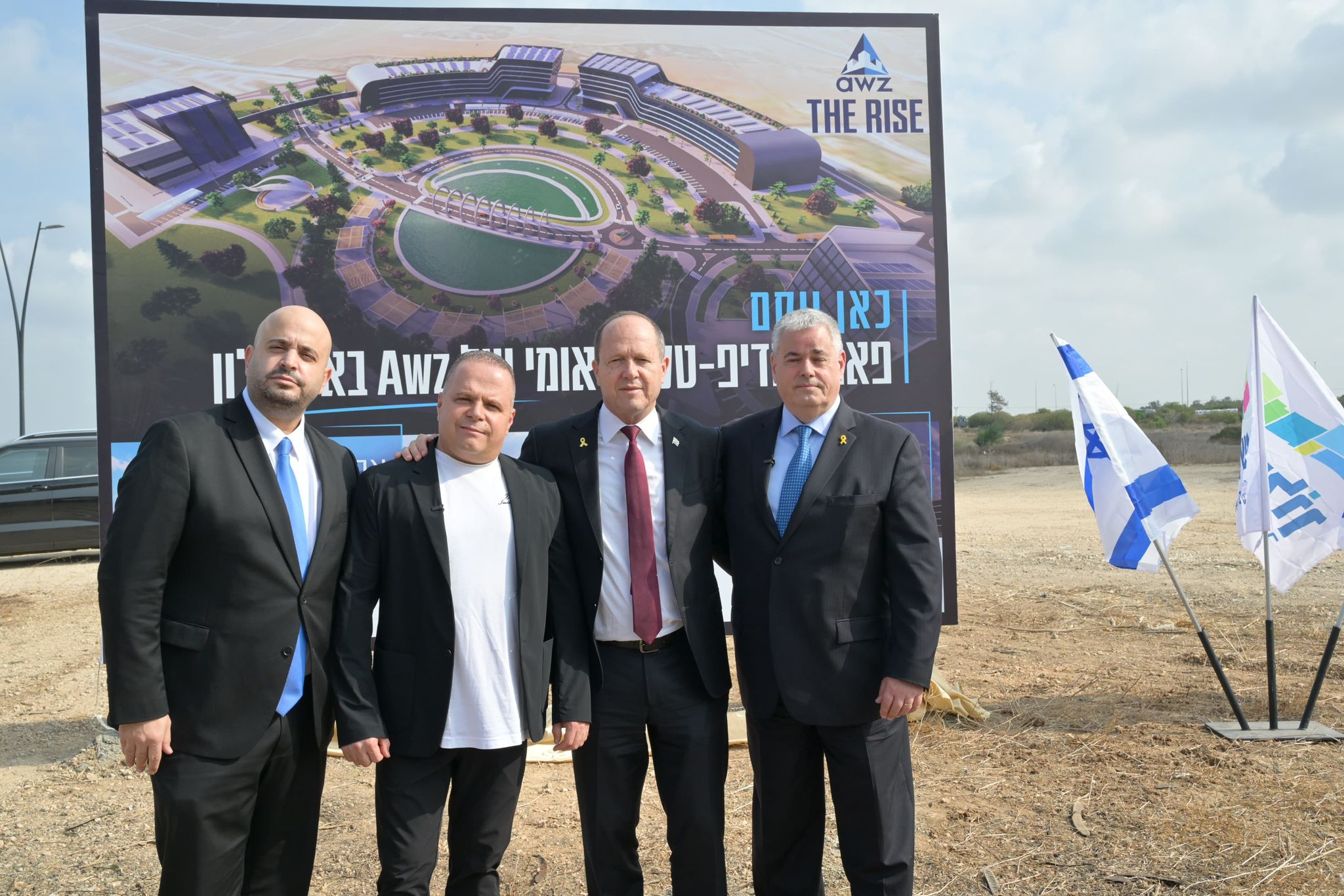
Economy Minister Nir Barkat called the project a “leap forward” on the path to positioning Israel as a “global chip and deep tech powerhouse,” which will create thousands of jobs and strengthen the economy. Barkat made the comments during a visit to the future site together with Ashkelon Mayor Tomer Glam, Ashkenazi, and other government officials.
Deep tech refers to a class of startups aimed at developing or engineering new technologies, in contrast to companies that focus on using existing technologies in new ways.
In light of a growing shortage of professional engineering staff in industry, an academy for deep tech talent is also being planned in collaboration with local and global academic institutions, alongside a startup incubator that will specialize in the development of deep tech technologies, the project’s boosters announced.
“The project seeks to attract new populations to Ashkelon and the southern region, including young families and graduates of the IDF’s leading technological units and other security branches,” said Ashkenazi.
Israel has in the past sought to steer major technology production facilities to areas outside of the Tel Aviv region, offering substantial tax incentives to locate in the north or south of the country.
The government in August announced a NIS 1.4 billion ($405 million) plan to develop the city of Ashkelon, located some 13 kilometers (8 miles) from the northern edge of Gaza.
The money is part of a comprehensive NIS 3.2 billion ($927 million) aid package for southern Israel to rehabilitate the area in the aftermath of Hamas’s October 7, 2023, attack on Israel.





The Times of Israel Community.