

A country divided, 20 years on
Israel’s dailies use the rally marking the 20th anniversary of Rabin’s assassination to voice fear over the gulf between the state’s political flanks
 Add ToI as a Preferred Source on Google
Adiv Sterman is a breaking news editor at The Times of Israel.
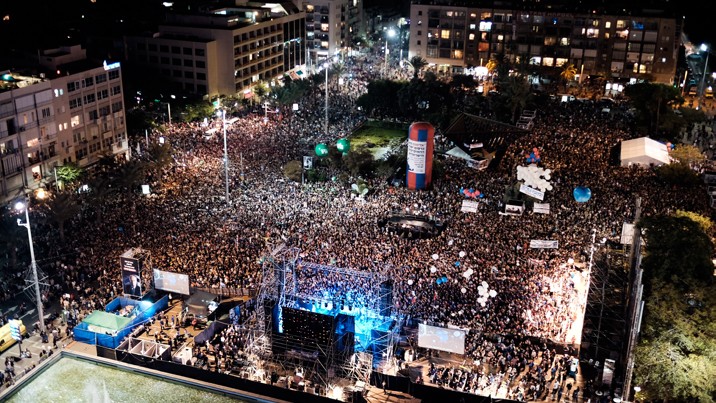
With a hint of nostalgia and a bit of pride, the country’s left and center-left leaning papers report on the success of Saturday night’s memorial rally in Tel Aviv marking the 20th anniversary of the assassination of prime minister Yitzhak Rabin by Jewish extremist Yigal Amir.
Alongside two aerial photos of Rabin Square, one taken during yesterday’s event and the other the fateful night on November 5, 1995, Yedioth boasts that over 100,000 people gathered to pay respects to the late prime minister. Haaretz shows a similar photo of the rally at the center of its front page, proudly noting the large crowd at the site last night.
“Once again, at the square,” reads Yedioth’s main headline, as if to convince itself that the Israeli leader’s vision for peace with the Palestinians is still shared by masses of people in the country, even at such a time of turmoil, divide, and unrest.
In that light, Nahum Barnea and Sima Kadmon, two of Yedioth’s leading analysts, can only barely conceal their frustration at the rightward shift that has overcome the state since Rabin’s death. “This kind of rage — a rage over the crumbling of democratic values, over the hate for the outsider, the racism, the violence in society — has no voters these days,” Barnea writes in an op-ed. “The people are going right, and that is totally fine,” he continues, though the article’s general tone already belies his words. “But someone has to warn them when they are being led to the edge of the abyss… this silence applies to what was once the left: [The left] is lying on its back, waving its legs up in the air and waiting for a boot to squash it.” The op-ed asserts a slow realization among many on the left that the country has changed, that Rabin’s dreams died along with him, and that most Israelis no longer share the view that peace with the Palestinians is a possibility.
“The strongest feeling that came up yesterday, when former US president Bill Clinton went up to the podium in Rabin Square, was that of grief,” Kadmon writes, echoing Barnea. “A sadness over the fact that such warm, wise, optimistic, strengthening, uniting words had to come from a US president, rather than from the prime minister of Israel.” At the rally, Clinton stressed that after Rabin’s death, it was now “up to” Israelis to choose peace.
“The antithesis to Clinton’s words were those of [Prime Minister Benjamin] Netanyahu earlier this week, who vowed that we will forever live by the sword.” Kadmon was referring to Netanyahu’s recent talk to opposition Knesset members, where he reportedly said there is no “magic wand” to resolve the conflict with the Palestinians, and that Israel will “forever live by the sword,” which was interpreted by some to mean that the Jewish state will have to be eternally vigilant, unable to relent in its readiness to use force to defend itself. “Doesn’t such a sentence not harm, discourage, encourage violence and erase any possibility for normal life?” a despairing Kadmon asks.
Right-leaning Israel Hayom is far more reserved over Rabin’s memorial rally, demoting the report to the bottom of its front page which leaves it lots of room for an article on a Russian plane which mysteriously crashed in the Sinai Peninsula, south of the Israeli border. The full report on the event in Tel Aviv only shows up on the paper’s seventh page. Featured almost as prominently by Israel Hayom as the rally is an utterance by little-known Tel Aviv director Orna Ben-Dor, who reportedly compared Netanyahu to Nazi leader Adolf Hitler. “Is this not incitement?” the paper asks rhetorically, as it plays up the significance of Ben-Dor’s words. “It is weird that the media which condemns incitement does not act similarly when the prime minister is involved,” the daily quotes an unnamed Likud party official as saying. The different focuses in each of the country’s major papers highlight how many on both sides of the political aisle feel, or, more accurately, are interested in cultivating a feeling, that they are seriously threatened by members of the opposing camp.
On that note, it comes as no surprise that Haaretz’s editorial demands that Justice Minister Ayelet Shaked put her political opinions aside and work to quell the fierce criticism being leveled at the Supreme Court — oft considered a bastion of liberal ideals — before the criticisms turn into dangerous actions. Indeed, following Jewish Home MK Moti Yogev’s unprecedented attack on the court over its ruling to halt home demolitions for terrorists, security around Justice Uzi Fogelman, who signed the decree, has been significantly tightened lest someone attempt to cause him harm. “The justice minister must voice a clear condemnation of the forces inciting against the court in a clear and loud voice,” the editorial urges, “in order to protect the justice system, the rule of law, and democracy in Israel.”








The Times of Israel Community.