

At UN, Ambassador Prosor addresses regional ‘myths’ and ‘truths’
In speech to the Security Council, Israel’s envoy sets the record straight on refugees, the humanitarian crisis in Gaza, and obstacles to peace
 Add ToI as a Preferred Source on Google
Stuart Winer is a breaking news editor at The Times of Israel.
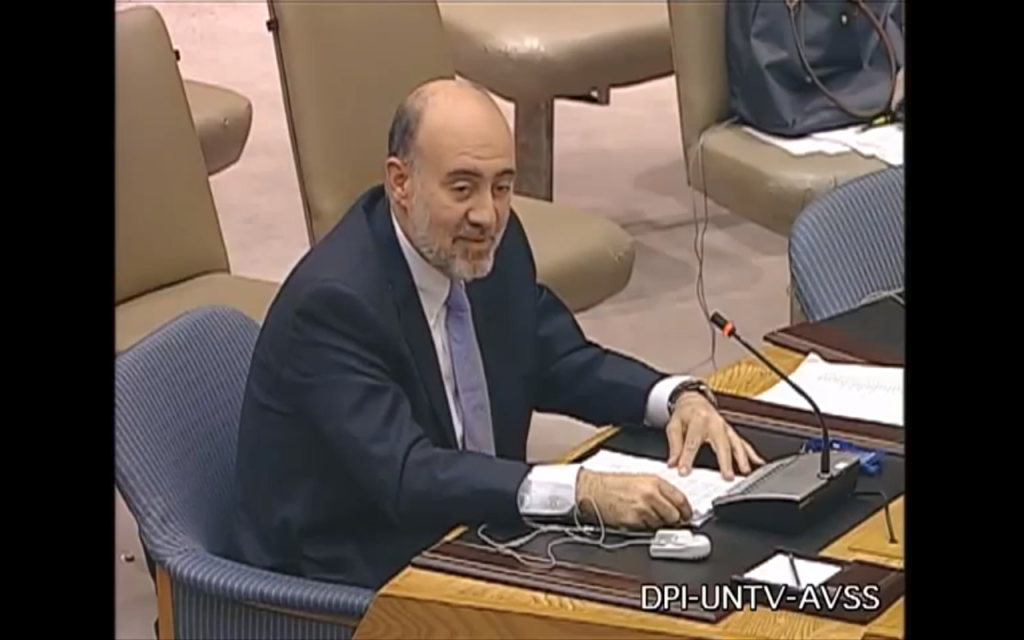
Israel’s Ambassador to the UN, Ron Prosor, on Monday attacked what he called the myths of the Middle East, including the centrality of the Israeli-Palestinian conflict, the perceived humanitarian crisis in Gaza, and the influence of the settlements as an obstacle to negotiating peace.
In a statement made during an “Open Debate on the Situation in the Middle East” session of the UN Security Council, Prosor called on the members to take an honest look at the region and its history.
First and foremost among damaging myths, the ambassador said, is the claim that the Israeli-Palestinian conflict is central to peace in the Middle East.
“The truth is that conflicts in Syria, Yemen, Egypt, Bahrain, and many other parts of the Middle East have absolutely nothing to do with Israel,” Prosor said. “It is obvious that resolving the Israeli-Palestinian conflict won’t stop the persecution of minorities across the region, end the subjugation of women, or heal the sectarian divides. Obsessing over Israel has not stopped Assad’s tanks from flattening entire communities. On the contrary, it has only distracted attention from his crimes.”
Describing Iran’s bid for nuclear weapons as the single greatest threat to the Middle East and the world, Prosor lamented the international community’s lethargic attitude toward Tehran.
“The Iranian nuclear program continues to advance at the speed of an express train,” he said. “The international community’s efforts to stop them are moving at the pace of the local train, pausing at every stop for some nations to get on and off.”
Prosor also dispelled the notion of a humanitarian crisis in Gaza and warned of the dangers that constant rocket attacks from the Hamas-controlled enclave pose to regional stability. Citing the fact that numerous international organizations have clearly stated that there is no humanitarian crisis in Gaza, Prosor noted that the Palestinian area saw its GDP increase by 25% during the first three quarters of 2011.
“Yet, as aid flows into the area, missiles fly out. This is the crisis in Gaza. And that is what keeps Gaza from realizing its real potential,” he said. “Each rocket in Gaza is armed with a warhead capable of causing a political earthquake that would extend well beyond Israel’s borders.”
Prosor also dismissed the dogma that the settlements are the biggest obstacle to peace. Recalling the failure of Arab states to absorb their own Palestinian refugees, Israel’s politically agonizing pullout from Gaza in 2005, and more recently a 10-month moratorium on settlement construction that failed to induce negotiations, Prosor argued that it is the Palestinian “Claim of Return” that is the true obstacle to peace.
“You will never hear Palestinian leaders say “two states for two peoples”,” he said. “You won’t hear them say “two states for two peoples” because today the Palestinian leadership is calling for an independent Palestinian state, but insists that its people return to the Jewish state. This would mean the destruction of Israel.”
Listing the long historical connection between Jews and the land of Israel, and in particular Jerusalem, Prosor claimed that it is the Jewish people who have seniority.
“Across the Arab World – and even at this table – you hear claims that Israel is ‘Judaizing Jerusalem,'” he said. “These accusations come about 3,000 years too late. It’s like accusing the NBA of Americanizing basketball.”
Prosor went on to condemn the UN for “overlooking” the 850,000 Jewish refugees who were forced to leave their homes in Arab countries and make their way to Israel.
“Out of over 1,088 UN resolutions on the Middle East, you will not find a single syllable regarding the displacement of Jewish refugees. There have been more than 172 resolutions exclusively devoted to Palestinian refugees, but not one dedicated to Jewish refugees. ”
The most obvious myth of all, Prosor said is that peace can be achieved without direct negotiations between Israeli and Palestinians.
“History has shown that peace and negotiations are inseparable,” he said, and highlighted the reluctance of the Palestinians to return to the negotiating table.
“Last January, Israel offered a clear proposal in Amman for restarting direct negotiations,” Prosor said. “That proposal — filled with Israel’s vision for peace — continues to gather dust, as Palestinian leaders continue to pile up new pre-conditions for sitting with Israel. They are everywhere except the negotiating table.”




The Times of Israel Community.