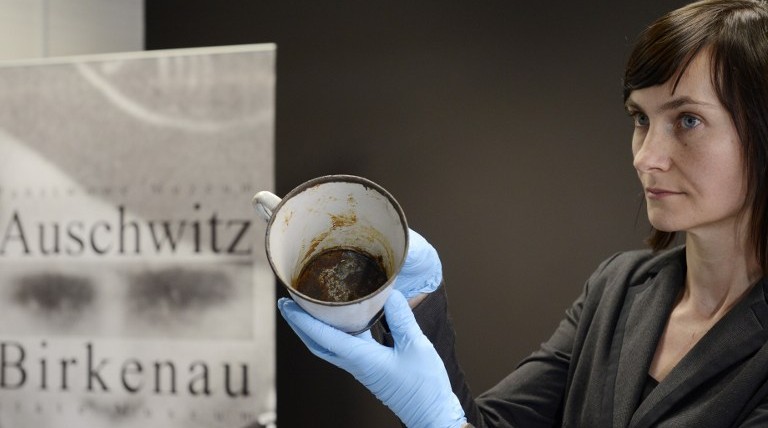
A woman presents on May 19, 2016 a metal mug with a double bottom in which a gold ring and necklace were found by employees of the Auschwitz-Birkenau museum in Oswiecim, Poland.
More than 70 years after the liberation of the World War II camp in occupied Poland, staff discovered the jewellery in a rusting enamel mug, one of thousands of pieces of kitchenware now on display at the museum. (Bartosz Siedlik/AFP)
Staffers at the Auschwitz Museum have found a gold ring hidden in a false bottom of one of the cups on display in the main exhibition.
During conservation work on one of the enamel mugs, a double, or false, bottom was discovered, the museum said in a statement this week.
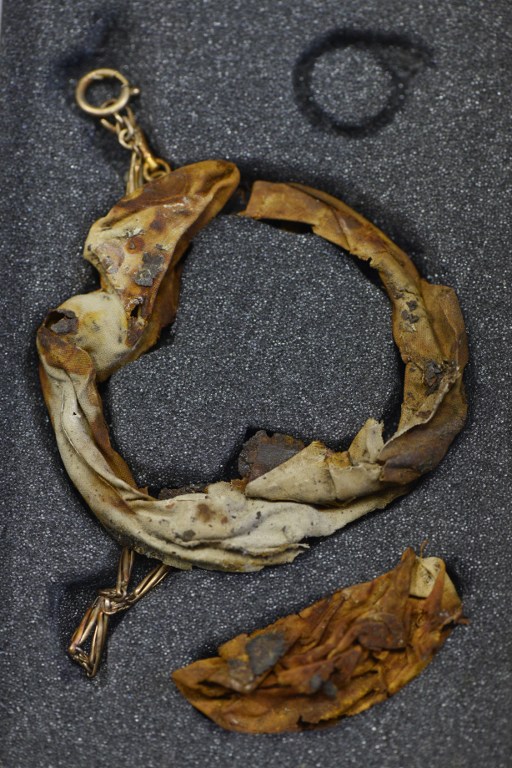
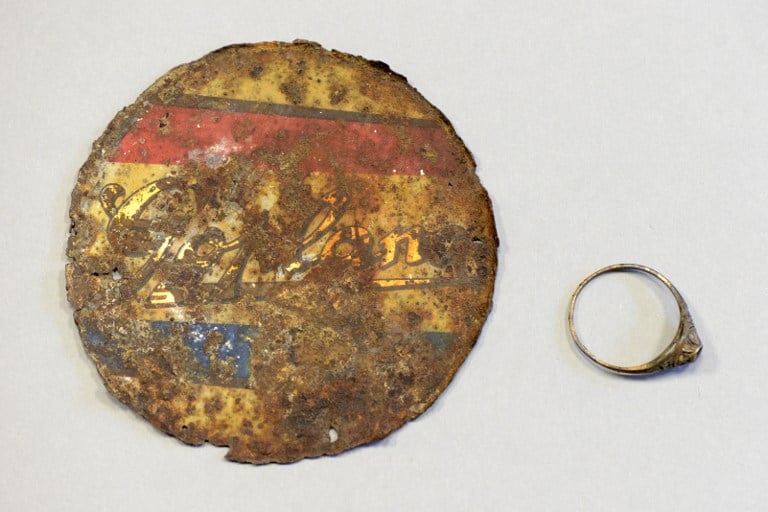
Inside the false bottom, the staffers discovered a women’s gold ring and a gold chain. Both items were tested and the lab determined, based on the properties of the gold, that they were likely made in Poland between 1921 and 1931.
“The hiding of valuable items — repeatedly mentioned in the accounts of survivors, and which was the reason for ripping and careful search of clothes and suitcases in the warehouse for looted items — proves on the one hand the awareness of the victims as to the robbery nature of the deportation, but on the other hand it shows that the Jewish families constantly had a ray of hope that these items will be required for their future existence,” Piotr Cywinski, director of Auschwitz Museum, said in the statement.
A gold necklace that was found by curators of Auschwitz – Birkenau Museum in a metal mug with double bottom is pictured on May 19, 2016 in Oswiecim. (Bartosz Sidlik/AFP)
The jewelry found in the mug will be displayed in a form reflecting the manner in which it had been hidden by the owner, the museum said.
Get The Times of Israel's Daily Editionby email and never miss our top stories
The Collections of the Memorial features more than 12,000 enameled kitchenware items, including cups, pots, bowls, kettles and jugs.
A gold ring that was found by curators of Auschwitz – Birkenau Museum in a metal mug with double bottom is pictured on May 19, 2016 in Oswiecim. (Bartosz Siedlik/AFP)
Animal lovers, this one's for you
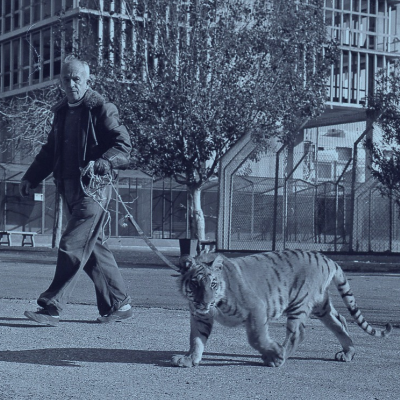
In 1935, Rabbi Max Shorenstein left Denmark to pursue his lifelong dream: building a zoo in Tel Aviv and teaching children to love animals. The Tel Aviv Zoo became one of the city’s greatest attractions, but envy, greed, and corruption drove Shorenstein from the paradise he created.
The film 'There Are No Lions in Tel Aviv' is available to screen November 19-26 for members of our reader support group, The Times of Israel Community. Join the Community todayto support our work and watch our DocuNation series of outstanding Israeli documentary films.
We’re really pleased that you’ve read X Times of Israel articles in the past month.
That’s why we started the Times of Israel - to provide discerning readers like you with must-read coverage of Israel and the Jewish world.
So now we have a request. Unlike other news outlets, we haven’t put up a paywall. But as the journalism we do is costly, we invite readers for whom The Times of Israel has become important to help support our work by joining The Times of Israel Community.
For as little as $6 a month you can help support our quality journalism while enjoying The Times of Israel AD-FREE, as well as accessing exclusive content available only to Times of Israel Community members.
Thank you, David Horovitz, Founding Editor of The Times of Israel


 Add ToI as a Preferred Source on Google