

Despite Egyptian operation, Hamas still producing rockets
Senior Israeli official warns that Gaza’s Islamist rulers can build tunnels without cement, as Egypt prepares to create 1,500 meter wide buffer zone along Rafah border

 Add ToI as a Preferred Source on Google
Avi Issacharoff, The Times of Israel's Middle East analyst, fills the same role for Walla, the leading portal in Israel. He is also a guest commentator on many different radio shows and current affairs programs on television. Until 2012, he was a reporter and commentator on Arab affairs for the Haaretz newspaper. He also lectures on modern Palestinian history at Tel Aviv University, and is currently writing a script for an action-drama series for the Israeli satellite Television "YES." Born in Jerusalem, he graduated cum laude from Ben Gurion University with a B.A. in Middle Eastern studies and then earned his M.A. from Tel Aviv University on the same subject, also cum laude. A fluent Arabic speaker, Avi was the Middle East Affairs correspondent for Israeli Public Radio covering the Israeli-Palestinian conflict, the war in Iraq and the Arab countries between the years 2003-2006. Avi directed and edited short documentary films on Israeli television programs dealing with the Middle East. In 2002 he won the "best reporter" award for the "Israel Radio” for his coverage of the second intifada. In 2004, together with Amos Harel, he wrote "The Seventh War - How we won and why we lost the war with the Palestinians." A year later the book won an award from the Institute for Strategic Studies for containing the best research on security affairs in Israel. In 2008, Issacharoff and Harel published their second book, entitled "34 Days - The Story of the Second Lebanon War," which won the same prize.
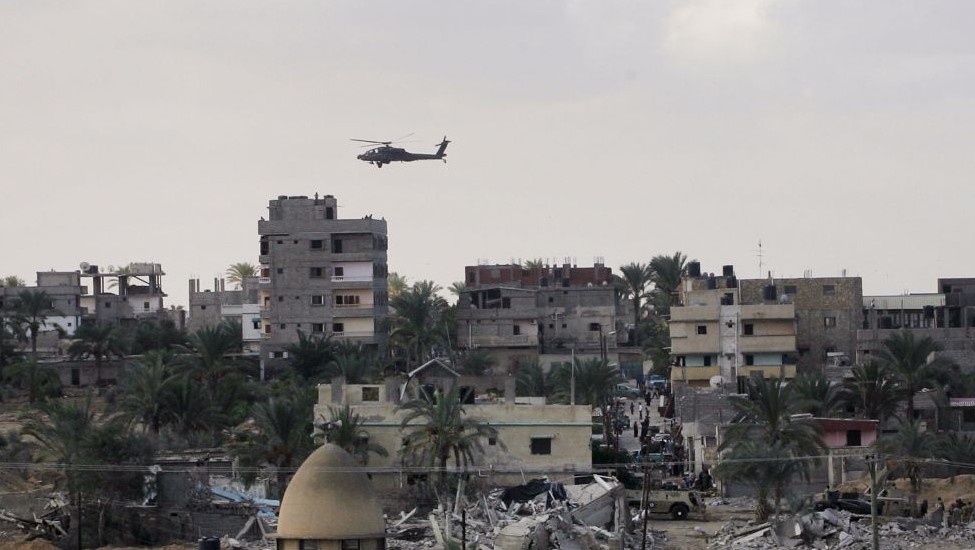
Despite intensified Egyptian efforts to eliminate the smuggling of weapon components from the Sinai Peninsula into the Gaza Strip, Hamas is still producing rockets, a senior Israeli official told The Times of Israel.
The source said that Egyptian counter-terrorism activities have drastically improved recently, including in the intelligence realm, which had been a major problem for Cairo. He added that the Egyptians are preventing the smuggling of dual-use materials that can be used in building rockets, such as metal pipes and fertilizer, into the Sinai and Gaza — tightening controls on the Egyptian borders with Sudan and Libya.
Still, Hamas recently renewed its rocket production in Gaza, albeit at a slower rate, especially mid-range rockets.
In addition, Israel also knows that Hamas is working hard to rehabilitate its tunnel network, both defensive tunnels inside Gaza and the cross-border attack tunnels destroyed by Israel. An embargo on building materials cannot solve problem entirely. The source said that, in the past, Hamas has used tunnels without cement and concrete, as it did in the kidnapping of IDF soldier Gilad Shalit in 2006. But it is evident that at this stage, the organization is being very wary about digging tunnels that go into Israel, the official said.
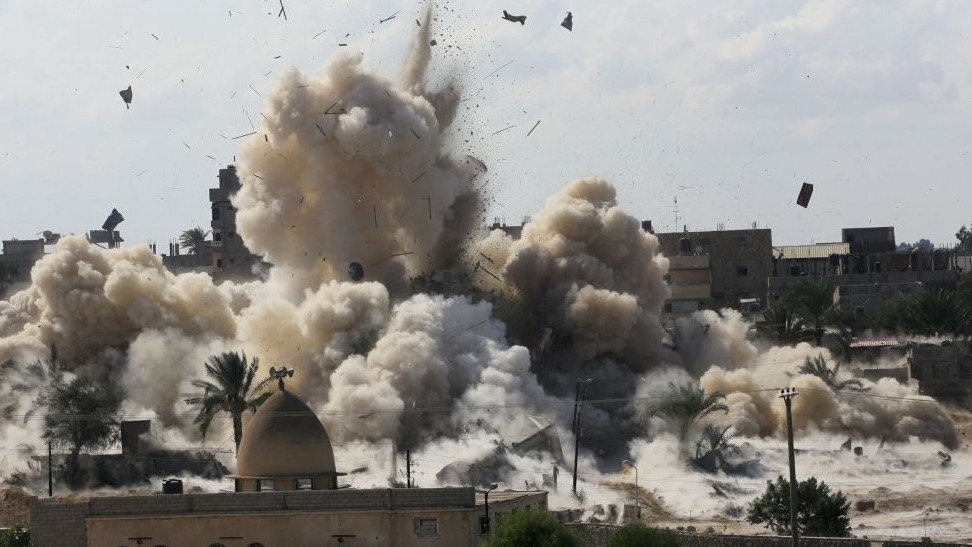
On Wednesday, with dynamite and bulldozers, Egypt’s army demolished dozens of homes along its border with the Gaza Strip, after the military ordered residents out to make way for a planned buffer zone meant to stop militants and smugglers.
The Egyptian operation had been planned at least three months in advance, said the source. Cairo received Israel’s approval to introduce special forces, attack helicopters, tanks, and armored vehicles, into the Sinai. In all, Egypt now has 11 battalions inside the peninsula.
The Egyptians and Israelis have intelligence that terror operatives from Ansar Bayt al-Maqdis, the organization responsible for a number of serious attacks against the Egyptian Army, are being helped by known Hamas operatives.
In addition, there is a permanent presence of Ansar Bayt al-Maqdis terrorists, who are helping Sinai jihadists from within the Gaza Strip, providing them with weapons and training.
The move to set up the planned 13-kilometer (8-mile) buffer zone, which will be 1,500 meters (yards) wide, comes after militants attacked an army checkpoint near Sheikh Zuweyid town last week, killing 31 soldiers. No group claimed responsibility.
The corridor will eventually be monitored by surveillance cameras, and feature a water-filled trench that will be 40 meters wide, 20 meters deep and run all along the border to the Mediterranean Sea, officials said.
The majority of the border area’s population is found in Rafah, a city that was split into two halves — one Palestinian and one Egyptian — after Egypt signed the Camp David accord with Israel in 1978. Plans to create a buffer zone along the Gaza border started after the Palestinian militant group Hamas seized the territory in 2007. Hamas used the tunnels as a way to escape an Israeli-Egyptian blockade imposed on Gaza.
Over the past decade, the northern region of the Sinai Peninsula has become a hub for Islamic extremists, although insurgency has spiked since last year’s military ouster of Islamist president Mohammed Morsi. It has also spread to other parts of Egypt, with militants targeting police in Cairo and the Nile Delta.
According to Egyptian estimates, there are still several thousand jihadists in the Sinai.
AP contributed to this report.








The Times of Israel Community.