

Hamas arrests Gaza merchants for refusing to sell lumber for tunnels
Israel charges Palestinian engineer with smuggling communication equipment into the Strip for use in underground passageways

 Add ToI as a Preferred Source on Google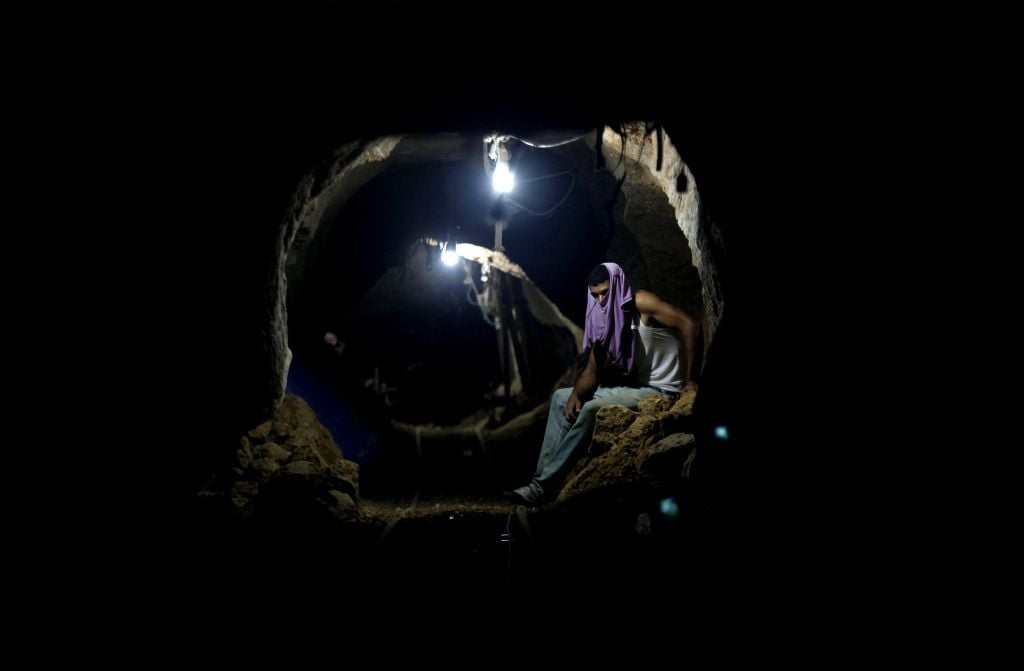
Hamas security forces recently arrested a group of lumber dealers in a Gaza refugee camp after they refused to sell the group wooden beams out of concern they’d be used in the reconstruction of the group’s attack tunnels.
Concerned they’d be accused of collaborating with the terror organization, the retailers refused the sale, resulting in their arrest by Hamas forces.
It wasn’t immediately clear when the arrests took place.
The Coordinator of the Government Activities in the Territories, Maj. Gen. Yoav Mordechai, recently banned the entry of certain types of wood into Gaza after officials said it was being used to reinforce terror tunnels.
On Thursday in a separate incident, Israel charged a Palestinian engineer with smuggling communication equipment from Egypt into the Gaza Strip for Hamas.
According to the indictment filed at the Beersheba District Court, the engineer knew the terror organization intended to use the equipment in its tunnels. Israel Radio reported that the engineer was caught with sensitive communication equipment, including a number of recording devices.
In March, Israeli defense officials said they believed Hamas had managed to dig several tunnels to be used for attacks near the Israeli border in the seven months since the end of Operation Protective Edge.
According to unnamed sources, Hamas has invested considerable effort in digging a new tunnel network within the coastal enclave, as well as several tunnels meant for eventual cross-border attacks.
But according to the security sources, the terror organization is careful to avoid crossing into Israeli soil, in order to avoid an eruption of hostilities.
The evidence of digging can be seen from the Israeli side of the border, and Israeli residents on the Gaza periphery have documented the construction some several hundred meters from the border.
The Islamic Jihad and Hamas terror groups have released videos in the past months in which members are seen working in the tunnels and traveling freely through them.
But the security sources maintained that only a few attack tunnels are being dug, rather than the dozens that were operational immediately before the summer conflict and during it.
According to Israeli accounts, more than 30 tunnels were operational inside Gaza, and most of them extended into Israel, before the bloody summer conflict.
Currently, there are no known tunnels extending under the border into Israel’s territory, and the assessment is that Hamas stopped digging some distance away from the Israeli side to prevent IDF strikes.
It’s possible that some of the tunnels destroyed during the Gaza war are being reconstructed, the sources said.
The attack tunnels extending into Israeli territory prompted an Israeli ground invasion into Gaza during Operation Protective Edge, which began in July and lasted for 50 days.
Destroying the tunnel threat was one of Israel’s goals during the summer’s military campaign, which saw over 2,100 people killed in Gaza and tens of thousands more left homeless, according to Palestinian and UN tallies, and 72 people killed in Israel.
Israel says half of the dead were fighters and blames Hamas, which situated much of its attack apparatus in residential areas, for all civilian deaths. During the operation, Gazan gunmen carried out several tunnel raids into Israel, killing 11 Israeli soldiers.
Reconstruction efforts in Gaza have been slowed over a lack of international funds and Israeli restrictions on certain building materials, over fears they could be used to rebuild Gaza’s military infrastructure.
The security sources said due to the strict Israeli inspections of building materials entering the coastal enclave, Hamas is investing less in concrete and cement-lined tunnels, and is accelerating the construction using other materials, similar to tunnels in the southern Gaza Strip between the Palestinian Rafah and Egyptian Rafah.
The sources added that tunnel construction near the Egyptian border has almost entirely ceased due to Egypt’s aggressive crackdown on the Hamas-run Strip.










The Times of Israel Community.