

House on fire
A coalition crisis is waiting in the wings as the Knesset gears up for its winter session; EU sketches ‘red lines’ in West Bank
 Add ToI as a Preferred Source on Google
Ilan Ben Zion is an AFP reporter and a former news editor at The Times of Israel.
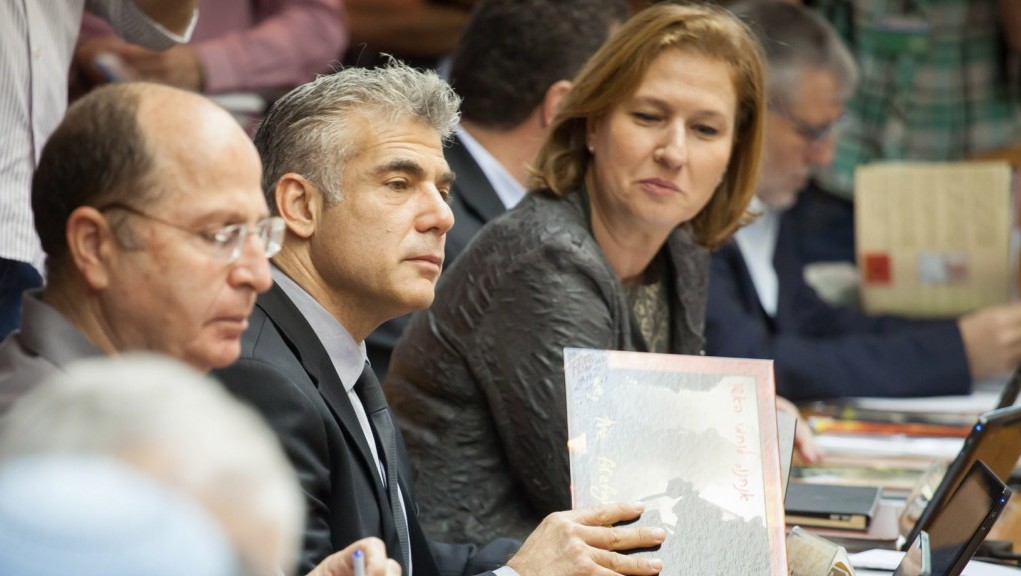
A coalition crisis captures the front pages ahead of the opening of the Knesset’s winter session on Sunday. The question remains: Will Israel’s government fall apart amid irreconcilable differences, resulting in snap elections?
“The last thing we need right now is elections, that’s the last thing the people of Israel need right now,” Prime Minister Benjamin Netanyahu is quoted in Israel Hayom saying Tuesday. The paper reports that Netanyahu is scheduled to meet with the heads of the various coalition parties, namely, Finance Minister Yair Lapid, Foreign Minister Avigdor Liberman, Justice Minister Tzipi Livni and Economy Minister Naftali Bennett, on Wednesday. The meeting aims “to agree upon a way to cooperate ahead of the opening of the [Knesset] winter session,” Israel Hayom says.
The real issue at hand, writes Yedioth Ahronoth, is outrage in the coalition over Netanyahu’s withdrawal of support for a bill to amend the legal standing of conversion to Judaism. The purpose of Wednesday’s meeting is to calm tensions in the government.
One member of the Jewish Home party charged that “Netanyahu shot down the conversion reforms in order to suck up to the ultra-Orthodox.”
“He decided to bury the decision in the government for reforming conversion as well as the law in the Knesset,” the senior Jewish Home party official is quoted saying.
Haaretz quotes members of the Likud party saying that “Netanyahu warned in recent days that the coalition is on the verge of collapse and that the government won’t be able to hold out more than a few months.” The paper notes that Netanyahu has been working toward advancing internal Likud elections, as well as forging new alliances ahead of a possible breakdown of the government. His rejection of conversion reform, the paper points out, may be to curry favor with the ultra-Orthodox parties in the Knesset at the expense of the secular moderates such as Yesh Atid and Hatnua.
No longer bros with Bennett, Lapid has found a new ally in Livni, Yedioth Ahronoth reports. According to Livni, “In the Knesset session that begins next week we’ll form single front in the government and in the Knesset on the diplomatic issue, a single bloc, 25 seats.”
“Together in favor of a diplomatic solution, together against ‘Danny Danon-ism’ and against nationalist [fervor]. Also on the issues of religion and state we’ll join forces,” the Hatnua party leader tells the paper. Lapid, in turn, tells Yedioth Ahronoth that the Yesh Atid and Hatnua parties are in “very close cooperation on these two issues,” and adds that on the issue of religion and state they also have the allegiance of Liberman’s Yisrael Beytenu party.
Israel Hayom, however, downplays the significance of the coalition tension over the conversion reform advanced by Livni’s party, reporting that “despite the Hatnua [party] criticism of Netanyahu’s decision” — which it said was to turn down the reform “at this stage” — “even this issue… won’t bring about the breakdown of the coalition.”
Outside the confines of coalition politics, the Israeli media reports on the selection of Jerusalem’s new chief rabbis, a mother’s response to her daughter’s death in Nepal, and tensions between Israel and the European Union over the West Bank.
Haaretz reports that the EU is interested in talks with Israel to prevent unilateral actions in the West Bank that it considers “red lines” which may endanger the formation of an independent Palestinian state. Among the stated red lines are construction in Givat Hamatos, over the Green Line in Jerusalem, which would jeopardize the contiguity of a Palestinian state; construction in E1, for the same reason; construction in Har Homa, also over the Green Line in Jerusalem; relocation of 12,000 Bedouin from the Jordan Valley, and changing the Temple Mount’s status quo. There’s no clear consensus on what repercussions would be levied in case of Israel’s violation of said limitations.
Yedioth Ahronoth interviews the mother of Tamar Ariel, one of the Israelis killed in an avalanche in Nepal and the first religious woman to serve as a combat navigator in the air force.
“It amazes me that she flew planes, raced on dirt bikes, drove all the most dangerous vehicles, and from a not-so-dangerous trek she didn’t return,” Ariel’s mother, Anat, says in a weekend interview with the paper previewed on Wednesday. “Evidently that’s something that needed to happen. I don’t believe that I am saying this, but Tamar touched so many people, and apparently she fulfilled her mission here.”
Israel Hayom reports that an unnamed electoral body selected the two new chief rabbis of Jerusalem — a post that’s regarded as the most prestigious after the chief rabbi of the State of Israel. Rabbi Aryeh Stern was chosen chief Ashkenazi rabbi and Rabbi Shlomo Moshe Amar the chief Sephardi rabbi.









The Times of Israel Community.