

Netanyahu welcomes Temple Mount video surveillance
Jordan, Israel both insist cameras will show which side violates status quo; Jordanian king praises PM’s ‘worthy commitment’
 Add ToI as a Preferred Source on Google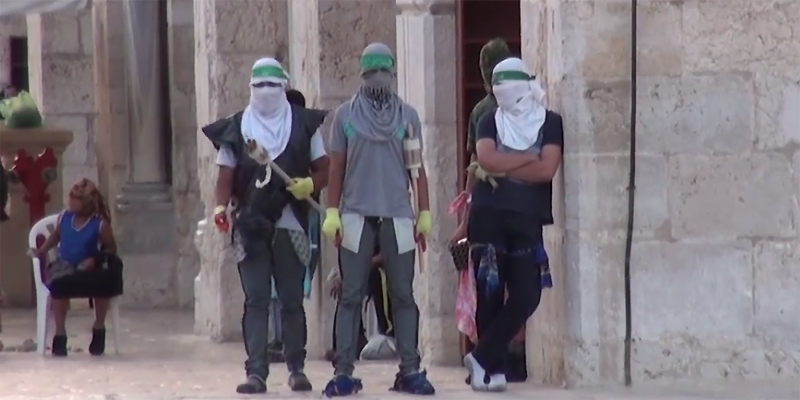
Prime Minister Benjamin Netanyahu on Sunday defended a US-brokered plan to install video surveillance at Jerusalem’s Temple Mount holy site, saying it could help refute claims that Israel is trying to expand the Jewish presence there, while Palestinians said they feared the cameras would be used to spy on and arrest people.
The conflicting statements reflected the tough path ahead for the US as it seeks to quell a monthlong wave of violence. The surveillance system is the centerpiece of a series of steps announced by US Secretary of State John Kerry over the weekend.
The violence has been fueled by Palestinian allegations that Israel is trying to alter a delicate arrangement at the holy site — a charge that Israel denies. The site is revered by Jews as the Temple Mount, the holiest site in Judaism and home to the biblical Jewish Temples. Today, it is home to the Al-Aqsa Mosque compound, the third-holiest site in Islam.
Speaking to the cabinet, Netanyahu said Israel has no plans to change the longstanding status quo at the site, where Jews are allowed to visit but not pray.
“The Temple Mount will be managed as it has been until now. The visits by Jews to the Temple Mount will be maintained, there will be no change, as with the prayer arrangements for the Muslims,” he said. “Israel has an interest in placing cameras around the Temple Mount” to counter the Palestinian claim that it is altering the status quo.
After days of meetings with Israeli and Arab leaders, US Secretary of State John Kerry announced Saturday that Israel and Jordan, the custodian of the holy site, agreed to a series of steps, including the video surveillance, to halt the violence.
Jordan’s King Abdullah said Sunday that he hopes Israel will respect its commitments to ensure that the status quo is not violated on the Temple Mount. “I followed the statements made by Israeli Prime Minister Benjamin Netanyahu who reiterated that he respects the status quo on the Temple Mount,” the king said. “This is a worthy commitment, provided that it is implemented on the ground.”
On Saturday, US Secretary of State John Kerry lauded the idea of placing round-the-clock surveillance cameras on the Temple Mount as a means of ensuring calm at the holy site.
On Sunday, Netanyahu vowed once again to leave the status quo on the Temple Mount in place, with Muslim prayer and non-Muslim visits guaranteed. He said the cameras would help dispel accusations that Israel was breaking the status quo, and expressed hope it would help calm the region.
In a late-night announcement, Netanyahu said he recognized the “special role” of Jordan at the site, and welcomed the “increased coordination” with the Jordanians.
But many key questions remain — including when the system will go into effect and who will do the monitoring. Israeli police already maintain hundreds of security cameras in Jerusalem’s Old City.
Palestinian official Saeb Erekat said Netanyahu was lying about his commitment to maintain calm. “Netanyahu wants the video cameras just to track our people and arrest them,” he told the Voice of Palestine radio station.
Azzam Khatib, director of the Jordanian Waqf, the religious body that runs the site, said the footage would be streamed on the Internet “so the world would see what is going on inside al-Aqsa.”
But a Jordanian intelligence official, speaking on condition of anonymity because he was not authorized to discuss the issue with reporters, said the arrangements announced by Kerry have not yet been discussed in detail.
The compound, known to Muslims as the Noble Sanctuary, is both a religious and national symbol for the Palestinians. The competing claims to the site lie at the heart of the Israeli-Palestinian conflict and have triggered violence in the past.
The latest unrest began in mid-September after Palestinian and Israeli Arab leaders and activists accused Israel of plotting to take over the site. Such accusations have been fueled by visits to the compound by right-wing Jewish groups seeking prayer rights, which are backed by far-right ministers.
Clashes repeatedly erupted between Palestinian protesters hurling rocks and firebombs and Israeli police, who responded with stun grenades. The violence quickly spread across Israel and into the West Bank and Gaza.
In the past five weeks, 10 Israelis have been killed in Palestinian terror attacks, mostly stabbings. Israel counts 28 Palestinian attackers who were killed in these attacks. According to Palestinian figures, 21 Palestinians have been killed by Israeli fire in clashes between Palestinian protesters and Israeli security forces.
On Sunday, two Palestinians disguised as ultra-Orthodox Jews stabbed an Israeli in the West Bank, wounding him moderately, the IDF said. The Israeli man shot at the attackers, who fled the scene.
Israel has accused Palestinian political and religious leaders of spreading lies about changes on the Temple Mount and inciting violence. Palestinians say the violence is the result of nearly 50 years of occupation and a lack of a political horizon toward statehood.
In his comments Saturday, Kerry gave little indication that he plans to address these deeper issues. Kerry had previously engaged in months of shuttle diplomacy aimed at reviving talks on a final peace deal, but those efforts collapsed in the spring of 2014.
Israel captured the Temple Mount from Jordan in the 1967 Six Day War. But under a decades-old agreement between Israel and Jordanian authorities, Jordan maintains custodial rights over the Muslim holy sites through an organization called the Waqf, and since signing a peace treaty with Israel in 1994, has often served as a mediator. When similar tensions erupted last year at the same site, Jordan briefly withdrew its ambassador from Israel and tensions subsequently abated.







The Times of Israel Community.