

Opposition calls emergency meeting in defense of democracy
Parties reject plans to raise elections threshold, accuse brand new government of bullying
 Add ToI as a Preferred Source on Google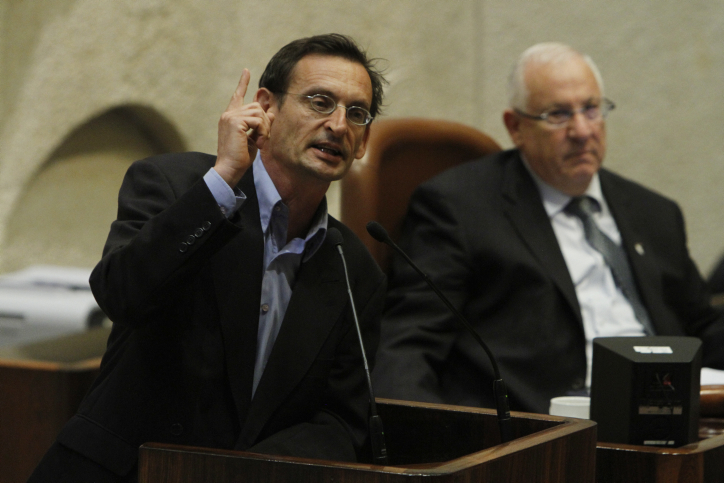
Hours after the 33rd government was sworn in Monday, Israel’s opposition members announced an “emergency meeting” Tuesday aimed at battling “dangerous” new legislation expected to be passed by the nascent coalition.
An invitation sent to opposition MKs said the new government “is starting out with a series of dangerous anti-democratic moves.” The letter cited the raising of the minimum threshold for parties in national elections from 2% to 4%, the demand for a special 65-MK vote to topple a sitting government, and the re-submission of several “anti-democratic bills” as signs indicating where the new coalition is headed.
“Increasing the threshold for parties to 4% endangers democracy. It is not the small parties who threaten the stability of the political system, it is not the small parties that hold corrupt primary races, and it is not the small parties who bring in people void of ideology and principals,” said Hadash MK Dov Hanin. “The ‘new politics’ embodied by [Naftali] Bennett and [Yair] Lapid is a politics of bullying and oppressing of minorities.”
“Joint action by the opposition on the government’s first day in power is a good sign as to our ability to produce a joint agenda and battle for Israel’s democracy,” Hanin added.
“We will not allow the government to act aggressively and act against the rules of the Knesset,” United Torah Judaism MK Moshe Gafni said. “We have already succeeded in thwarting the rapid passing of the budget, allowing us more time to debate it. We will continue battling for these principles. Today’s meeting signifies the continuation of the battle.”
“We are initiating a battle for Israel’s democracy before it is too late. Anyone worried about Israel’s democratic character must stand up, issue a warning and join our fight,” said Labor Party MK Nachman Shai.
The Knesset’s new opposition, led by Labor, is made up of 52 MKs from Labor, Meretz, Kadima, Shas, UTJ and the three Arab parties. Raising the electoral threshold would force some of the parties to join forces ahead of the next coalition to ensure they keep their representation at the Knesset. All three Arab parties and Kadima polled less than 4% nationwide, and would have disappeared in the January 22 elections if the threshold had been set at that level.
Six weeks of negotiations following the elections resulted in a 68-member-strong coalition led by Benjamin Netanyahu and made up of four parties: the joint Likud-Beytenu list with 31 Knesset seats, Yesh Atid with 19, Jewish Home with 12 and Hatnua with six. It won the support of the Knesset on Monday by 68-48, with four abstentions.
The opposition will be led by Labor chairwoman Shelly Yachimovich, as the head of the largest party with 15 seats.
At the swearing-in ceremony Monday, Yachimovich wished the new government luck, but noted bitterly: “This is an unrestrained, capitalistic government. It will not lead us to a diplomatic breakthrough or to any sort of relief.”



The Times of Israel Community.