

Pointing the finger
Comments by the UN secretary general have tabloids up in arms, while an annual intelligence report provides cannon fodder on threats facing Israel
 Add ToI as a Preferred Source on Google
Raoul Wootliff is a former Times of Israel political correspondent and Daily Briefing podcast producer.
In recent weeks some lawmakers, responding to perceived unfair attacks and punitive measures against Israel, have proposed a series of bills aimed at giving the accusers a taste of their own medicine.
In an attempt to highlight — or maybe just to punish — what they see as discrimination by the BDS movement, the initiators of the EU’s West Bank labeling guidelines and left-wing NGOs, some Knesset members have decided to fight fire with fire: boycotting the boycotters, labeling the labelers and breaking and silencing Breaking the Silence.
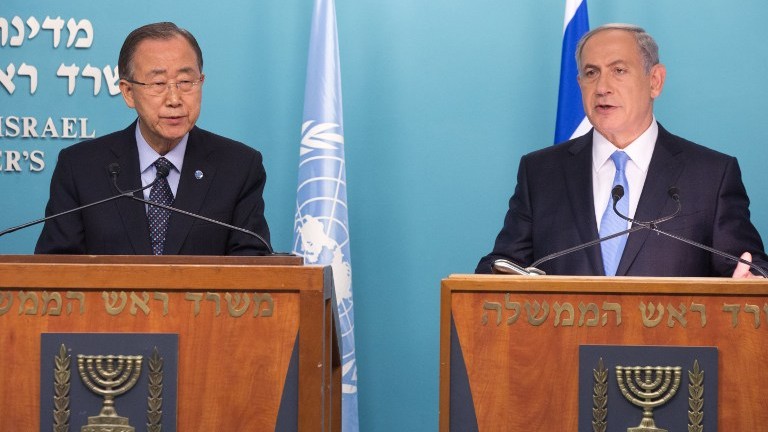
Wednesday’s tabloids seem to employ the same approach to express their outrage at comments made by UN secretary General Ban ki-Moon blaming Israel and occupation for the recent wave of stabbing attacks.
“As oppressed peoples have demonstrated throughout the ages, it is human nature to react to occupation, which often serves as a potent incubator of hate and extremism,” Ban told a session of the UN Security Council Tuesday.
Attacking the attacker, Yedioth Aharonoth shouts, “The chutzpa of the Secretary,” from its front page next to a smug looking photo of Ban
Blaming the blamer, Israel Hayom runs as its front page headline Prime Minister Benjamin Netanyahu’s salient response: “The secretary general is encouraging terror.”
In another possible accusatory effort, the two papers both run their headlines next to the smiling face of Shlomit Krigman, who died Tuesday of wounds she sustained in a stabbing attack a day earlier.
Inside the paper on the page two-to-three spread, Israel Hayom continues to juxtapose the two stories, running reports on Krigman’s funeral and accounts of her before he death alongside Israeli responses to Ban’s speech.
Yedioth does the same on pages four and five, using the earlier and more prominent pages to instead highlight the plight of Holocaust survivors living in Israel under poverty, to coincide with International Holocaust Remembrance Day.
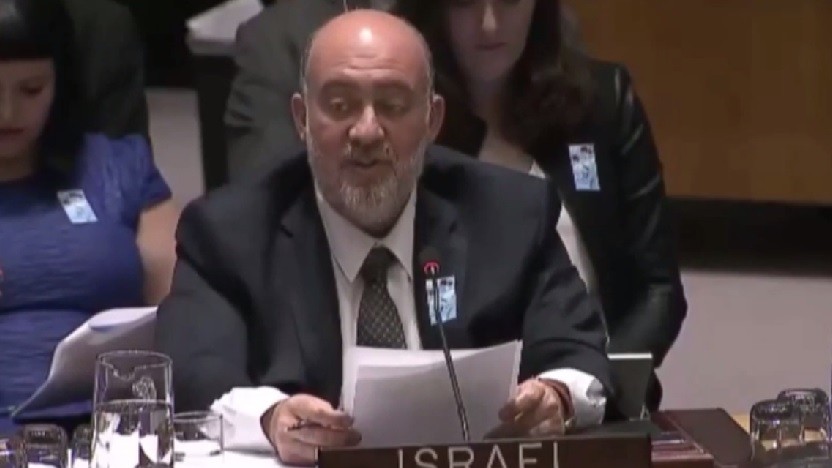
To respond to Ban, Yedioth enlists the help of Ron Prosor, former Israeli ambassador the UN, who gives a damming assessment of the institution and the man at its helm.
“The UN has previously crossed many red lines when it comes to Israel, but this time I think it has reached new heights.” He writes. “It is time for the UN to start acting responsibly and put an end to Palestinian incitement instead of fanning its flames.
Haaretz however, in the austere manner of a serious broadsheet, and perhaps in the absence of the same sense of shock at Ban’s words, is not overexcited. The paper dedicates a brief front page summary of Ban’s speech and Netanyahu’s response, freeing up the rest of the paper for other, less sensational issues.
The annual intelligence assessment of the IDF’s Intelligence Branch features prominently in Wednesday’s papers, with some taking various aspects of the report to focus on different security threats facing Israel.
For Israel Hayom the important revelations in the report are that ISIS will eventually turn its attentions to Israel, and that the next conflict with Hezbollah will be on a larger and more destructive scale than previous ones.
“Planes will fall, the airport will close,” reads the ominous headline on the report.
“Naval vessels could be targeted, planes could be shot down and Ben-Gurion International Airport will possibly be closed. IDF officials said the army has the ability to ‘hit hard’ at anyone who targets Israel, but that no one should think the army can finish the next round of fighting in a matter of 48 hours,” reports the paper’s military correspondent, Lilach Shoval.
Military analyst Yoav Limor is similarly pessimistic.
“Rather than having a clear, square board with known black and white pieces moving across it, we are dealing with a round, multicolored board, with myriad pieces going in all directions,” he writes.
Summarizing the report in Yedioth Ahronoth, Alex Fishman says “the destruction of IS in Syria could leave the Hezbollah-Iran-Syria axis stronger, and with its eyes on Israel.”
For Haaretz, the report’s assessment of the situation in the West Bank takes center stage.
“The Israeli army believes that there is a great potential for escalation in the West Bank in the absence of steps to ease tensions – whether by means of an economic improvement in the Palestinian Authority or close cooperation with the Palestinian security services,” writes military correspondent Gili Cohen.
The paper’s military analyst, Amos Harel, says the report “brings into sharp relief the gaps between Israel’s official position as reflected by statements from Prime Minister Benjamin Netanyahu and others, and the analysis of experts.
“While the prime minister emphasizes the issue of incitement, and continues to make accusations against Palestinian Authority President Mahmoud Abbas, the Israel Defense Forces focuses on other aspects of reality in the West Bank,” he says.
Harel concludes by lauding the military officials for standing their ground and in doing so points a finger of his own at another perceived threat.
“It is encouraging to see the army continue to present professional positions, without toeing the line of politicians’ expectations. The need to preserve the independence of the expert opinions of security officials is a lesson Israel had seared into it in past experiences. The question is whether this independence can be maintained for long even under the current circumstances,” he writes.







The Times of Israel Community.