

Qatar: American friend, Israeli foe
By working closely with Hamas-championing Qatar on the Gaza conflict, the US has sent Israel the wrong message, says American expert
 Add ToI as a Preferred Source on Google
Elhanan Miller is the former Arab affairs reporter for The Times of Israel
America’s close relations with Qatar are undermining its bid to broker a credible ceasefire in Gaza and eroding trust with Israel, experts told The Times of Israel.
Irrespective of the veracity of a Channel 1 leak quoting US President Barack Obama’s phone conversation with Israeli Prime Minister Benjamin Netanyahu on Sunday, in which Obama supposedly said he trusted Qatar and Turkey to pressure Hamas into a ceasefire after Israel suspended its military operation in Gaza (both Israel and the US denied the accuracy of the story), ties between the US and the tiny Gulf state seem closer than ever before.
This 40-year-old relationship, said Lori Plotkin Boghardt, a fellow in Gulf politics at the Washington Institute for Near East Policy, serves the two countries’ fundamental strategic interests.
“The US gets a relatively friendly base from which to pursue regional security policies; and Qatar receives the basic security of its small state, sandwiched between larger neighbors Saudi Arabia and Iran,” she told The Times of Israel.
While there are many differences between the US and Qatar, she added, “their strategic partnership almost always overrides these.” In fact, Qatar’s closeness with “unpalatable” regional actors such as Hamas is actually viewed in Washington as advantageous in helping to achieve certain objectives, like a ceasefire in Gaza.

Qatar maintains close security links with the US, hosting the Central Command’s Forward Headquarters. But the “icing on the cake” of the relationship, as Plotkin Boghardt put it, is an $11 billion arms deal signed in mid July and providing Qatar with state-of-the-art American attack helicopters and air defense systems.
And yet, for those seeking proof of Qatar’s closeness with Hamas — sworn enemy of what is supposed to be the US’s key ally in the region, Israel — one need only watch the high-profile TV interviews given by Qatari Foreign Minister Khaled al-Attiyah over the past few days.
On Saturday, Attiyah told his country’s mouthpiece Al-Jazeera that Israel has left the people of Gaza no choice but to “resist and defend themselves.”
“Gaza faces two types of death,” he said. “Either slow death through siege and starvation or fast death by bullets.”
The Palestinian requests, Attiyah continued — citing Hamas preconditions for a ceasefire, including the complete removal of the Israeli blockade and the construction of a seaport — are not only “just” but also “the bare minimum for a respectable life.” In an interview with CNN, he said that “Israel never leveraged the pragmatic approach of Hamas.”
Hamas is formally committed to the destruction of Israel. Israel has maintained a security blockade of Gaza in large part in order to prevent the smuggling in to the Strip of missiles and other material for use in Hamas’s war efforts against Israel. After US Secretary of State John Kerry on Friday conveyed a ceasefire document to Israel reflecting Qatari input, on Hamas’s behalf, and providing for an easing of access to Gaza, the Israeli security cabinet voted 8-0 to reject it, and government sources leaked bitter criticism of Kerry for having capitulated to Hamas.
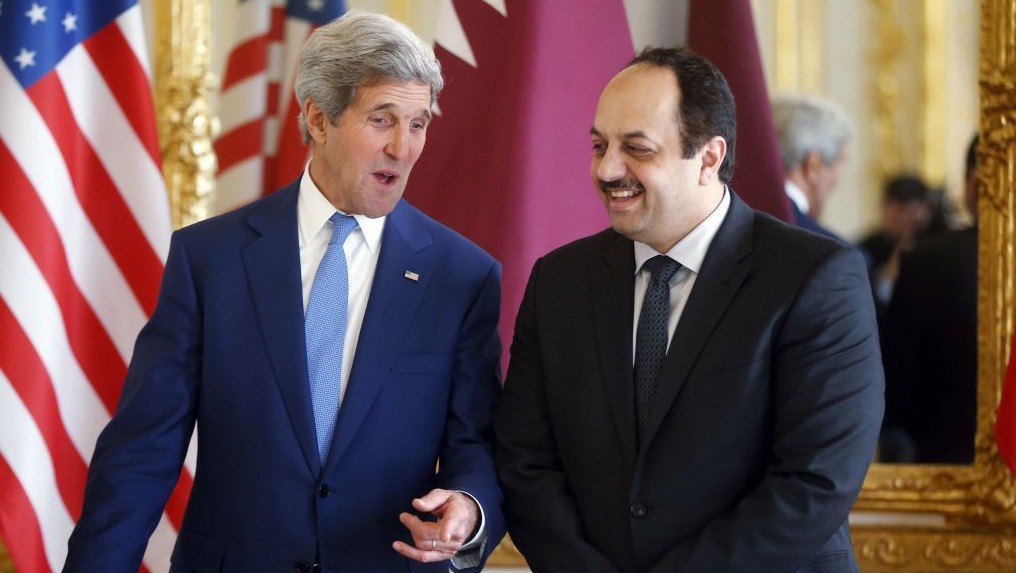
On Saturday, Kerry met in Paris with the Qatari and Turkish foreign ministers, prompting more Israeli criticism. The episode created further strains in the already complex relationship between the Netanyahu government and the Obama administration. Subsequently, Kerry recommitted to the original Egyptian ceasefire proposal.
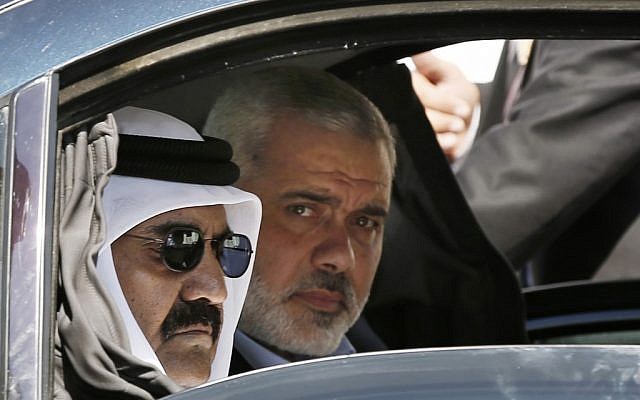
Though Attiyah insisted on CNN that “Qatar does not support Hamas, it supports the Palestinians,” a Western source close to the Qatari regime told The Times of Israel that a ceasefire draft presented by Qatar to Mahmoud Abbas earlier this month “had Hamas’s handwriting all over it.” The source added that “Qatar is clearly biased toward Hamas over Fatah.”
For Israel, Qatar’s Hamas favoritism is irrefutable. Yaakov Amidror, a former national security adviser, told The Times of Israel that Hamas currently considers Qatar one of its closest allies, alongside Turkey and — to a lesser extent — Iran. While the US has blocked the transfer of Qatari money intended for Hamas salaries in Gaza, Qatar continues to fund the movement’s terror apparatus abroad, enabling tunnel digging and rocket launching.
Former president Shimon Peres charged last week that Qatar had been helping turn Gaza into “a center of death.”
While Israel emphatically does not want Qatar involved in talks over a ceasefire in Gaza, said Uzi Rabi, director of the Moshe Dayan Center at Tel Aviv University and an expert on the Arab Gulf, it may be faced with an American dictate to compromise.
“This places US-Israel relations in a tough spot,” Rabi told The Times of Israel.
Like Egypt, Qatar is viewed as a biased broker by some of the parties (namely, Israel and the PA) and is therefore limited in its effectiveness, he added.
“While the US is playing a less dominant role in the ceasefire efforts, the potential mediators are partial. Egypt and Qatar are not mediators in their essence,” Rabi said.
Still, Plotkin Boghardt of the Washington Institute noted that the heavy criticism from American allies in response to the Qatari track may cause Kerry to tread more carefully from now on when working with Qatar.
“Working closely with Qatar and other state supporters of Hamas on the Gaza conflict has obviously sent the wrong message to America’s strongest allies in the region, including Israel,” she said.








The Times of Israel Community.