

Taking Internet by storm, Iran stages diplomacy blitz
Tehran has latched onto Twitter and Facebook, launched refurbished news sites in bid to control flow of information
 Add ToI as a Preferred Source on Google
Ilan Ben Zion is an AFP reporter and a former news editor at The Times of Israel.
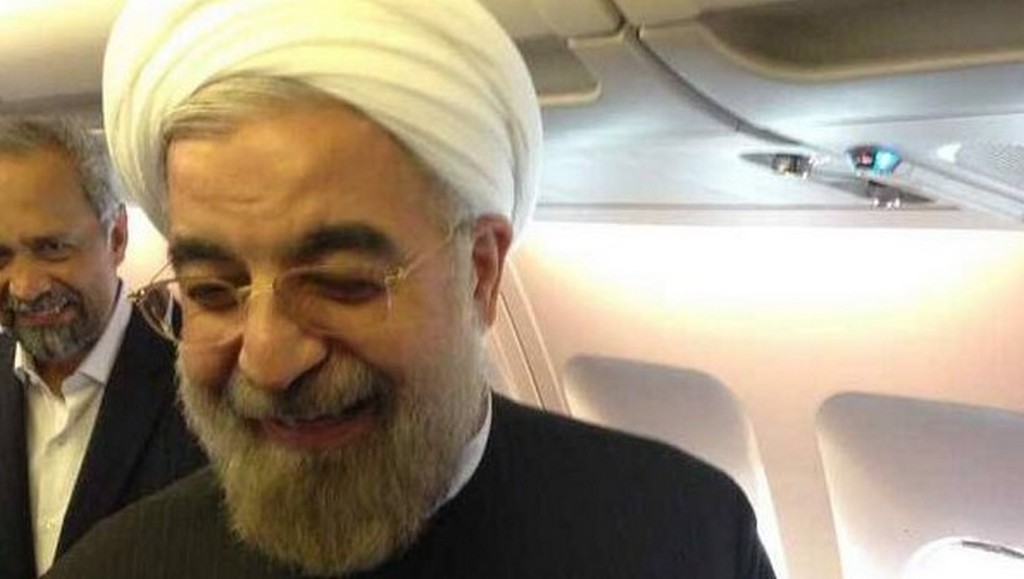
Protracted negotiations over Iran’s nuclear program ended early Sunday morning in Geneva with a momentous tweet by the head of Iran’s negotiation team, Foreign Minister Mohammad Javad Zarif: “We have reached an agreement.” Retweeted over 5,000 times, Zarif’s five-word statement on the microblogging site is part of a much broader public diplomacy campaign, designed by Tehran to present a fresh face to the West through new and conventional digital media.
We have reached an agreement.
— Javad Zarif (@JZarif) November 24, 2013
Iran’s much publicized so-called charm offensive kicked off earlier this fall with President Hassan Rouhani’s address before the United Nations General Assembly, interviews with American news outlets and an op-ed in The Washington Post. Away from the cameras, Tehran set out on a digital media blitz aimed at combating negative public opinion in the West. Just four years after authorities in Tehran shut down the microblogging site during the failed Green Revolution, its leaders now use Twitter and Facebook in an unprecedented fashion. Iranian news sites, long antiquated and neglected, have revamped their home pages and produce English content as never before.
Despite the official ban on Facebook and Twitter in the Islamic Republic, Supreme Leader Ayatollah Khamenei, Rouhani, Zarif and Deputy Foreign Minister Abbas Araqchi opened and have started to regularly use their accounts both in Persian and, perhaps more tellingly, English. Zarif more typically conveys messages to followers in Persian on his Facebook account.
Khamenei regularly tweets snippets from his speeches translated into English, publishes digital-image memes and even exhorts followers to go vote. Since opening his account in October 2010, the supreme leader’s staff has published tweets on his behalf just over 4,800 times, a large percentage of which were in English. Rouhani, Zarif and Araqchi (or their staffs) publicize remarks about the nuclear talks or other international issues on the social media platform.
Met w/ Dmitry @Rogozin, Deputy PM of #Russia, where we discussed further expansion & deepening of bilateral ties. pic.twitter.com/oK1UfM7I3V
— Hassan Rouhani (@HassanRouhani) November 23, 2013
The Iranian president’s perspicacity in this regard is evident. Examination of his Twitter feed shows that the president’s usage of the platform spiked during his visit to New York and in the days immediately following his speech to the UN. The campaign’s apparent success didn’t escape the watchful eye of Swedish Foreign Minister Carl Bildt, who noted Tehran’s embrace of digital media.
Iran has really embraced digital public diplomacy as it seeks to explain its nuclear activities to the world. http://t.co/KBnDsF2QfC
— Carl Bildt (@carlbildt) November 24, 2013
Iran’s state-controlled online media upgraded their English-language news sites and have started cranking out foreign-language coverage as never before. The official and semi-official Fars News Agency, Mehr News Agency, Tasnim News Agency and Islamic Republic News Agency have all rebranded themselves with sharp-looking new sites that are updated around the clock with content. The old sites, by comparison, looked like a prototypical webpage created around the time the dot-com bubble burst, and would only translate day-old content.
As talks in Geneva reached fever pitch earlier in November, and a deal between world powers and Tehran was reportedly on the verge of being signed, Iran published a cutting-edge website, nucleariran.ir, which explains the regime’s position on the nuclear issue in plain English and provides readers with its version of Iran’s nuclear history.
Replete with flash videos and a crisp design, one journalist in Tehran remarked that nucleariran.ir was “one of the most sophisticated websites in Iran to date.” The site also employs an accompanying Twitter feed to provide its growing coterie of followers with live coverage of the negotiations with world powers. On Saturday, the feed tweeted that since its launch, Israelis were the most popular visitors.
Interesting fact: More than any other visitors to our website, Israelis go through most pages on average. #curiosity #Iran
— Iran Nuclear Energy (@nuclearenergyir) November 23, 2013
These developments are too deliberate to be coincidental. Together, “this cannot be otherwise than part of a comprehensive campaign,” said Dr. Jan Melissen, professor of diplomacy at the University of Antwerp.
“Authoritarian regimes like Iran realize that they somehow have to join, accept what are the new rules of the game. While they cannot accept free media and free speech within their own country, they realize very much that outside their own country they have to reach target audiences not intermediated by traditional media, but directly,” he said in an interview.
Trita Parsi, author of “Treacherous Alliance — The Secret Dealings of Israel, Iran and the United States,” agreed that there was a clear new media strategy, but “how comprehensive or sustainable it is remains to be seen.” That strategy, he said, was aimed “at presenting Iran’s position clearly while rendering any efforts to depict Iran as the intransigent and must-be-more-sanctioned side more difficult.”
In other terms, Tehran’s efforts would appear to try to “‘correct’ the view of Iran from abroad,” said Iranian-American journalist and author Hooman Majd.
“The target audience is the outside world… where it is important for Iran to be better understood, and where public diplomacy might help in changing people’s perception of an ‘Iranian threat’ or the dangers of what people have called ‘irrational actors,'” Majd said in an email.
Another Iranian-American journalist, who preferred to remain unnamed, noted that Khamenei was the first major Iranian leader to take to Twitter, Facebook and Instagram and started the trend of disseminating his worldview to the masses.
“Khamenei’s office opened the door,” she said over Twitter. “Rouhani’s campaign paved the way… Zarif made it popular… And now everyone wants in.”
She expressed hope that the trend marked a “new era” of scaled-back restrictions on media and said that “everyone wants a share.” She was skeptical, though, that it was a concerted effort by the Iranian regime to harness the Internet for broader political aims.
Majd, however, contended that the social media and online news blitz must have received some level of approval from on high.
“There are a number of sophisticated and media-savvy personnel in the administration or connected to it who organized during Rouhani’s campaign and continue to work in public diplomacy, either officially or semi-officially,” he said. “Ultimately, without the supreme leader’s tacit approval, we would not see this level of PR.”
Melissen, the University of Antwerp professor, drew some parallels between Iran’s new approach and China’s investment in foreign broadcasting as a means of communicating with democratic states. “These countries are very much conscious of how Western countries can use what they see in social media for ideological purposes,” he noted, adding that autocratic governments realize that they have to be part of the conversation if they want to have a say.
“I can imagine that countries like Iran, even North Korea, feel victimized by very stereotypical images of what they constitute as a country and what are their legitimate interests in international relations, and they can try and break through this, not by dissuading Western journalists to write in another way about their country, but by engaging citizens directly,” he said.
What remains to be seen is whether Tehran’s embrace of social media will be followed by eased restrictions on the press and Internet freedoms, and whether Iran’s open communication channels with the West can actually foster a freer flow of ideas.






The Times of Israel Community.