

A killing, and a community inflamed: 8 things to know for July 2
The police slaying of Solomon Tekah sets off wide protests by Ethiopian-Israelis and brings their complaints of racism and abuse back to the fore
 Add ToI as a Preferred Source on Google
Joshua Davidovich is The Times of Israel's Deputy Editor
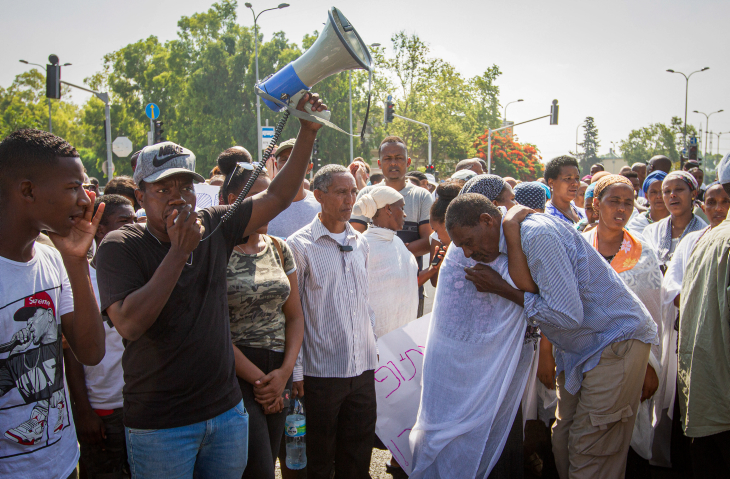
1. Burning outrage: Anger over the shooting death of Solomon Tekah boiled over into fiery protests at major road junctions around the country Monday, shining a light on simmering anger in the Ethiopian-Israeli community.
- Demonstrators burned tires and garbage receptacles, and blocked roads — first in the Haifa area, and then elsewhere in the country — to express anger over the killing of Tekah by an off-duty police officer.
- Fiery images of the protesters crossing their forearms into an “X” led news broadcasts Monday, overshadowing even Iran breaching the nuclear deal and a major reported Israeli strike in Syria, and are spread across front pages of major papers on Tuesday morning.
- Numbers of protesters range from the hundreds to the thousands in news reports, though live stand-ups by TV reporters at the scene show at least some of those there just wanting to make trouble or get on TV, with youths flashing pictures of their favorite soccer teams or waving and grinning stupidly as a reporter tries to give his spiel.
- The vast majority, though, were committed to having their voices and their pain heard.
- “Why do you have to kill a kid? Why does it need to come to this? The blame is also for politicians. Everyone needs to think, from ministers to the prime minister… stop sending us nice words. I am done with them… Find out the truth. I say this from a broken heart,” protest organizer Assaf Govana tells Army Radio.
2. Scarred and scared: For many, the protests are seen as about much more than just Tekah’s death, which community members say is just the latest example of institutional racism by police and others, including against those born and raised in Israel.
- “The second generation of Ethiopian immigrants were born and grew up in a situation of abandonment, a situation in which our blood is worthless,” Danny Adeno Abebe writes in a front page column in Yedioth Ahronoth.
- “The Ethiopian community’s protest is justifiably directed at the police, but the blame for the fact that even the second generation of Ethiopian immigrants is having a hard time assimilating into Israeli society lies with the government and the one who heads it. So long as this issue isn’t made a national priority, it will continue to claim victims,” reads the lead editorial in Haaretz.
- “Our little kids are afraid of police cruisers,” writes journalist Inno Farda Sanbato in Israel Hayom. “Just like kids near Gaza run for shelter when they hear any siren, also our kids, when they hear the sirens of ambulances or various law enforcement bodies, look for where to hide.”
- If it sounds familiar, Ynet reporter Attilla Somfalvi hammers it home on Twitter.
Black lives matter
— אטילה שומפלבי Attila Somfalvi (@attilus) July 2, 2019
3. More fury expected: Tekah’s funeral is scheduled for noon in Haifa, and there are fears/expectations that the protests will intensify shortly after, with some drawing parallels to mass protests by the community in 2015.
- “We hope the funeral will pass quietly. We are hearing two different things from within the community,” an officer tells Walla news.
- The officer adds that like Monday, police will refrain from trying to break up the protests and avoid confrontations.
- But Channel 12 news reports at the same time that police plan on taking a zero-tolerance approach to violence, including threats against the officer accused in the crime, who has been put under house arrest and is under heavy guard fearing for his life.
- “I’m afraid that we will see the same stormy sights and rage that we saw in 2015 and this time it will get worse. The community is going out [to the streets] from Rosh Hanikra to Eilat,” Channel 12 reporter Branu Tegene says.
- The 2015 protests saw running street battles between cops and demonstrators in central Tel Aviv as weeks of protests boiled over into a melee.
4. How it went down: Haaretz reports that Tekah immigrated to Israel from Gondar, Ethiopia, six years ago. An aunt tells the paper that he was “a positive kid, smiling, respectful of his parents.”
- Another relative says “he was a healthy kid, big, and maybe that’s why he seemed threatening.”
- According to police, the officer claims he opened fire because he believed himself to be in danger but aimed downwards, and a bullet ricocheted from the ground, hitting Tekah. The officer claimed he was trying to break up a street fight he came across, but was set upon by three youths who hurled stones at him, endangering his life.
- However, a witness tells Channel 12 that “there was no group of people, nobody hitting anyone.”
- The father of one of the people who had been with Tekah tells Israel Hayom, “The police stopped them and told them to identify themselves. They told him to get out of here, and then there was an argument and the officer pulled a gun. They tried to run away and hide behind a car, and the cop shot at them, hitting my son’s friend and killing him.”
- Channel 12 reports that an investigation will focus on whether the officer’s life was actually in danger when he pulled the trigger, and whether he was justified to use his weapon in that situation, even if it is finally determined that Tekah was indeed killed by a ricochet.
5. Breaching news: There is no doubt that Iran pulled the trigger on upping its nuclear program, moving beyond the 300 kilogram stockpile limit for low enriched uranium, and threatening to also enrich uranium to higher levels.
- The Associated Press reports, “Breaking the stockpile limit by itself doesn’t radically change the one year that experts say Iran would need to have enough material for an atomic bomb, if it chooses to pursue one. But by coupling an increasing stockpile with higher enrichment, it begins to close that one-year window and hamper any diplomatic efforts at saving the accord.”
- “Iran: We broke the nuclear deal,” reads a small headline in Yedioth Ahronoth, which manages to play down the news and get it wrong, all at once.
We have NOT violated the #JCPOA.
Para 36 of the accord illustrates why:
We triggered & exhausted para 36 after US withdrawal.
We gave E3+2 a few weeks while reserving our right.
We finally took action after 60 weeks.
As soon as E3 abide by their obligations, we'll reverse. pic.twitter.com/bSxaMFaktH
— Javad Zarif (@JZarif) July 1, 2019
- Explaining Iran’s position, Henry Rome, an Iran analyst at the Eurasia Group, tells the New York Times, “It’s basically a unilateral interpretation from the Iranian side of what the nuclear deal means. In their view they can reduce compliance commensurate with what the other side does.”
6. Breaking the non-deal: Perhaps just as confusing was the White House’s insistence that Iran was violating the nuclear deal even before there was a deal, which seems a logical impossibility.
- The Independent calls the statement “nonsensical.”
Seriously? pic.twitter.com/oZApumVt2T
— Javad Zarif (@JZarif) July 2, 2019
7. Spinning in circles: Prime Minister Benjamin Netanyahu, though, called Iran’s move a “significant step toward making a nuclear weapon,” and Israel Hayom actually plays the news above the protests of the Tekah killing.
- Columnist Yoav Limor writes that it “brings us back to the early days of the decade and the covert and open race between Jerusalem and Tehran.”
- Former ambassador John Negroponte, meanwhile, is already looking way ahead.
- “We’ve got to improve the Iran agreement to the point where it’s also something that could serve as a model for North Korea. But persuading countries not to go nuclear is hard,” Negroponte tells CNBC. “We have to think about triangulating between Iran and North Korea.”
8. Back in the cockpit: The move came hours after Israel reportedly carried out a massive series of sorties against Iranian facilities in Syria.
- According to ImageSat, among the targets hit was a hangar likely used as an advanced weapons storehouse.
- Looking at local reports about the strikes, Amos Harel in Haaretz concludes, “The distribution of the sites attacked could attest to the real goal – hitting what is apparently a logistical chain that supplies advanced weapons to Hezbollah, linking Iran to Lebanon via Syria.”
- The strikes came just days after Israel, the US and Russia held a meeting in Jerusalem about Syria. Yedioth’s Alex Fishman writes that the attack shows that Israel and Russia are no longer at loggerheads.
- “It could not have happened without understandings with Russia,” he writes.








The Times of Israel Community.