

Anti-migrant activist admits being behind alleged threat to Supreme Court judge
South Tel Aviv resident Sheffi Paz says she plastered stickers outside home of Justice Uzi Vogelman, who filed police complaint, but she denies it was intended to be threatening
 Add ToI as a Preferred Source on Google
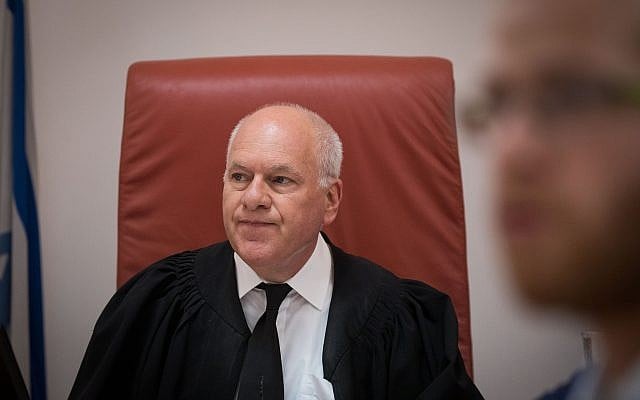
An anti-migrant activist from Tel Aviv admitted Monday that she plastered stickers outside the home of Supreme Court Judge Uzi Vogelman, an action that prompted him to file a police complaint and stoked political condemnation of the rhetoric of Prime Minister Benjamin Netanyahu.
Sheffi Paz, who has for years campaigned against the housing of African migrants in her south Tel Aviv neighborhood, said she put up the stickers found earlier in the day on Vogelman’s mailbox and at the entrance to his residential building.
The stickers carried the slogan “Jewish blood is cheap — the High Court of Justice,” a play on a slogan used by right-wing extremist Jewish activists who campaign under the message that “Jewish blood is not cheap.”
The stickers, which were also marked with the “South Tel Aviv Liberation Front,” Paz’s organization, were apparently referring to High Court rulings that have prevented the government from removing the migrants from the neighborhood where local residents say they are a source of violent crime, including rape.
“We have a long history with Uzi Vogelman,” Paz said in a statement. “It took me some time to find his address, otherwise I would have done it long ago.”
Paz’s actions came the day after the judiciary said Justice Anat Baron had received two threatening messages.
Initial speculation was that the two incidents were carried out by right-wing extremists. Paz did not take responsibility for the threats to Baron.
Prior to Paz’s admission, opposition leader MK Yair Lapid of the Yesh Atid-Telem party blamed “incitement” by Netanyahu for the threats made against Supreme Court justices.
As his trial began last month, Netanyahu accused the justice system of engaging in a conspiracy to oust him from office.
On Sunday morning, a spokesperson for the judiciary said Baron had received a threatening letter on Friday, and linked the previous letter to “continuous unbridled incitement” against the courts.
The earlier letter appeared to threaten harm to Baron’s son. The content of the second letter was not published.
In a statement, the judiciary spokesperson said the body in charge of securing the courts had filed a police complaint.

Attorney General Avichai Mandelblit in 2018 ordered a probe into possible incitement after a poster of Interior Minister Aryeh Deri was burned during an anti-migrant protest in Tel Aviv.
Paz then stood by the burning of the picture and denied anyone had called for violence against Deri or other government officials.
“His people need to stop being crybabies,” she said at the time, according to the Srugim website.
In recent years, the estimated 35,000 African migrants in Israel have been detained, threatened with deportation, and faced hostility from lawmakers and residents. The High Court has pushed back against government plans to jail or deport the migrants, saying a solution in line with international norms must be found.
While many of the migrants say they are refugees fleeing conflict or persecution, Israel views them as job-seekers who threaten the Jewish character of the state.
The Africans, mainly from war-torn Sudan and dictatorial Eritrea, began arriving in Israel in 2005 through its porous border with Egypt, after Egyptian forces violently quashed a refugee demonstration in Cairo and word spread of safety and job opportunities in Israel.
Tens of thousands crossed the desert border, often after enduring dangerous journeys, before Israel completed a barrier in 2012 that stopped the influx.
Since then, Israel has wrestled with how to cope with those already in the country. Many took up menial jobs in hotels and restaurants, and thousands settled in southern Tel Aviv, where Israeli residents began complaining of rising crime.
Agencies contributed to this report.










The Times of Israel Community.