

Netanyahu’s strong defense of Israel unlikely to sway critics abroad. Will it move voters at home?
The PM worked to dismantle the foul genocide allegation, and belatedly denounced Qatar. But his omissions, and his assertions of national unity in a society whose rifts he has widened, will have stung for many Israelis

 Add ToI as a Preferred Source on Google
David Horovitz is the founding editor of The Times of Israel. He is the author of "Still Life with Bombers" (2004) and "A Little Too Close to God" (2000), and co-author of "Shalom Friend: The Life and Legacy of Yitzhak Rabin" (1996). He previously edited The Jerusalem Post (2004-2011) and The Jerusalem Report (1998-2004).
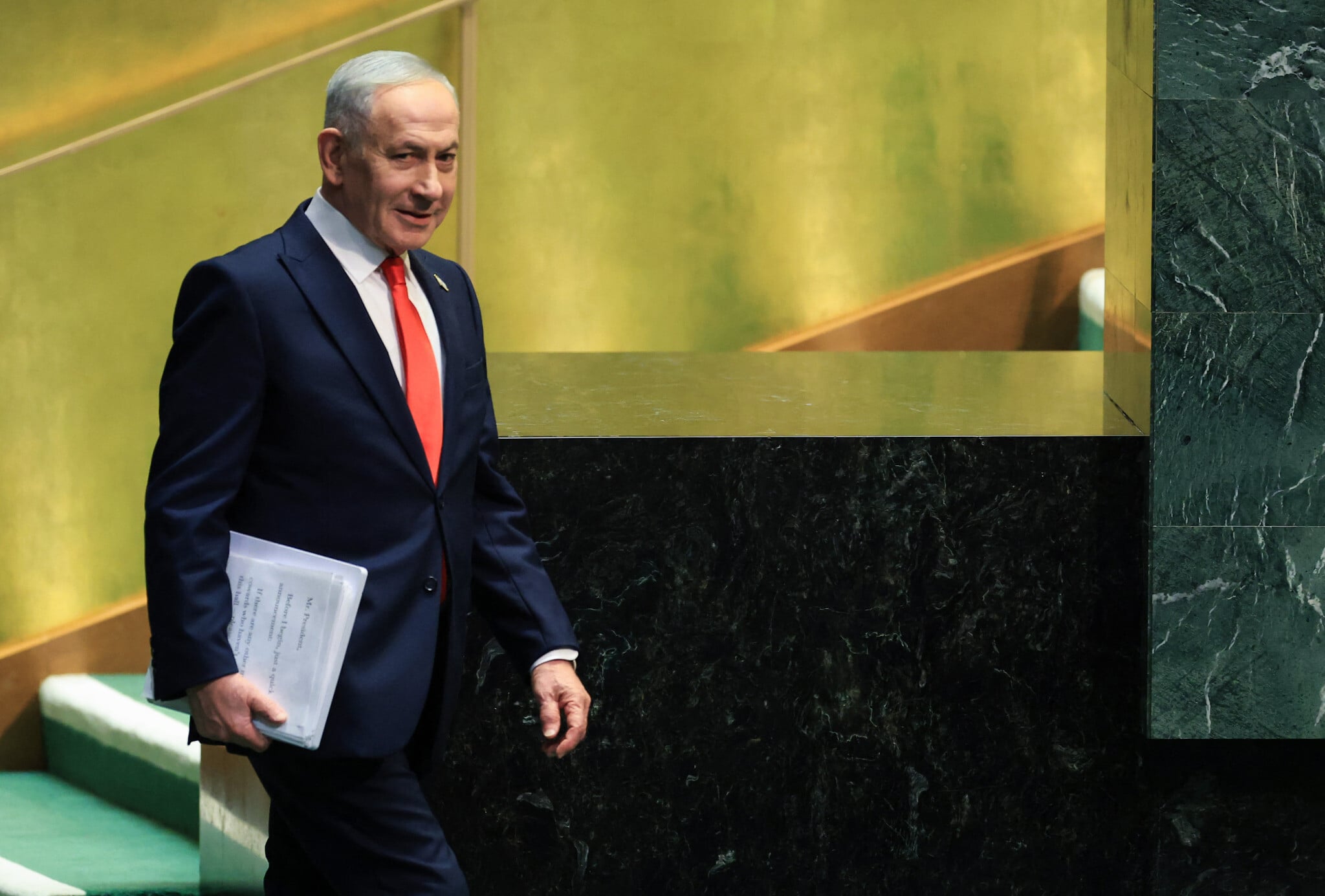
Prime Minister Benjamin Netanyahu delivered a ferocious, frequently bitter and ultimately bullish argument on behalf of Israel, the morality of its military conduct, and his own leadership, at the United Nations General Assembly on Thursday.
Of necessity, he worked hard to dismantle the foul allegation that Israel has carried out genocide in the Gaza Strip, or been trying to do so, since thousands of Hamas-led terrorists invaded Israel, slaughtered some 1,200 people and abducted 251 on October 7, 2023.
He directed his most potent phrase in that regard, with its stinging, undeniable accuracy, at the mayor of the city in which he was speaking: “Here’s the simple truth. Israel didn’t commit genocide. Israel prevented genocide. And that’s exactly what Mr. Mamdani’s Hamas buddies would have done to us had we not stopped them. They would have killed every last one of us.”
He denounced European fecklessness and defeatism in the face of Islamic extremism, seizing on French President Emmanuel Macron’s pathetic assertion from the same podium two days earlier that Hamas, the main protagonist of the early 2000s’ Second Intifada onslaught of suicide bombings, “never operated” in the West Bank.
He highlighted the “eighth front” on which Israel has been battling — “the war for truth” — reserving particular denunciation for Qatar, which he very belatedly called out for its decades of “massively funding American universities and toxic media outlets like Al Jazeera” with the goal of brainwashing “young minds to hate Israel, hate America and hate the West.”
And he issued withering criticism of “phony human rights protesters,” name-checking the diplomats who’d showily walked out before he started speaking and the demonstrators denouncing him and Israel outside, for their singular silence when the Iranian regime “butchered and maimed tens of thousands of unarmed Iranian civilians” at the start of this year.
He also attempted to claim that the international outcry over extremist settler violence is obsessive and unjustified, by falsely minimizing its scope, ignoring the moral and reputational damage that stems from the security authorities’ inability to thwart it, and citing the horrors of ongoing deadly Palestinian terrorism as some kind of counter-argument.
Overall, Netanyahu’s was a strong case for Israel’s defense, delivered with characteristic verve and flourish.
There was, of course, no mention of his own prime culpability in the failure to prevent October 7, when Israel had obtained Hamas’s specific war plans more than a year earlier, and when Netanyahu had always styled himself — indeed, still tries to — as uniquely wary of Israel’s enemies and uniquely effective in defeating them. No acknowledgment of his stated belief that Hamas was deterred. No recognition, even with that blast at Qatar, that he for years encouraged the Qataris to fund Hamas-run Gaza to the tune of hundreds of millions of dollars. No reference to his refusal to countenance a state commission of inquiry into the disaster. And, amid his appreciation of Israeli warriors’ heroism, only the barest admission that the seven-front enemy has not yet actually been defanged and defeated.
He refuses to admit to any of this to his own people. He was certainly not about to do so on the world stage.
Similarly absent was any reference to the divisions he has widened in Israel’s strained society — by hugely funding and adamantly refusing to draft the ultra-Orthodox community through these three harsh years of war, by trying to destroy Israel’s independent judiciary, by shamelessly installing Jewish supremacists and racists in key ministerial positions, by inciting Jews against Jews as a political survival strategy.
All of these are leading issues in the election he is gearing up to fight barely a month from now.
What he proffered, instead, was disingenuous bravado, designed to stir the hearts of watching voters back home: “Throughout this long war, our goal never wavered: To win! To win with unwavering resolve. To win with unrelenting courage. Because this is Israel. One nation fighting for one future. Left and right. Young and old. Religious and secular. Do we have our differences? Of course we do. Who doesn’t? But in the critical moments, those moments that shape our destiny, we stand together, because what unites us is so much stronger: our history, our values, our courage.”
There is a lot of truth in that passage. But, to put it politely, Netanyahu and his right, far-right, ultra-Orthodox coalition can claim precious little credit for the extent to which Israelis have stood together.
A prime minister who lives for moments like Thursday’s at the UN podium will hope that at least some in the global audience were given pause for thought. Equally or more important to him, he will hope that his impeccable English and mastery of the international spotlight, and his rousing talk of victory, resilience and an eternal Israel, will have pulled at least a little more of the electorate in his direction.
In fact, much of the world has stopped listening, which is beyond tragic since it needs to hear so much of what he had to say.
As for many Israelis, perhaps even most, words from Netanyahu after October 7, however carefully formulated, are just that: words.





The Times of Israel Community.