

Courting new players, Israeli women’s netball team shoots for the hoops in Scotland
With no dribbling but plenty of teamwork, the basketball-ish sport was brought here by immigrants who’d played abroad. Now young Israelis are getting involved
 Add ToI as a Preferred Source on Google
Luke Tress is The Times of Israel's New York correspondent.
The women darted down the court, passing the ball quickly as they advanced toward the opposing team’s hoop. Wearing bright blue jerseys, they reached their designated goal shooter, who lobbed the ball through the net at the far end of the floor.
It was the last practice for Israel’s national netball team before this week’s European Open Championship in Scotland.
The players are working to promote the women’s sport in the country but struggle with a lack of awareness, a weak women’s sports culture in Israel and an absence of government funding.
Netball, similar to basketball, is tailored for women. Players do not dribble, and they need to pass or shoot within three seconds of receiving the ball. It is played on a court, with seven players on each team, but the hoop has no backboard. Each player has a specific role on the team, and can only move through designated areas of the court.
The separation of roles promotes close teamwork, said team member Nomi Komar. There is also a place for women with different physiques and skill sets, and for both the young and fast and older players who can capitalize on their experience and knowledge of the game.
“It’s a little different from basketball in that everyone has their own role, and they build a team. One person can’t do everything. If you look at the court everyone has their specific area they can go to, which makes for a lot of cooperation,” Komar said.
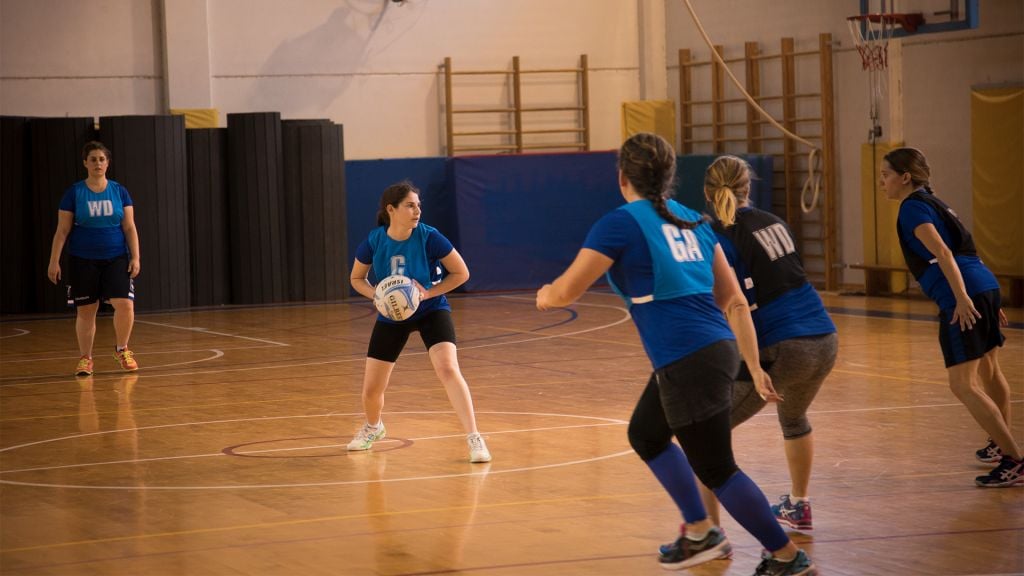
Netball evolved as an alternative to basketball, one better suited to women. The sport is most popular in Commonwealth nations, especially Australia, the UK and New Zealand, where it is often a part of girls’ physical education curriculum. The International Netball Federation’s top five ranked teams are all members of the Commonwealth.
The sport took root in Israel about 20 years ago in Raanana, said the team’s assistant coach, Shan Berman. Immigrants who grew up with the game and wanted to continue playing formed the first teams. There are now teams playing in six cities, including Jerusalem, Tel Aviv and Raanana. The national team’s players all participate in a local league, and practice together once a week in the city of Modiin in central Israel.
Netball in Israel is still mostly played by immigrants — Berman is from New York, and head coach Alexi Schapiro is from Australia — but is slowly being adopted by Israelis. The team communicates during play in both English and Hebrew.
It often fills a void for new immigrants in their struggle to assimilate, Schapiro said.
“There was that desire to be part of a team and a group in a sport that I love,” said Schapiro, who played in Sydney before immigrating 12 years ago.
Komar’s mother, originally from England, introduced her to the sport. The 22-year-old physical education student grew up in Jerusalem and now lives in Gush Etzion. The sport’s focus on teamwork can also help different sectors of Israeli society connect, she said.
“We’re such a diverse country, so many different colors and cultures, it can mesh very well, and that’s what is happening. You can see here secular people, religious, from settlements, city people, everything,” Komar said.
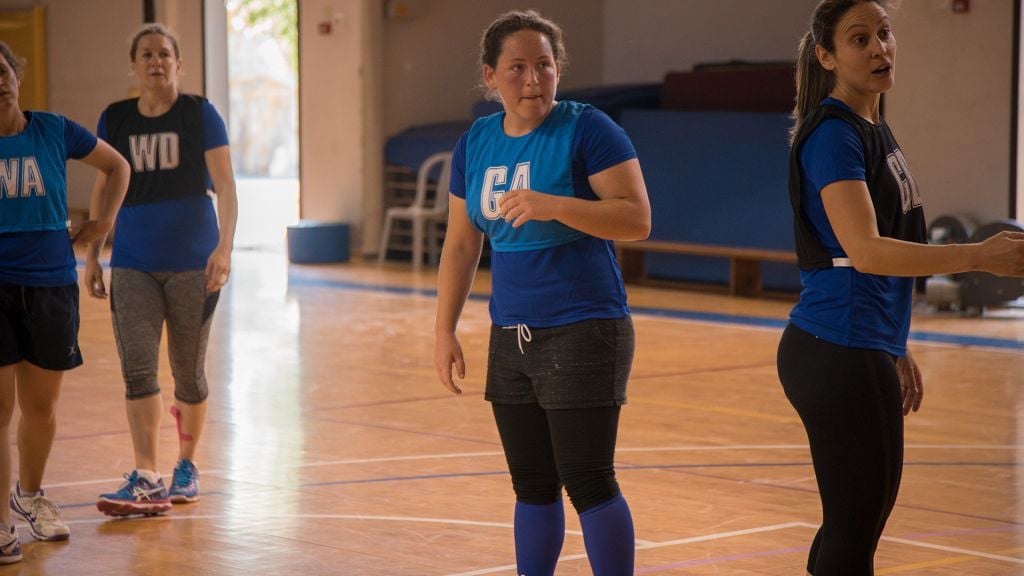
Komar, who was recognized as the tournament MVP at last year’s Open Championships in England, hopes to use her physical education degree to advance the sport in Israel’s schools. She and other members of the team are involved in youth programs, and the community would like to see the sport in religious girls’ schools, Berman said.
The league struggles to attract and retain players, who usually stop playing during their army service and after having children, and teams cannot play on Shabbat, making scheduling difficult, Berman said.
Culturally, women’s sports are not invested in enough, Schapiro said. The sport also lacks government funding, and the team needs to pay for their own travel expenses and time on the court.
“It’s in the Australian culture. It’s not in the Israeli culture, and that’s something we’d like to change,” Schapiro said.
Encouragingly, though, most of the junior team members are now native-born Israelis, which the players hope will help them gain recognition, and funding, from the Ministry of Culture and Sport.
The national team usually competes against other developing nations internationally, including Malta, Gibraltar, Grenada and Bermuda, and has its sights set on July’s Maccabiah Games. This week it is competing in the open division at the European Open in Scotland, which began on Thursday and ends on Sunday, May 14.








The Times of Israel Community.