

Debating Clinton, Sanders says he’s ‘very proud to be Jewish’
Democratic presidential hopefuls spar in heated Michigan debate over American economy, both call for governor’s resignation over Flint water
 Add ToI as a Preferred Source on Google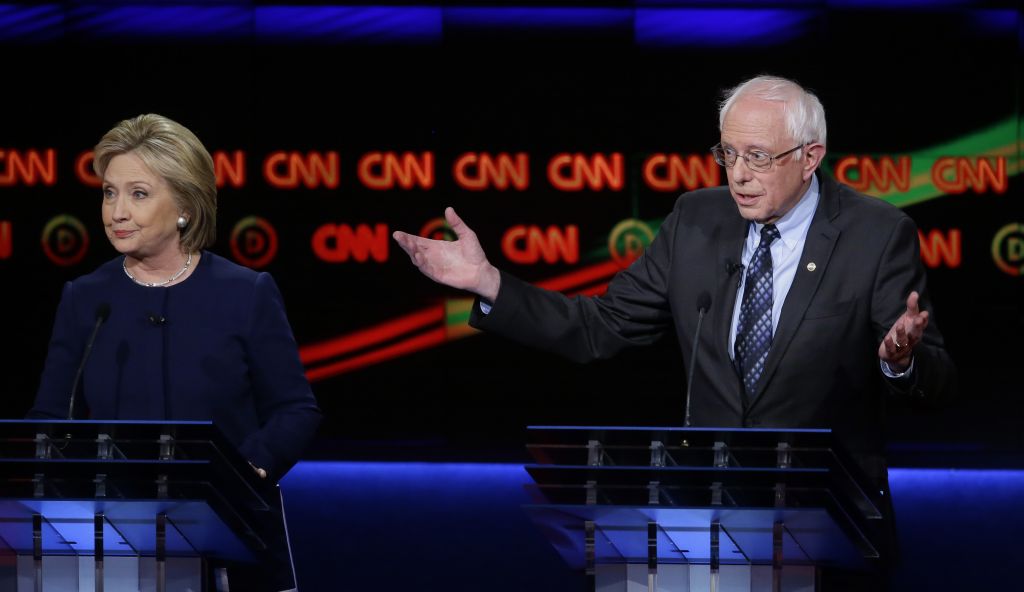
Bernie Sanders said he is “very proud to be Jewish” during Sunday night’s Democratic presidential debate in Flint, Michigan.
The Democratic presidential candidate was fielding a question from debate moderator Anderson Cooper as to whether he was intentionally keeping his Jewish identity in the background. Until now the Vermont senator has largely avoided broadcasting his Jewish background on the campaign trail.
“Look, my father’s family was wiped out by Hitler in the Holocaust. I know about what crazy and radical and extremist politics mean,” he said. “I am very proud of being Jewish and that is an essential part of who I am as a human being.”
The two Democratic hopefuls were asked about their stances on religion and Sanders, asked if God is relevant, said all religions hold dear the premise that people should treat others like they want to be treated. He said “we are in this together.”
Hillary Clinton, asked whom she prays for, said she is a “praying person” and prays for people she knows and those going through tough times. She says “I need that strength and I need that support,” especially when her husband was president.
Clinton said she prays on a pretty regular basis throughout the day because she needs God’s strength and support.
Ratcheting up the rancor, Clinton and Sanders tangled aggressively in a Democratic presidential debate Sunday night over trade, Wall Street influence and more, with Clinton accusing him of turning his back on the auto industry and Sanders countering that Clinton’s friends on Wall Street had “destroyed this economy.”
It was a marked change in tone for the two Democrats, signaling Sanders’ increasingly difficult effort to slow the party’s front-runner. Both candidates frequently interrupted one another and accused each other of misrepresenting their records.
“Let’s have some facts instead of some rhetoric for a change,” Clinton snapped at Sanders at one point.
“Let me tell my story, you tell yours,” Sanders shot back at another. “Your story is voting for every disastrous trade amendment and voting for corporate America.”
More than once, Sanders chafed at Clinton’s interruptions, saying, “Excuse me, I’m talking” or “Let me finish, please.”
Their disagreements were clear, but still the debate’s tone was nothing like that of the Republican debate in Detroit just three days earlier, a four-way faceoff that was marked by a steady stream of personal attacks, insults and even sexual innuendo. The Democrats’ faceoff, in comparison, was a more civil if heated affair.
Clinton said that while she and Sanders have their differences on policy, “compare the substance of this debate with what you saw on the Republican stage last week.”
Sanders chimed in, “We are, if elected president, going to invest a lot of money into mental health and when you watch these Republican debates you know why.”
Both had a good laugh at that.
Each made a case for being the best candidate to defeat GOP front-runner Donald Trump in a November matchup.
Clinton said she’s gotten more votes than Trump in the primaries, and predicted that his “bigotry, his bullying, his bluster are not going to wear well on the American people.”
Sanders declared: “I would love to run against Donald Trump,” adding that polls show “Sanders vs. Trump does a lot better than Clinton vs. Trump.”
Sanders, who argued with considerably more edge than in past debates, pounced early when Clinton spoke about a need to keep jobs from shifting overseas.
“I am very glad that Secretary Clinton has discovered religion on this issue,” he said, then went on to criticize her past support for trade deals that he maintained had “disastrous” consequences.
Clinton, too, took the offensive early on but more often found herself fending off Sanders’ criticisms.
In her most pointed thrust, she said Sanders had voted against a 2009 bailout of carmakers, adding, “I went with them. You did not. If everybody had voted the way he did, I believe the auto industry would have collapsed, taking 4 million jobs with it.”
Sanders countered that the money for the auto industry was part of a larger bailout package for Wall Street, adding, “I will be damned if it was the working people of this country who have to bail out the crooks on Wall Street.” He referred to the overall package as “the Wall Street bailout where some of your friends destroyed this economy.”
Ultimately, President George W. Bush and Treasury Secretary Hank Paulson agreed to provide $23.4 billion for the auto industry from the federal bailout money for the financial sector.
Sanders also took direct aim at the former secretary of state’s paid speeches to Wall Street banks and other financial companies. She promised to release transcripts of her private remarks only if all her opponents — Democratic and Republican — did the same.
“I’m your Democratic opponent, I release it,” Sanders said, throwing imaginary speech transcripts into the air. “Here it is. There ain’t nothin’. I don’t give speeches to Wall street for hundreds of thousands of dollars.”
The debate started on a more conciliatory note, with Clinton joining Sanders in calling for Michigan’s Republican governor to resign over his handling of the Flint water crisis.
An emotional Sanders said he felt “literally shattered” by the toxic tap water in Flint and renewed his call for Gov. Rick Snyder to resign.
Clinton, who had not previously made that call, added emphatically: “Amen to that,” and then said that Snyder should “resign or be recalled.”
Snyder quickly tweeted that “political candidates” will be leaving Flint and Michigan in a few days after the state’s primary but he is “committed to the people of Flint.”
In the race for the Democratic nomination, Clinton has at least 1,130 delegates to Sanders’ 499, including superdelegates — members of Congress, governors and party officials who can support the candidate of their choice. It takes 2,383 delegates to win the nomination.









The Times of Israel Community.