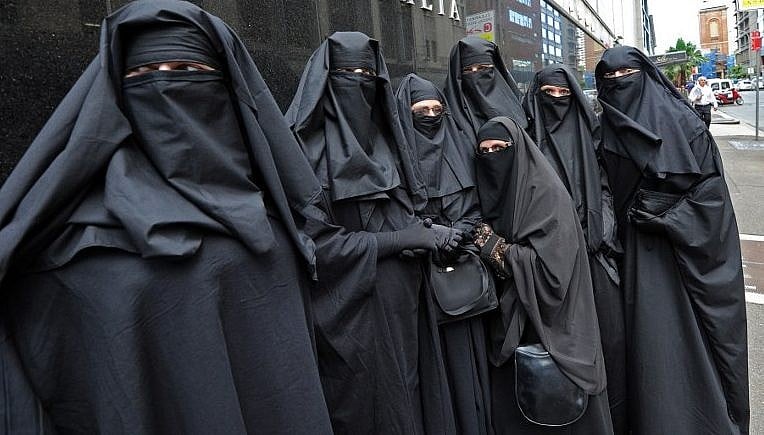
THE HAGUE, Netherlands — The Netherlands banned the wearing of a face-covering veil, such as a burqa or niqab, in public buildings and on public transportation from Thursday as a contentious law relating to the garment worn by some Muslim women came into force.
Between 200 and 400 women are estimated to wear a burqa or niqab in the country of 17 million people.
The Dutch legislation was passed in June 2018 after more than a decade of political debate on the subject. The far-right politician Geert Wilders had proposed the face-covering veil ban back in 2005.
“From now on the wearing of clothing which covers the face is banned in educational facilities, public institutions and buildings, as well as hospitals and public transport,” the Dutch interior ministry said in a statement.
It added that it was important in such public places to be recognized and seen, which besides the burqa, also bans a face-covering helmet or hood. A person could be fined 150 euros ($165).
Get The Times of Israel's Daily Edition
by email and never miss our top stories
By signing up, you agree to the
terms
However, the public transportation sector said it would not stop to make a woman in a burqa get off as it would cause delays. And hospitals also said they would still treat people regardless of what they are wearing.
The Dutch law does not ban the wearing of a burqa on the street, unlike France’s ban which took effect in 2010. Belgium, Denmark and Austria have similar laws.
Help us report truthfully on social media

As a multimedia journalist, my job is to take the quality, fact-based journalism produced by The Times of Israel newsroom and make it accessible across every platform — from Instagram posts to podcasts to short-form videos.
This is how many, especially young people, consume news these days. But misinformation is rampant on social media. Our team at ToI produces accurate, responsible short-form reporting on Israel and the Jewish world.
If you believe in the importance of factual social media journalism, please consider joining our reader support group, The Times of Israel Community. Your financial support is essential to sustain responsible multimedia reporting.
— Gabriella Jacobs, multimedia journalist
Support our work
Support our work
Already a member? Sign in to stop seeing this
You're a dedicated reader

We’re really pleased that you’ve read X Times of Israel articles in the past month.
That’s why we started the Times of Israel - to provide discerning readers like you with must-read coverage of Israel and the Jewish world.
So now we have a request. Unlike other news outlets, we haven’t put up a paywall. But as the journalism we do is costly, we invite readers for whom The Times of Israel has become important to help support our work by joining The Times of Israel Community.
For as little as $6 a month you can help support our quality journalism while enjoying The Times of Israel AD-FREE, as well as accessing exclusive content available only to Times of Israel Community members.
Thank you,
David Horovitz, Founding Editor of The Times of Israel
Join Our Community
Join Our Community
Already a member? Sign in to stop seeing this


 Add ToI as a Preferred Source on Google