

In destitute Gaza, Hamas rides world’s goodwill all the way to the bank
Terror group uses tax money, donations from well-meaning countries eager to ease hardship for Gazans, to fund its military build-up

 Add ToI as a Preferred Source on Google
Avi Issacharoff, The Times of Israel's Middle East analyst, fills the same role for Walla, the leading portal in Israel. He is also a guest commentator on many different radio shows and current affairs programs on television. Until 2012, he was a reporter and commentator on Arab affairs for the Haaretz newspaper. He also lectures on modern Palestinian history at Tel Aviv University, and is currently writing a script for an action-drama series for the Israeli satellite Television "YES." Born in Jerusalem, he graduated cum laude from Ben Gurion University with a B.A. in Middle Eastern studies and then earned his M.A. from Tel Aviv University on the same subject, also cum laude. A fluent Arabic speaker, Avi was the Middle East Affairs correspondent for Israeli Public Radio covering the Israeli-Palestinian conflict, the war in Iraq and the Arab countries between the years 2003-2006. Avi directed and edited short documentary films on Israeli television programs dealing with the Middle East. In 2002 he won the "best reporter" award for the "Israel Radio” for his coverage of the second intifada. In 2004, together with Amos Harel, he wrote "The Seventh War - How we won and why we lost the war with the Palestinians." A year later the book won an award from the Institute for Strategic Studies for containing the best research on security affairs in Israel. In 2008, Issacharoff and Harel published their second book, entitled "34 Days - The Story of the Second Lebanon War," which won the same prize.
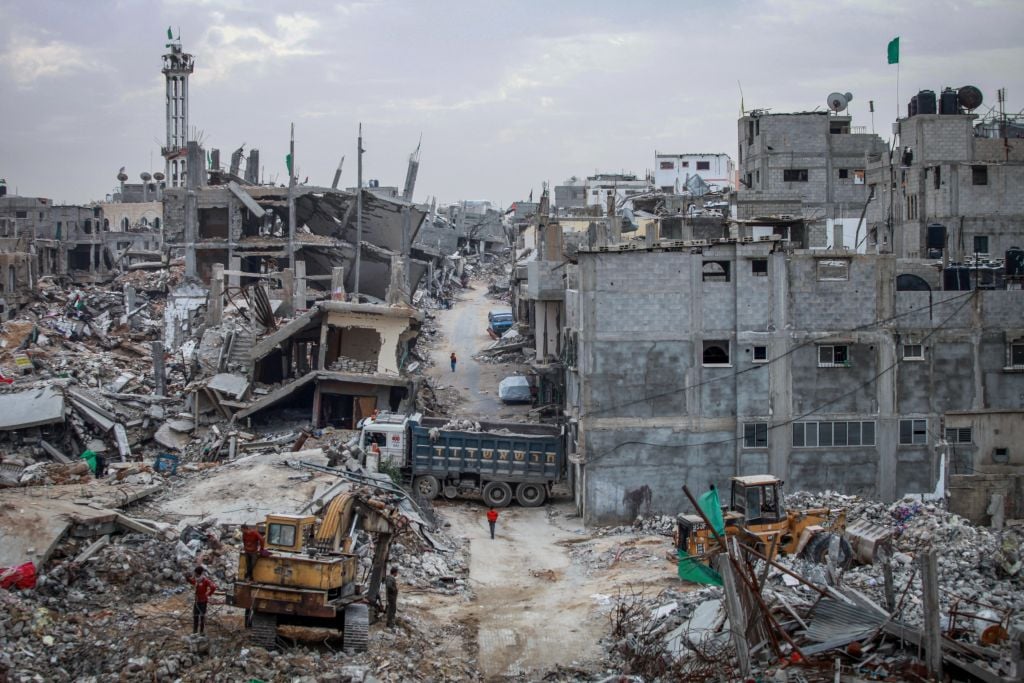
There’s been a lot of talk in the international media about the slow pace of rebuilding in the Gaza Strip, where some 100,000 people still don’t have housing following the summer 2014 war between the IDF and Hamas-led groups in Gaza.
But what most people haven’t heard is that new homes are being built, slowly, for the 17,000 or so families whose houses were totally destroyed.
Or at least that’s how it looks on paper.
In actuality, the homes, donated by Qatar, are being practically given away to Hamas cronies while others have to pay off the terror group to put a roof over their heads — one of myriad ways Hamas is exploiting the humanitarian crisis in the Strip to pad its own coffers.
Muhammad Al-Amadi, a Qatari envoy charged with overseeing the emirate’s funding of Gaza’s rebuilding, recently inaugurated a new neighborhood near Khan Younis in the southern Strip, completely paid for by his country. “Hamad City,” named in honor of the father of the current ruler of Qatar, who took the throne two years ago, constitutes some 1,040 new housing units for Gaza’s homeless.
The Hamas government, the de facto rulers of Gaza, instituted a lottery in which those who had no home could register to win apartments for free.
But that was not what was really going on.
The winners discovered to their amazement that they were required to pay Hamas $40,000 for each apartment. One claim was that a significant sum was needed to connect the homes to infrastructure such as water and electricity. Others were told that they needed to make a donation for those who were still left homeless.
The sum of $40,000 is cheap for a new apartment, but it’s still a princely sum in Gaza, where unemployment is rampant and the average person makes $174 a month, according to a 2014 UNRWA report. At the end of the day, Hamas will be $36 million richer on Qatar’s dime.
Why not $41 million? According to Palestinian sources, some 150 of the lottery winners had the $40,000 fee waived because they are considered “close to Hamas.”
The housing saga caused considerable anger against the group, but it’s not the only area in which Hamas is oppressing its own people and sparking animosity.
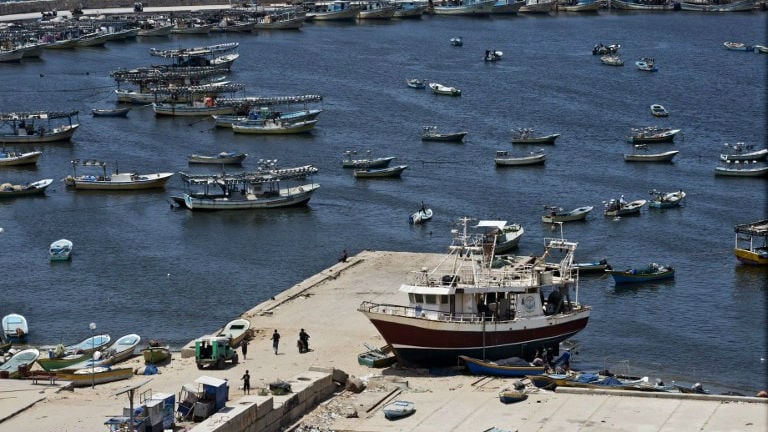
While Gaza doesn’t have a lot of land for farming or natural resources, it does have ample access to the sea, and fishing has always been one of the Strip’s strongest industries.
Yet fisherman have been hamstrung to some extent by Israeli restrictions on how far they can go out because of the concern over smuggling, among other reasons. This matter is an almost constant cause of complaint against Israel from the international community.
Israeli security forces even seize the vessels of those fishermen who stray beyond the permitted fishing boundary. But once the boat is returned to the Strip after any suspicion is cleared, Hamas forces the owner to pay a tax to get it back.
Residents are also made to pay a tax any time they need the help of a policeman.
Despite the delays in paying the wages of Hamas government employees, the members of the military wing — some 40,000 in number, including police – continue to be paid, though the money comes from Iran and not from those fees.
And the group doesn’t reach only into people’s wallets, but also into their medical charts. It’s no secret that in Gaza for a certain amount of money you can get a note from a senior doctor for urgent medical treatment in the West Bank or even in Israel. Hamas uses those who have these permits to transfer cash or messages to operatives in the West Bank.
All the while, the international community focuses on economic hardship in the Strip caused by the Israeli and Egyptian blockade, while seemingly casting a blind eye on Hamas, which raises funds on the backs of the Strip’s residents and invests tens of millions of dollars each month on building up its fighting force, digging attack tunnels that may stretch into Israel and manufacturing rockets.
According to Israeli estimates, each year, Hamas invests nearly NIS 100 million ($25 million) alone on smuggling materials for manufacturing weapons and setting up tunnels. The military wing takes care of buying the materials, sometimes from Israeli vendors who don’t realize where it is going.
Gaza trader Usama Zuarub, for example, bought nearly $30 million of steel on behalf of Hamas. Just the communications equipment that Hamas buys each year comes to NIS 8-9 million.
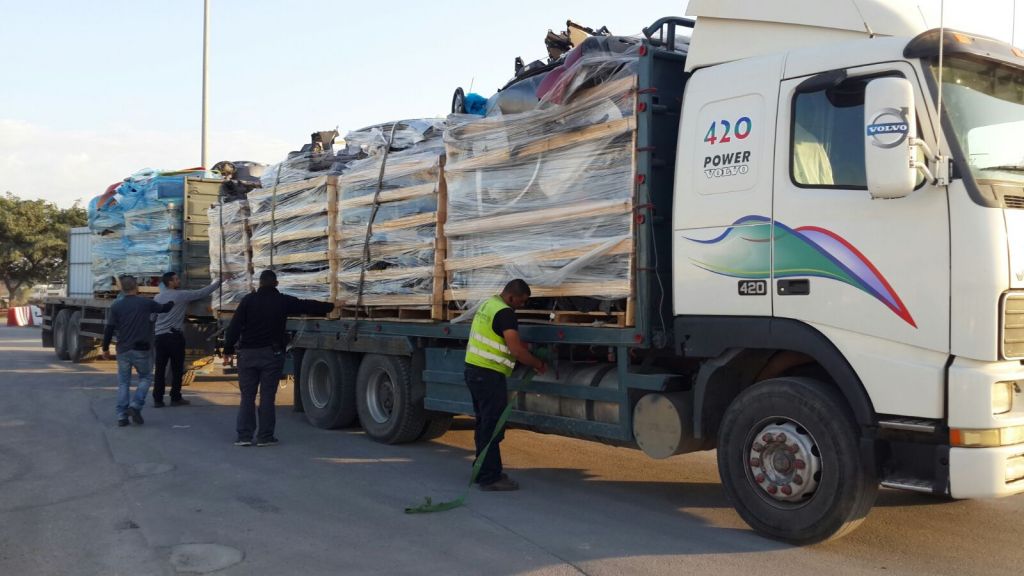
Most of those smuggled materials come into the Strip via the Kerem Shalom crossing with Israel, where Hamas takes advantage of trucks carrying what little is allowed into Gaza.
According to recent statistics on the Israeli side, each day some 650-700 trucks go through the crossing, many of them carrying goods from around the world, shipped via Israeli or Egyptian ports.
Israel inspects the goods before they go into Gaza, and hardly a week goes without the discovery of smuggled materials used either for digging tunnels or manufacturing rockets.
The amount is huge: tons of steel wire, for example, that is used in tunnel construction, radio and communications equipment, steel, motors, fiberglass and more.
Recently, Israeli authorities even discovered electrodes packed into butter shipped from a Ramallah factory.
All that is aside from the military uses Hamas makes of construction material such as cement and wood that are brought into Gaza for the purpose of rehabilitating homes, the very homes that were destroyed in that last war.









The Times of Israel Community.