

Health Ministry moves to calm fears over polio vaccines
Some children with weak immune systems told to stay home from school, but others okay to mingle as long as precautions taken
 Add ToI as a Preferred Source on Google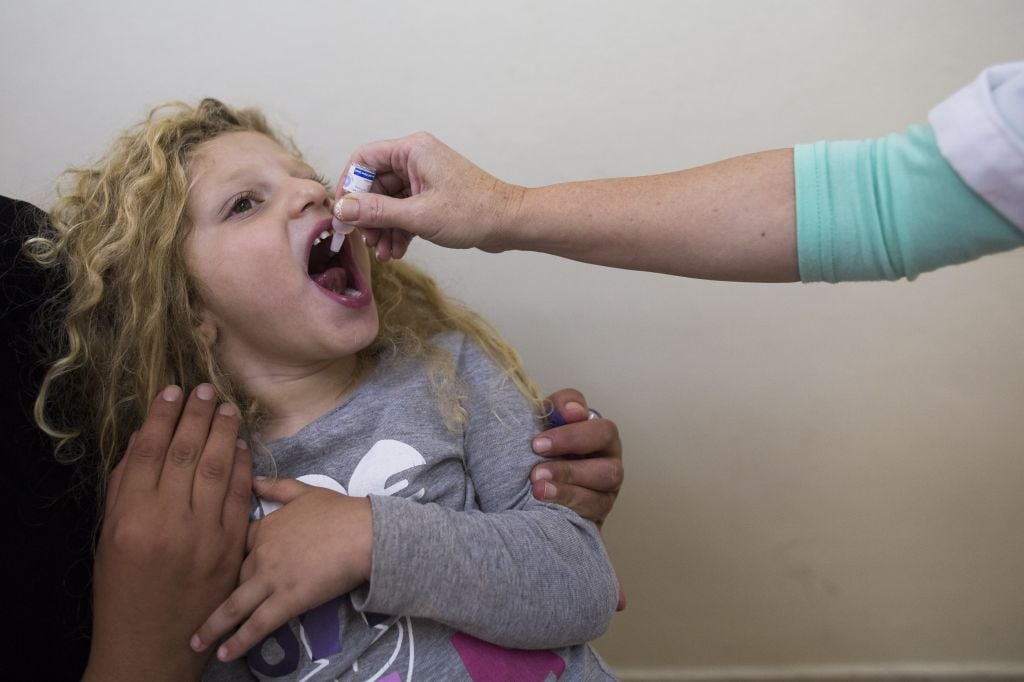
The Health Ministry issued fresh directives Monday for parents fearful that children with compromised immune systems may be susceptible to contracting the polio virus, as a nationwide campaign to inoculate the country’s children continues.
The new rules include keeping some kids home from school and restricting contact with children who have already received the weakened virus vaccination, according to the ministry.
Some 40,000 children were vaccinated with a live attenuated strain of the virus on Monday, the second day of the campaign, bringing the two-day total to 74,000. The country has so far given out 134,000 doses of the vaccine since starting the campaign in the south earlier this month.
The new instructions were put out to calm growing panic over the possible danger to those who have a weakened immune system and who may come in contact with children who received the live vaccine, especially as children return to school next week, Channel 2 reported on Monday.
As a precaution, the ministry said that children living with people who are immunocompromised should not be administered the live attenuated vaccine and added that nurses in medical centers will be trained to question families in order to identify those who should be excluded from the program.
However, the ministry stressed that members of the public should not refrain from participating in festival meals during the coming Jewish High Holidays, as the polio vaccine is not spread via air, food, or water. In addition, chlorinated swimming pools are safe, health officials said.
The officials defined three groups of people based on the state of their immune system: The first group includes the majority of immunocompromised patients who, according to the ministry, are not in increased danger of the vaccine. The second group consists of children or adults who have undergone bone marrow transplants, or — due to leukemia or cancer — underwent chemotherapy in the last six months. The third group is those who have significantly low levels of gamma globulin in their blood and who are considered immunocompromised.
Those who have any doubts as to the status of the immune system are advised to consult with a doctor.
The ministry instructions for all three groups — and, in particular, for the latter two groups — are to avoid contact with body fluids from children who have been vaccinated and to take care in maintaining hygiene by washing their hands. Children who fall into the third group were advised to not attend kindergarten or school during the vaccination program and for six weeks after it ends.
Authorities decided on using a live virus — in order to guarantee that the degraded, vaccinating strain spread quickly from the children to their surroundings, including family members and friends, thus vaccinating the general population.
The use of a live virus, discontinued since 2005, has been somewhat controversial, though the Health Ministry has said the measure is necessary to stem what they call a “wild” virus threatening to spread across the country.
According to a Channel 10 survey Monday, 46% of parents said they did not intend to bring the children to clinics for the vaccines, while 47% said that they will, and 7% said they had already vaccinated their children.
The virus is believed to have arrived in Israel from Egypt, where polio was discovered in sewage last December. Health authorities believe it first arrived in Israel in February, crossing the border from Egypt to the southern Bedouin city of Rahat. It was first detected in Rahat’s sewage in late May.
The vaccination process in the south began in early August, when the Health Ministry decided to inoculate some 150,000 children in the 66 towns and communities of the southern Negev desert. Some 60,000 children have already been vaccinated as part of that initial effort, the Health Ministry reported on Saturday.
The operation is expected to last 60 days and requires approximately 1 million doses, which were ordered in recent weeks from the pharmaceutical giant GlaxoSmithKline at a cost of approximately NIS 1 ($0.28) per dose.


The Times of Israel Community.