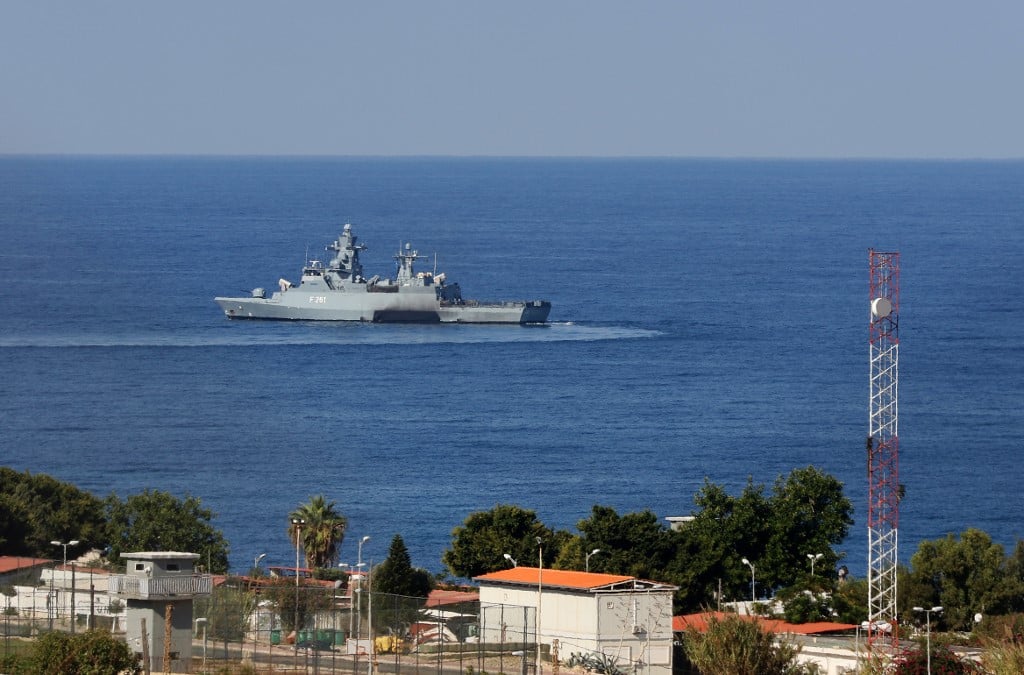
A United Nations ship is pictured in the southernmost area of Naqura, by the border with Israel, on October 14, 2020. (Mahmoud Zayyat/AFP)
Israel has accused Lebanon of changing its position in talks on their disputed maritime border and warned it could lead to a “dead end” that would be damaging for the whole region.
The two countries, which remain technically at war, opened negotiations on the border dispute under US and UN auspices last month to clear the way for offshore oil and gas exploration.
“Lebanon has changed its stance on its maritime border with Israel seven times,” Energy Minister Yuval Steinitz tweeted late Thursday.
“Its current position contradicts not only its previous one, but also Lebanon’s stance on its maritime border with Syria, which takes into account Lebanese islands close to the border,” Steinitz said.
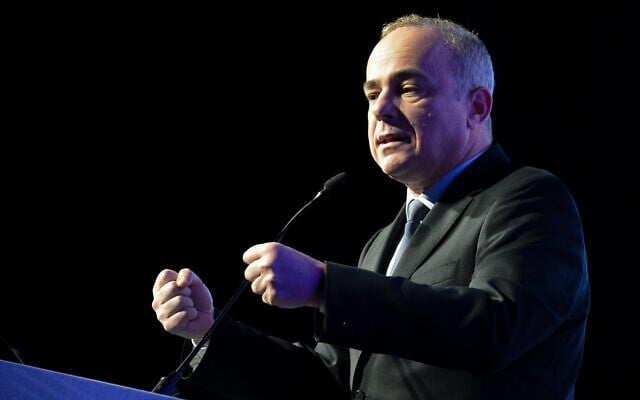
Energy Minister Yuval Steinitz speaks at a conference in Tel Aviv on February 27, 2019. (Flash90)
Earlier on Thursday, Lebanese President Michel Aoun had set out his country’s position on the maritime border, which he said should be “based on the line that departs on land from the point of Ras Naqoura.”
Get The Times of Israel's Daily Editionby email and never miss our top stories
The demarcation should be “according to the general principle known as the median line, without taking into account any impact of the occupied Palestinian coastal islands,” Aoun tweeted, referring to the Israeli coastline.
Lebanese Communist Party supporters burn Israeli flags at a rally to protest ongoing maritime talks with Israel, at the Lebanese southernmost border area of Naqura, on November 11, 2020. (Mahmoud Zayyat/AFP)
Israel and Lebanon have been negotiating based on a map registered with the United Nations in 2011, which shows an 860-square-kilometer (330-square-mile) patch of sea as being disputed.
But Lebanon considers that map to have been based on wrong estimates.
As a multimedia journalist, my job is to take the quality, fact-based journalism produced by The Times of Israel newsroom and make it accessible across every platform — from Instagram posts to podcasts to short-form videos.
This is how many, especially young people, consume news these days. But misinformation is rampant on social media. Our team at ToI produces accurate, responsible short-form reporting on Israel and the Jewish world.
If you believe in the importance of factual social media journalism, please consider joining our reader support group, The Times of Israel Community. Your financial support is essential to sustain responsible multimedia reporting.
We’re really pleased that you’ve read X Times of Israel articles in the past month.
That’s why we started the Times of Israel - to provide discerning readers like you with must-read coverage of Israel and the Jewish world.
So now we have a request. Unlike other news outlets, we haven’t put up a paywall. But as the journalism we do is costly, we invite readers for whom The Times of Israel has become important to help support our work by joining The Times of Israel Community.
For as little as $6 a month you can help support our quality journalism while enjoying The Times of Israel AD-FREE, as well as accessing exclusive content available only to Times of Israel Community members.
Thank you, David Horovitz, Founding Editor of The Times of Israel


 Add ToI as a Preferred Source on Google