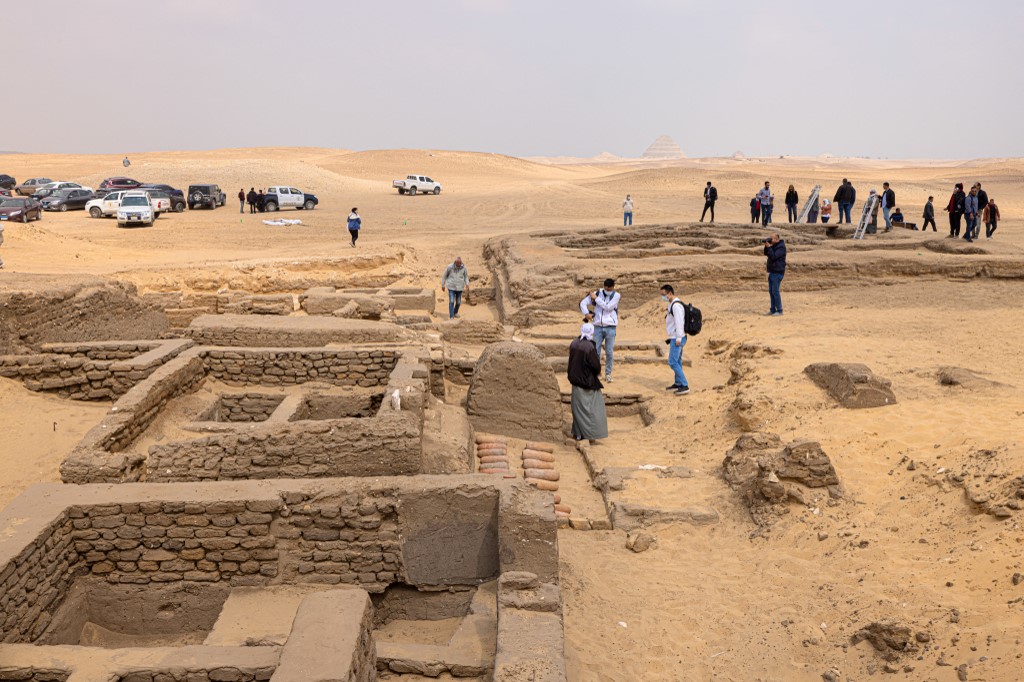
Members of the media gather on March 19, 2022, in the area where five ancient Pharaonic tombs were recently discovered at the Saqqara archaeological site, south of the Egyptian capital Cairo (Khaled Desouki/AFP)
Egypt says a limestone pharaonic painting has gone missing from the famed Saqqara necropolis, becoming the latest artifact to disappear in a country known for its rich and lengthy history.
The painting was in the tomb of Khentika in the Saqqara necropolis outside Cairo, says Mohamed Ismail, secretary-general of the Supreme Council of Antiquities. The tomb was found in the 1950s and hasn’t been opened since 2019.
Prosecutors are investigating the circumstances of the painting’s disappearance, he says, without giving further details.
According to Egyptian media, the painting exhibited the ancient Egyptian calendar that divided the year into three seasons mirroring the Nile River’s ebb and flow. It included the flooding season, Akhet, the planting season, Proyat, and the harvest season, Shomu.
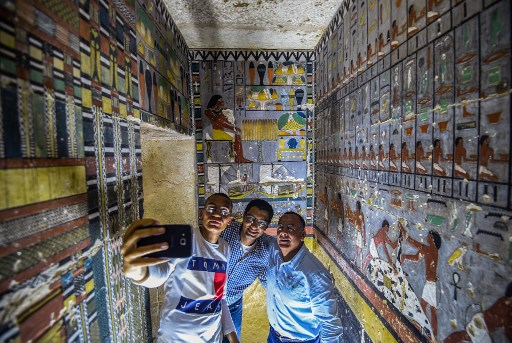
Mohamed Mujahid, head of the Egyptian mission which discovered the tomb, posing for a “selfie” photograph on a cell phone inside the newly-discovered tomb of the ancient Egyptian nobleman “Khewi” in Saqqara necropolis in Egypt on April 13, 2019. (Mohamed el-Shahed / AFP).
The tomb dates to the sixth dynasty of the ancient Old Kingdom — roughly from around 2700 B.C. to 2200 B.C.
The Cairo 24 news outlet reports that a British mission working in the tomb discovered the painting was missing in May.
The tomb is one of the few in ancient Egypt to have a curse inscribed on its facade warning intruders they could face divine punishment, according to British Egyptologist Harry James, who co-authored a research paper on the tomb in the 1950s.
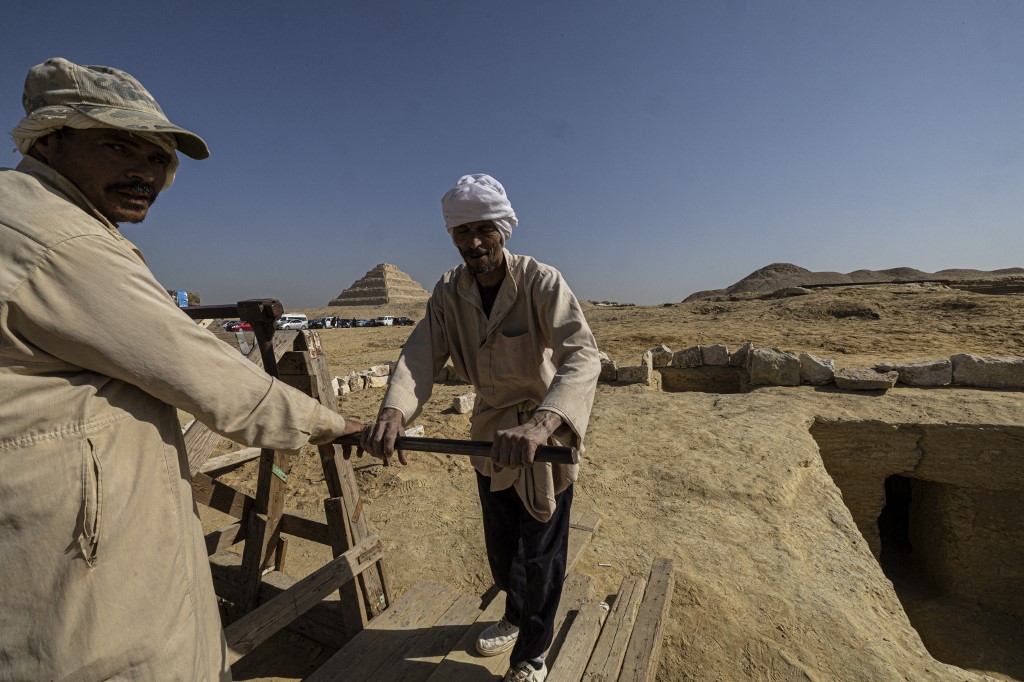
Egyptian antiquities workers dig at the Saqqara archaeological site, south of Cairo on January 26, 2023. (Khaled DESOUKI / AFP)
The Saqqara site is part of a sprawling necropolis at Egypt’s ancient capital of Memphis that includes the famed Giza Pyramids, the step pyramid of Djoser, as well as smaller pyramids at Abu Sir, Dahshur and Abu Ruwaysh.
Sunday’s announcement comes less than a month after an ancient pharaoh’s bracelet was stolen from the Egyptian Museum in Cairo and melted for its gold.
Help us report truthfully on social media
As a multimedia journalist, my job is to take the quality, fact-based journalism produced by The Times of Israel newsroom and make it accessible across every platform — from Instagram posts to podcasts to short-form videos.
This is how many, especially young people, consume news these days. But misinformation is rampant on social media. Our team at ToI produces accurate, responsible short-form reporting on Israel and the Jewish world.
If you believe in the importance of factual social media journalism, please consider joining our reader support group, The Times of Israel Community. Your financial support is essential to sustain responsible multimedia reporting.
We’re really pleased that you’ve read X Times of Israel articles in the past month.
That’s why we started the Times of Israel - to provide discerning readers like you with must-read coverage of Israel and the Jewish world.
So now we have a request. Unlike other news outlets, we haven’t put up a paywall. But as the journalism we do is costly, we invite readers for whom The Times of Israel has become important to help support our work by joining The Times of Israel Community.
For as little as $6 a month you can help support our quality journalism while enjoying The Times of Israel AD-FREE, as well as accessing exclusive content available only to Times of Israel Community members.
Thank you, David Horovitz, Founding Editor of The Times of Israel


 From the Liveblog of
Monday, October 6, 2025
From the Liveblog of
Monday, October 6, 2025
 Add ToI as a Preferred Source on Google