

Netanyahu briefs Australia, India and UK leaders on captured Iran nuke archive
Prime minister continues to update key allies on the trove of documents that the Mossad obtained from a secret Tehran warehouse
 Add ToI as a Preferred Source on Google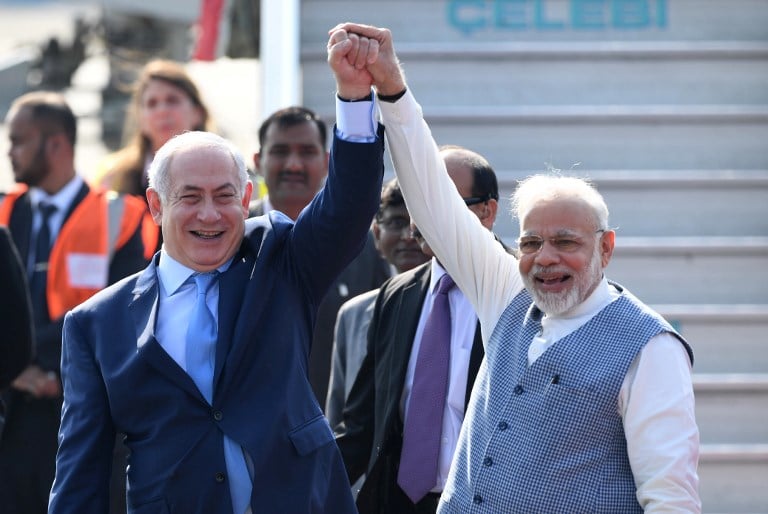
Prime Minister Benjamin Netanyahu on Friday spoke with three key international leaders about the Iranian nuclear archives acquired by Israel, his office said, as he sought to garner further support for his call to “fix” or “nix” the Iran nuclear deal.
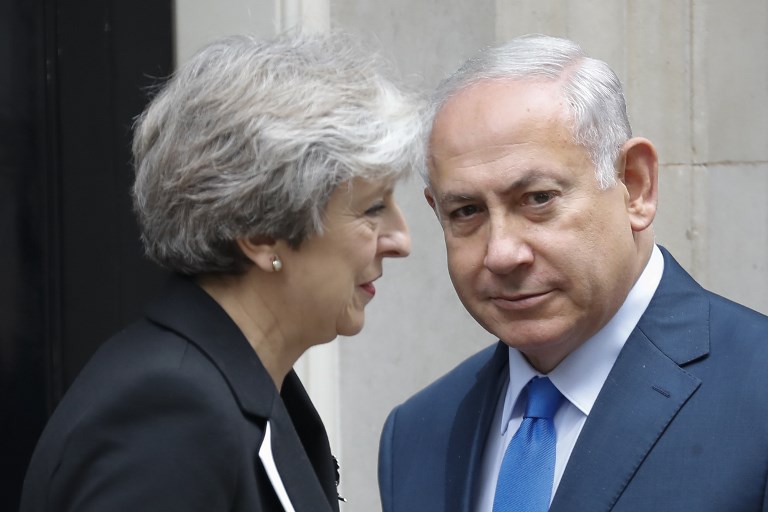
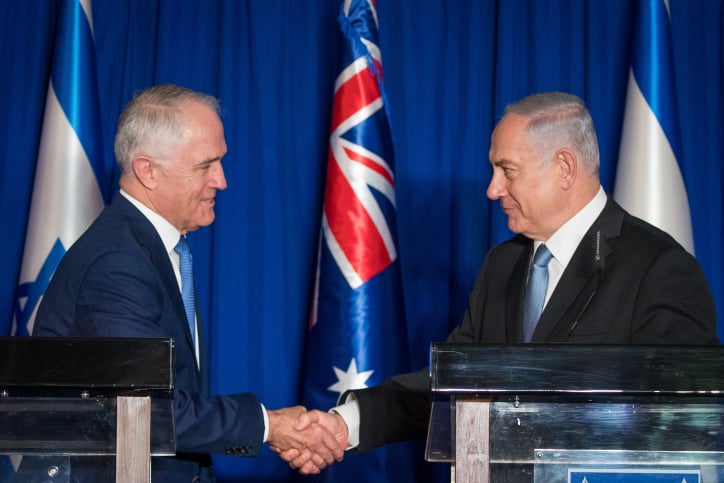
Netanyahu spoke with Australian Prime Minister Malcolm Turnbull, Indian Prime Minister Narendra Modi and British Prime Minister Theresa May. His office said he “discussed regional issues with the world leaders and also updated them on the important material that he revealed regarding the Iranian nuclear archive.”
Earlier in the week, Netanyahu said he would share the archive of more than 100,000 documents from a Tehran warehouse that appeared to prove Iran’s past clandestine efforts to assemble nuclear weapons. He singled out the European co-signatories on the Iran nuclear deal.
“The leaders of the E3 — Britain, France and Germany — said they want to see the material. They’re very interested in seeing what we discovered,” Netanyahu told journalists in his Jerusalem office.
Intelligence professionals from London, Paris and Berlin are coming to Jerusalem later this week to examine the material Israel presented, he said.
On Monday evening, Netanyahu spoke to French President Emmanuel Macron, Russian President Vladimir Putin and German Chancellor Angela Merkel to update them about the Mossad’s findings.
“I told Putin that he’s welcome, too, to see the material. I also invited the leader of China and [Yukiya] Amano,” the head of the International Atomic Energy Agency, Netanyahu said.
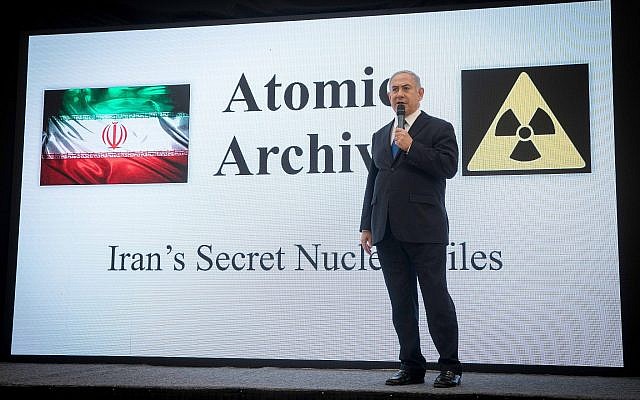
During an at-times-theatrical presentation Monday evening, Netanyahu showcased an enormous trove of Iranian documents that he said proved the existence of Iran’s Project Amad, which it froze in 2003.
Earlier this year, Mossad agents managed to obtain and smuggle into Israel 55,000 paper documents and 183 CDs with another 55,000 documents that seemed to shore up the international community’s longstanding suspicion that the Islamic Republic was investing great efforts in building a nuclear weapon.
“What happened in last weeks is we turned questions marks into exclamation marks,” Netanyahu told the reporters. “We uncovered things we believed were true but couldn’t prove, and also discovered new things regarding Iran’s nuclear weapons program.”
Commenting on the expectation that the United States will pull out of the Iran nuclear deal on May 12, he added: “The decision is President [Donald] Trump’s decision alone. He’s a leader who knows to take decisions, and he takes them.”
A senior intelligence official, meanwhile, said that Israel had never received so much intelligence information in one fell swoop as it did several weeks ago, when Mossad agents managed to penetrate what Netanyahu described Monday as a “dilapidated warehouse” in south Tehran’s Shorabad district and smuggle half a ton of documents to Israel.
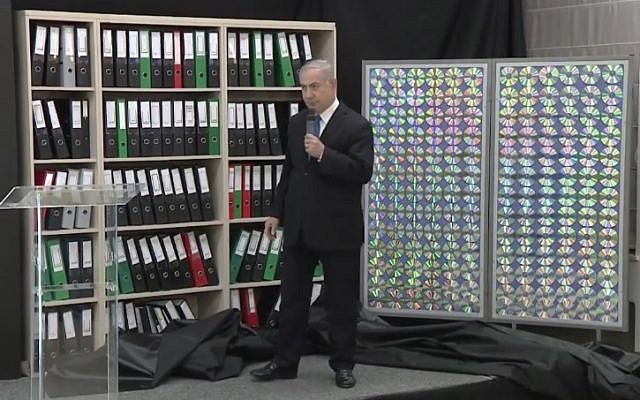
In fact, the officer said, Israel did not take the entire archive, because it was “very heavy” and some documents were left behind.
“It’s a vast amount of information,” said the intelligence officer, who was involved in planning the operation. “It’s a challenge for us to go through the material — it is very technical and very complicated.”
The Mossad’s best translators are still busy working on the documents, the official said, adding that while most of the material has been reviewed, there are still documents that require further work, and that it is possible that more significant information will be revealed in the process.
The official rejected critics of Netanyahu’s presentation who argued that the existence of Iran’s clandestine nuclear weapons program was already known and detailed in an IAEA report from 2011. He said that the agency’s report was based on the review of “more than a thousand” pages of documents, while Israel had obtained more than 100,000 documents.
“This archive teaches us many more details about Iran’s nuclear weapons program. We now have a much more detailed knowledge of what went on there,” he said.
While its existence has been suspected for a long time, Israel now has “evidence of a whole different level. We have a different level of proof of their weapons programs, and that it was ordered by the Iranian leadership. We have many new details on the equipment the Iranians have, which people are involved, and many other new things. Iran will be required to explain all of them,” the official added.
Some of the documents Israel obtained showed ways to build nuclear weapons, which for obvious reasons should not be made public, he went on.
“But Iran will need to explain all of this,” he said.







The Times of Israel Community.