

Price of expanding cabinet: Up to NIS 300m just in expenses and bureaucracy
Measure would cancel 2014 law limiting the cabinet to 18 ministers; PM expected to hand out 26-28 portfolios to members of his new government

 Add ToI as a Preferred Source on Google
Raoul Wootliff is a former Times of Israel political correspondent and Daily Briefing podcast producer.
Among the hundreds of motions filed in an attempt to delay the 2015 bill to expand the cabinet, one mocking proposal called for changing the title “minister-without-portfolio” to “MK who knowingly wastes public funds.”
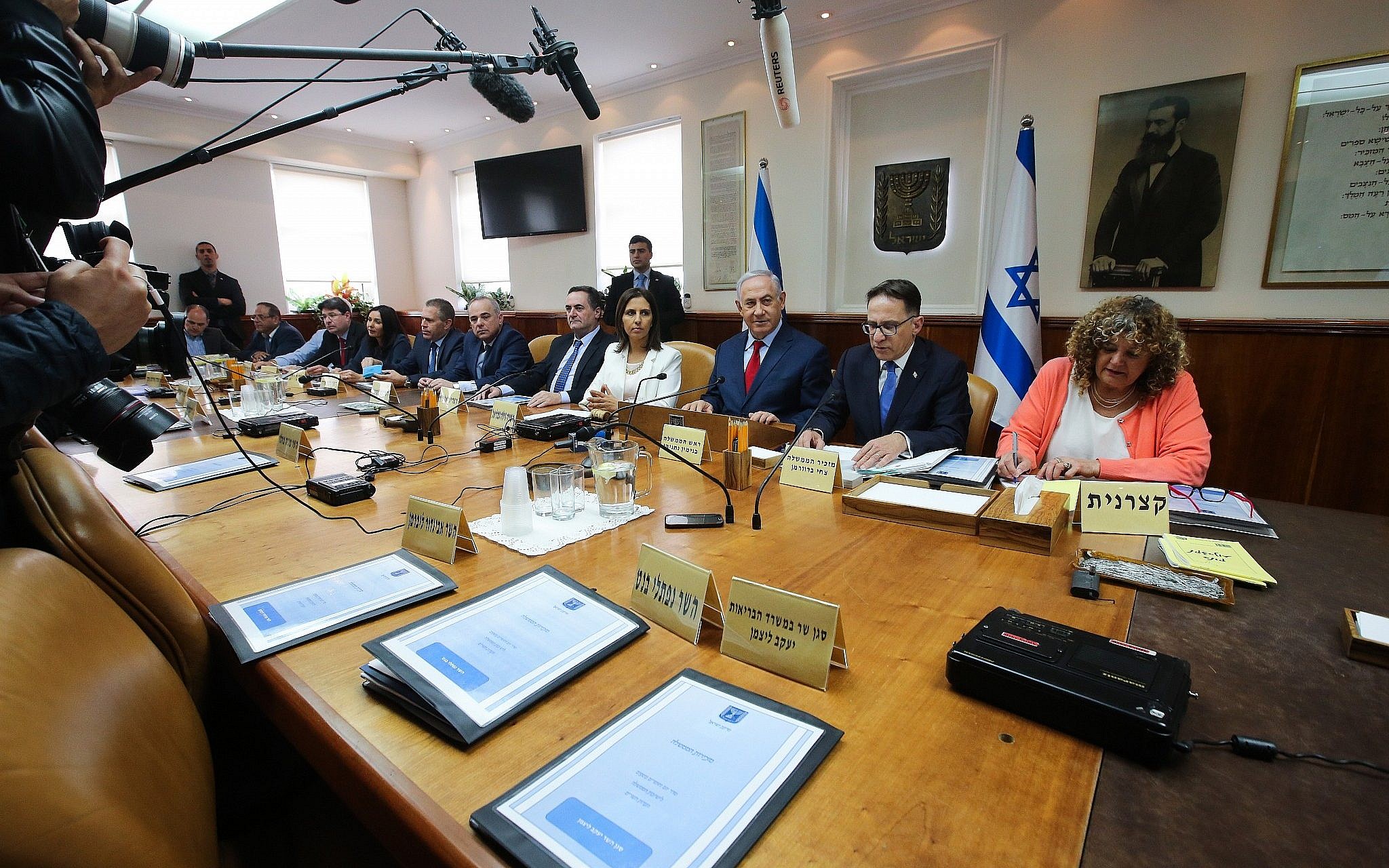
Four years after that incoming government succeeded in pushing through the measure, which increased the maximum number of cabinet ministers from 18 to 21, the currently emerging government is seeking to extend the size of the cabinet table even further. In addition to preserving the possibility of appointing “ministers-without-portfolio” — a title that past prime ministers have assigned to MKs after running out of ministries for them to helm — this latest effort could cost taxpayers around NIS 300 million ($84 million) in funding the increased number of ministers’ offices, staff and expenses.
With time running out for him to finalize a deal to form a new government, Prime Minister Benjamin Netanyahu is seeking to appeal to the six parties, including his own Likud, vying for ministerial posts by again expanding the cabinet, this time from its current 21 members to an expected 26-28.
After the 2013 elections, the new Yesh Atid party conditioned joining the government on the passage of a major government reform bill that amended the constitutional Basic Law: The Government, limiting the cabinet to 19 members, including the prime minister, plus four deputy ministers, and outlawing the institution of ministers-without-portfolio. Following the 2015 elections, however — the first opportunity for this new 2014 law to be implemented — Netanyahu passed a temporary amendment expanding the number to 21. Now, with the Supreme Court having since ruled that quasi-constitutional Basic Laws cannot be changed via temporary amendment, he wants the law, and the limitations, scrapped altogether.
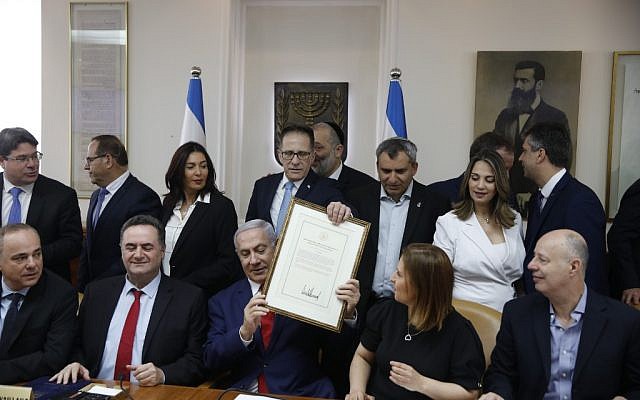
With just over a week remaining before the May 28 deadline for Netanyahu to submit a coalition to the Knesset, talks appear to have stalled, and no agreement has been signed with any party. Without reconciling the conflicting demands of the secularist Yisrael Beytenu and the ultra-Orthodox parties, as well as the other factions likely to join, Netanyahu will be unable to assemble a coalition of at least 61 seats in the 120-member Knesset.
Increasing the number of ministers would give Netanyahu additional collateral to court the parties he needs to give him a majority, while also satisfying the demands of his own party members, who are likely to miss out on key positions doled out to coalition partners. (The 33rd government had at one point 32 ministers and eight deputies. Four were ministers without portfolio, and several had posts invented for them, such as the minister for strategic affairs, the minister for intelligence and atomic energy, the minister for citizens’ services and the deputy minister for the advancement of youth, students and women.)
At a heated Monday morning meeting of the Knesset Arrangements Committee, one of the three temporary committees established until a government can be sworn in and the permanent parliamentary committees formed, members of the Blue and White party as well as other parties in the likely opposition railed against the proposal, saying that it was a waste of money aimed purely at political gain.

“You are stealing budgetary funds from the public who need it. Don’t pretend to care about cancer patients or others who need more help when you are taking the money from under their noses for yourselves,” Blue and White MK Meir Cohen said, pointing at the Likud MKs in the committee.
“This is a corrupt deal being made in front of us all,” said Meretz chair Tamar Zandberg.
Blue and White leader Benny Gantz went as far as to accuse Netanyahu of resorting to “political bribery” in his bid to woo coalition partners into the government.
“Can you believe we are going to talk today about increasing the number of ministers? This is simply another tool in the toolbox of political bribery. Its only aim is political gain. Anyone who accepts this is accepting a political bribe,” railed Gantz at his party’s weekly faction meeting on Monday, referring to the prime minister’s attempts to protect himself from prosecution in three corruption cases against him.
According to Finance Ministry estimates included in the footnotes of the government bill, each additional minister would cost the state NIS 4.5 million to NIS 6.5 million ($1.25 million – $1.8 million) each year, and each additional deputy minister would cost NIS 2 million ($560,000). If Netanyahu were to therefore appoint 28 ministers and 10 deputy ministers, two more than in the outgoing cabinet, the annual costs beyond those set out in the current Basic Law would be NIS 57 million ($16 million) to NIS 77 (NIS 22 million) million. Over the four and a half year maximum life of the government, that would total NIS 256.5 million ($71 million) to NIS 364 million ($102).
The Finance Ministry also stressed that its estimates only cover the costs of setting up an office, various bureaucratic costs, and expenses. Any budget involving the actual activities of a new ministry, which would likely come to significantly more, would be on top.
According to a report of the Knesset’s Research and Information Department commissioned by MKs during the 2015 debates, the treasury estimates cover the costs of salaries for up to six advisers, up to five secretaries, an office manager, and full time driver, as well as the boost of an MK’s salary of NIS 44,000 ($12,200) per month to that of a minister, which stands at NIS 48,800 ($12,500).

Dr. Ofer Kenig, a senior lecturer at the Ashkelon Academic College and a research fellow at the Israel Democracy Institute, told The Times of Israel in a Monday phone interview that the cost of the additional ministers was “only one prism for looking at the proposal, and it’s not the most important one.”
Instead, Kenig warned that revoking the limitation on the number of ministers in the next government could have a deeper impact on its effectiveness.
“Firstly, and most simply,” he said, “a larger number of ministers harms the effectiveness of the government meetings. It becomes a forum for endless speeches. Research has shown us that this hampers progress across all ministries.”
Pointing to previous large governments, Kenig said the new portfolios would likely be created by splitting various ministries into two or establishing new ones. “This creates ineffective governance. In order to govern effectively you have to create stability in the civil service. Each new ministry, each splitting of a ministry creates more bureaucracy and harms effectiveness,” he said.
A recent Israel Democracy Institute paper found that compared with countries with similarly sized populations, Israel, with a population of nearly 9 million (a figure it has since exceeded), has a disproportionately large number of cabinet ministers. Austria, for example, with a population of 8.8 million, has just 14; the Czech Republic, with a population of 10.6 million, has 15.
“If you take a comparative view, we have a hugely exaggerated cabinet,” Kenig said. “Here, too, we see that a larger government creates instability.”
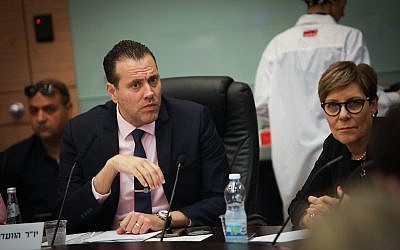
Speaking at Monday’s meeting, committee chair MK Miki Zohar of Likud said that the bill would in fact create more stability and even save money by “preventing another election within two years. That would cost billions!”
On Sunday, Netanyahu complained that his potential coalition partners were unyielding in their demands and obstructing any prospect for significant progress in talks. “Unfortunately the parties are still at the top of the trees they have climbed,” the prime minister said at the opening of the cabinet meeting in Jerusalem.
“I hope that the way will soon be found to bring them down to the ground so that together we can establish a strong and stable government for the State of Israel, which will continue to lead the country to new heights,” he said.
If Netanyahu fails to form a coalition by May 28, the task could be assigned to a different member of the Knesset. If no member of the legislature is likely to be able to form a government, the country could then face new elections.








The Times of Israel Community.