

Sa’ar visits Somaliland to meet with president for 1st time since Israeli recognition
Alongside Somaliland’s president, foreign minister says Israel ‘truly honored’ to be first to recognize country, hopes others will follow; both reiterate pledge to open embassies
 Add ToI as a Preferred Source on Google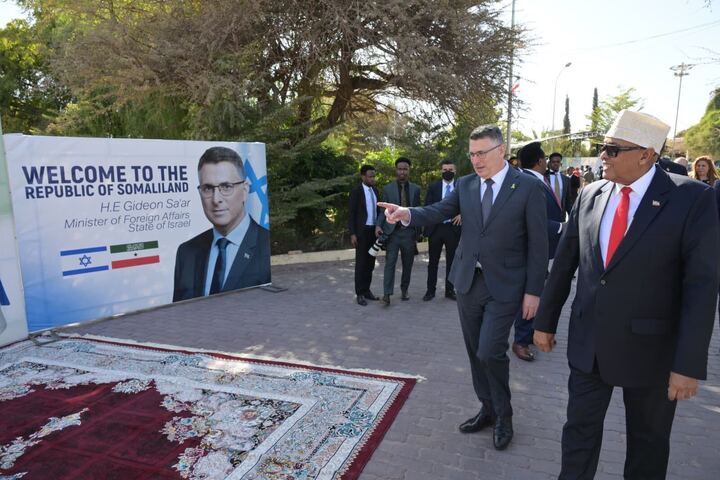
Foreign Minister Gideon Sa’ar visited Somaliland on Tuesday for the first official visit since Israel recognized the breakaway state last month, where he met with Somaliland President Abdirahman Mohamed Abdullahi and other top officials, Sa’ar’s office and Somaliland’s presidency confirmed.
“A delegation led by the Israel Foreign Minister Gideon Sa’ar landed at the Hargeisa town, he was received at the airport by senior government officials. He had meetings with the Somaliland top officials,” the presidency said in a statement.
Sa’ar’s office confirmed that the foreign minister would be meeting with Somaliland’s Foreign Minister Abdirahman Dahir Adam, Presidential Affairs Minister Hader Hussein Abdi, and Chief of Staff Nimsan Yusuf Osman.
“Unlike ‘Palestine,’ Somaliland is not a virtual state,” Sa’ar said alongside Abdullahi, in remarks released by the Foreign Ministry. “It’s a functioning state. Somaliland is a fully functioning country based on the principles of international law.”
“Somaliland is, and has been, a stable democracy for nearly 35 years,” he added. “It has democratic elections, most recently in November 2024, and peaceful transitions of power. It’s pro-Western and friendly to Israel.”
Late last month, Israel became the first country to recognize the Republic of Somaliland as an independent state, more than three decades after the African region broke away from Somalia.
Today, at the Presidential Palace, I received @gidonsaar H.E. Mr. Gideon Sa’ar, Minister of Foreign Affairs of the State of Israel, and a high-level delegation on an official visit to the Republic of Somaliland, the first such visit by a foreign minister in 34 years. I conveyed… pic.twitter.com/AQfntPBnZC
— Cabdiraxmaan Cirro (@Abdirahmanirro) January 6, 2026
Israel is “truly honored” to be the first country to recognize Somaliland as an independent and sovereign nation, Sa’ar said alongside Abdullahi.
“This is the moral thing to do and this is what we did,” he said. “We hear the attacks, the criticism, the condemnations. Nobody will determine for Israel who we recognize and who we maintain diplomatic relations with.”
He expressed hope that “other nations soon follow suit,” amid rumors that other countries could recognize Somaliland in the near future.
Abdullahi, in a statement on Sa’ar’s visit, said he had expressed his “deep appreciation to the Government of Israel for its historic and courageous decision” to recognize Somaliland.
“This milestone reflects a relationship founded on mutual respect and shared interests, aimed at cooperation and stability without prejudice to any party,” he said, stressing that Somaliland was a “reliable and responsible partner,” ready to advance “regional and international peace, security, and constructive engagement.”
As part of the December 26 agreement formalizing Israel’s recognition of Somaliland, both countries agreed to open embassies in the other and to appoint ambassadors.
Sa’ar reiterated this pledge on Tuesday, saying that they would “get that done soon.”
Abdullahi, too, said the countries were “ready to deepen engagement and move decisively toward the establishment of diplomatic infrastructure, including the opening of embassies.”
He ensured Sa’ar of “our full readiness and political will to establish our embassy in Israel.”
Speaking to Abdullahi on the phone after signing the official recognition, Prime Minister Benjamin Netanyahu had invited the president for an official visit to Israel. Abdullahi confirmed on Tuesday that he will accept the invitation, but did not provide a date for his visit.
Israeli Foreign Minister arrives in Somaliland after recognition. pic.twitter.com/neWTFM03LD
— Clash Report (@clashreport) January 6, 2026
When signing the deal last month, Abdullahi said Somaliland would join the Abraham Accords, a deal brokered by the Trump administration in 2020 that saw Gulf states the United Arab Emirates — a close partner of Somaliland — and Bahrain establish ties with Israel.
Israel’s recognition of the breakaway state sparked criticism from Somalia, which has long opposed Somaliland’s bid to secede, as well as from the African Union and the Arab League, which both said it “undermines” the territorial integrity of Somalia. The EU also criticized the move, and the United States said that it continued to recognize the territorial integrity of Somalia, “which includes the territory of Somaliland.”
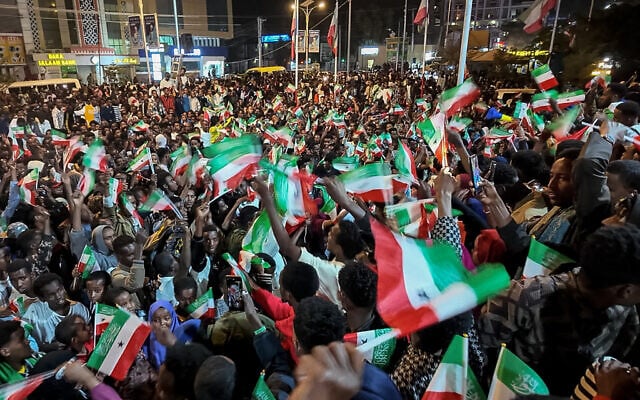
Somaliland declared independence from Somalia in 1991 and has for decades pushed for international recognition. A self-proclaimed republic, it enjoys a strategic position on the Gulf of Aden and has its own money, passports and army. But it has been diplomatically isolated since its unilateral declaration of independence.
Sa’ar’s visit on Tuesday sparked anger in Somalia, which said in a statement that it “condemns in the strongest terms the unauthorized incursion” of the Israeli foreign minister.
It characterized his visit as “an unacceptable interference in the internal affairs” of Somalia.
Netanyahu has said Israel would pursue cooperation with Somaliland in agriculture, health, technology, and the economy.
Located in the Horn of Africa, the northern region of Somaliland is across the Gulf of Aden from Yemen, where the Houthis hold territory, making it strategically valuable. The Houthis, a terror group, began attacking Israel and maritime traffic in November 2023, a month after the October 7, 2023, Hamas massacre, drawing Israeli airstrikes. They halted attacks after a ceasefire was reached in Gaza in October.
Regional analysts believe that relations with Somaliland would provide Israel with better access to the Red Sea, enabling it to hit Houthi rebels in Yemen.
The breakaway state’s government last week denied that it had agreed to accept Gazan refugees or allow Israel to establish military bases on its soil in exchange for Israeli recognition, after Somalia’s presidency claimed that it had done so.
Israel’s announcement of the recognition made no reference to quid pro quo demands or conditions.
Additionally, plans for the voluntary migration of Gazans — initially advanced enthusiastically by Israel — have become dead in the water with US President Donald Trump gradually withdrawing support from the idea he proposed in February, coupled with a global refusal to accept Palestinian refugees from Gaza.






The Times of Israel Community.