

Hawkish Saudi minister leads campaign against Iran and proxies
Power player Thamer al-Sabhan, seen as having orchestrated the unsuccessful resignation of Lebanon’s PM, is openly critical of Tehran and Hezbollah
 Add ToI as a Preferred Source on Google
BEIRUT (AP) — Saudi Arabia’s powerful crown prince relies on a small core group of advisers, none more provocative than Thamer al-Sabhan, the fiercely anti-Iran government minister whose fingerprints were on the hurried and ultimately unsuccessful resignation of Lebanon’s prime minister earlier this month.
As Saudi minister for Gulf affairs, Sabhan has a hand in helping shape the kingdom’s high-stakes gambles to counter rival Iran.
For days before Lebanese Prime Minister Saad Hariri’s surprise resignation, which the kingdom is widely believed to have orchestrated, Sabhan issued threats against Lebanon’s government as well as Iran and its ally Hezbollah via Twitter, unnerving many Lebanese who feared being dragged yet again into the forefront of the Saudi-Iran rivalry for regional supremacy.
Three months earlier, Sabhan had been sent to Beirut to meet with Hariri and deliver a blunt warning against concessions that could favor Iran’s allies in Lebanon.
Hariri’s resignation, announced from Riyadh on November 4 on a Saudi-owned TV station, seemed to confirm fears that the kingdom’s rivalry with Iran could destabilize yet another country in the region, this time Lebanon’s delicate power-sharing system. Mediation by France, a close ally of both Saudi Arabia and Lebanon, helped reverse the resignation, which Hariri suspended after his return to Beirut.
Though Saudi Arabia may have succeeded in pressuring Hezbollah and bringing attention to the Shiite militant group’s expanding regional footprint, the kingdom’s political moves in Lebanon were largely seen as a debacle that backfired.

The 50-year-old Sabhan was at the center of it all.
Sabhan’s first trip to Washington, in March, was with Mohammed bin Salman, who just months later would be named crown prince and heir to the Saudi throne. It was a pivotal visit that would cement Riyadh’s relationship with the newly inaugurated US President Donald Trump.
A subsequent trip to Washington earlier this month, however, didn’t go as well. Days after Hariri’s resignation, Sabhan met with officials from the US State Department, Pentagon and the White House National Security Council.
Instead of raising support for the resignation, Sabhan was given an earful from US officials who chided him and pressed him to stop his provocative tweets, according to Arab media reports and a person privy to the meeting’s outcome, who spoke on condition of anonymity because he wasn’t authorized to discuss the encounter. They also asked who gave Sabhan the right to undermine Lebanon’s stability at a time when Washington was backing the Lebanese armed forces and the country was hosting more than a million Syrian refugees.
The 32-year-old Saudi crown prince’s hawkish policies toward Iran are largely embodied and amplified in Sabhan. Nowhere is that spelled out more clearly than on Twitter, where Sabhan has referred to the Iranian-backed Hezbollah — which means “Party of God” in Arabic — as the “Party of Satan.”
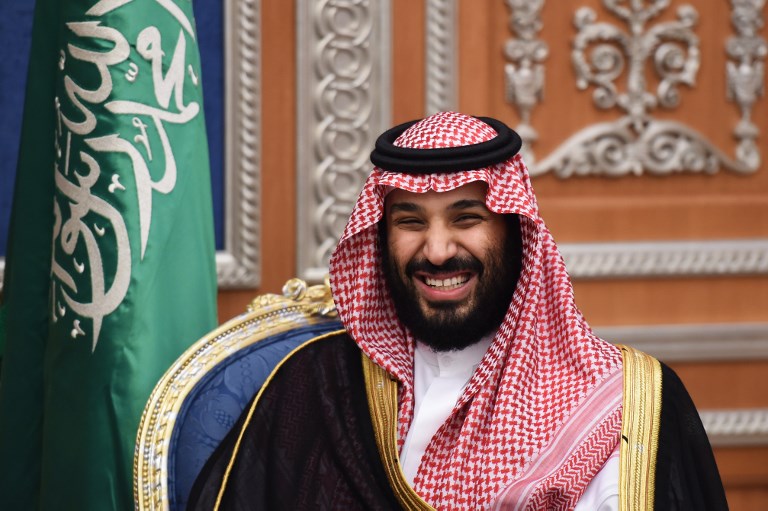
A few days before Hariri’s resignation, Sabhan warned in an interview with a Lebanese TV station that there would be “astonishing” developments to topple the Shiite militant group in Lebanon. He also said that Lebanon’s government — headed by Hariri — would be dealt with as a hostile government that’s declared war against Saudi Arabia because of Hezbollah’s power-sharing role.
“It is up to (Lebanon’s) leaders to decide whether it is a state of terror or peace,” Sabhan wrote on Twitter two days after Hariri’s resignation.
Sabhan, who as Saudi Arabia’s military attaché in Lebanon in 2014 and 2015 monitored Hezbollah, was fed information by some Lebanese politicians about the group’s role in the Syrian civil war, according to a Lebanese man who frequently spoke with Sabhan during his time in Beirut.
Sabhan would often chat with politicians, journalists and businessmen at a cafe in Beirut’s upscale Verdun neighborhood, said the man, who spoke on condition of anonymity to discuss the private conversations.
“He is a tight-lipped person. He listens more than he talks,” the Lebanese man said.
After his stint in Lebanon, Sabhan was appointed Saudi Arabia’s first ambassador to Iraq in more than 25 years.
But just nine months into the job, Iraq’s government demanded that Sabhan be replaced after he sparked an outcry for alleging the government refused to provide him better protection in the face of what he claimed were plans by Iranian-backed Shiite militia groups to assassinate him. He also called on Iraq’s government to exclude Shiite paramilitary groups from the military campaign against the Islamic State group.
Sabhan was recalled and appointed to his current ministerial post, where he has used Twitter to vocalize the kingdom’s brash anti-Iran rhetoric.
He’s also been sent on missions far and wide. He was spotted last month in the Syrian city of Raqqa with a US official after the Islamic State group’s de facto capital was recaptured by Syrian US-backed and Kurdish-led forces.

In Saudi Arabia, Sabhan has sat in on high-level meetings and welcomed Lebanon’s Maronite patriarch when he visited the conservative Sunni Muslim country in a first ever such trip. He was also present at the patriarch’s meeting with King Salman.
Sabhan has also sat in on the king’s meeting with Turkey’s foreign minister in June, the crown prince’s meeting in August with prominent Iraqi Shiite cleric Muqtada al-Sadr and meetings with Iraq’s Prime Minister Haider al-Abadi.
On Twitter, Sabhan has openly tried to call the shots in Lebanon, demanding that Hezbollah be kicked out of the government and calling on the Lebanese to confront the militant group. He even got into a Twitter spat with Hezbollah leader Sheikh Hassan Nasrallah.
In one of the Hezbollah leader’s speeches, he described Sabhan as “zaatout,” a derogatory Arabic term that means variously “little monkey with lots of hair” or an “adult who behaves like a child.”
Sabhan responded with a tweet of his own. “If an incompetent man criticizes me, this is proof that I am a whole man,” he wrote.
Former Lebanese Cabinet Minister Wiam Wahhab, a Hezbollah ally, described Sabhan in a television interview as a “monster on the loose.”
“I hope that Thamer al-Sabhan paid the price for such militia-style behavior,” he said.



The Times of Israel Community.