

With an eye on the past, a textile artist prints 3D fabrics of the future
Ganit Goldstein, a Bezalel graduate winning accolades for her first collection, is a technology and sustainability enthusiast in the world of fashion
 Add ToI as a Preferred Source on Google
Jessica Steinberg, The Times of Israel's culture and lifestyles editor, covers the Sabra scene from south to north and back to the center

Ganit Goldstein doesn’t think of herself as a fashion designer, but rather as a technology developer for the fashion world.
The recent Bezalel graduate, who has studied traditional Japanese crafts and has dyed her own yarns for weaving, has developed an algorithm for creating 3D lace in the tradition of 15th century hand-crocheted pieces.
It all comes together in Goldstein’s first collection of clothing and shoes, which drew deeply on the past in order to look forward to the future.
She was a finalist at the 2018 Arts of Fashion Competition in San Francisco, California, and was one of 11 designers invited to show her collection of seven dresses and six pairs of shoes in Hong Kong at a sustainable fashion design competition. She placed second overall.
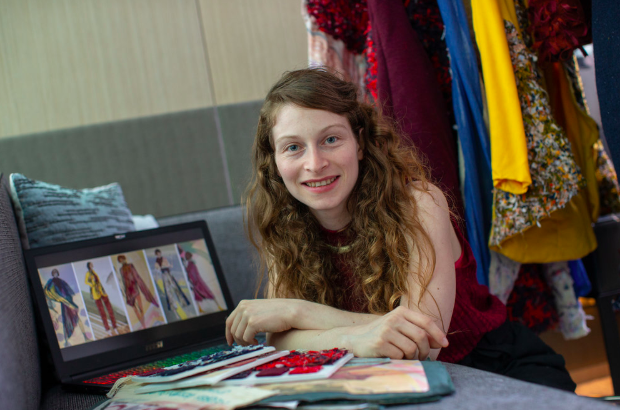
“I’m not a fashion designer,” said Goldstein. “I believe in development and in development of technology for the world of fashion. And I want the fashion world to think more about the environment and sustainable systems, where nothing is left over.”
Goldstein has been working with 3D printers since her second year at Jerusalem’s Bezalel Academy of Arts and Design, when she realized how much freedom the technology offered in the world of textile and fashion.
“You can build and go backwards and add layers,” she said. “The whole world of technology really allowed me to express myself.”
Goldstein isn’t the first Israeli fashion student to work with 3D printing. Several Israelis have used the technology with great success abroad. Danit Peleg’s final collection for Shenkar drew accolades, television appearances and commissions, while Eden Saadon wowed industry experts with the lace she created with a simple 3D pen.

Goldstein combines an appreciation for handiwork and crafts with figuring out how current technology can create similar textures.
She spent a year at Bezalel working on a 3D project in which she used mathematical concepts that mimicked the intricate beauty of antique, finely crocheted lace.
“I wanted to create lace of our century,” she said. “The math allowed me to create all kinds of variations of lace without any handiwork. It was all based on numbers, and it created something that is different in its look.”
Goldstein’s descriptions sound like engineering, but she says she’s not a math person, nor has she ever considered studying engineering. She described her use of 3D printers as mostly visualization, with the emphasis always on balancing the past and the future to determine what textiles can become in the present day.
During Goldstein’s third year of school she went to study at the Tokyo University of the Arts. Speaking no Japanese, she became a student in the antique craft department, which allowed no technology at all, not even computers. She studied traditional weaving and cloth painting, working only with her hands (and taking videos of the instruction classes so she could follow up if she had missed anything.)
“Textile is really visual, so I learned a lot from looking,” she said. “It just did so much with my handiwork.”
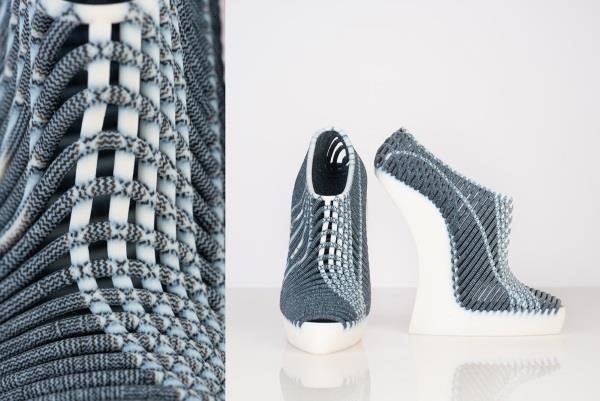
Her final project for Bezalel was based on much of what she learned in Japan, with each of the seven outfits and six pairs of shoes made with 3D printing but inspired by the ancient world, said Goldstein.
Once back in Israel, Goldstein worked closely with Intel and 3D printing company Stratasys, which helped her create a loom based on a real body shape and enabled her to weave her 3D works, each of which also includes handiwork that makes each piece unique.
“I created a kind of lab for myself,” she said. She bought two 3D printers for her home and ran them both every day over the course of several months.
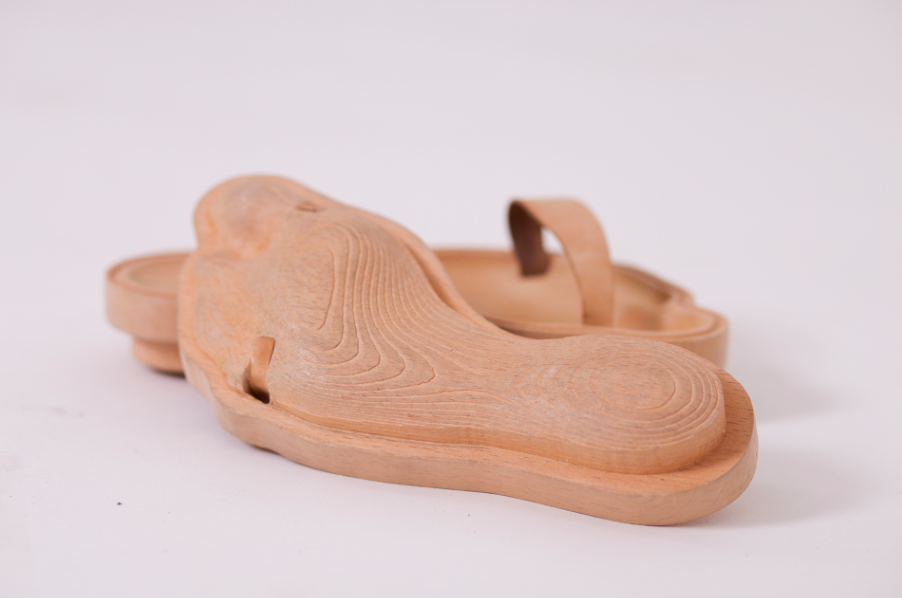
Now that Goldstein has presented her final collections, she’s moving on, aiming to create solutions within technology for the fashion world. Her hope is to make her ideas more commercial, and more available to the fashion industry.
“I’m going to the world of high-tech,” she said.










The Times of Israel Community.