

Volkswagen suspends lobbyist over emission tests on humans, monkeys
CEO says auto giant has ‘taken first consequences’ for experiments designed to study effects of diesel exhaust fumes
 Add ToI as a Preferred Source on Google
BERLIN, Germany (AFP) — Germany’s scandal-hit auto giant Volkswagen on Tuesday suspended its chief lobbyist Thomas Steg as outrage mounted over monkey and human experiments carried out by the company to study the effects of diesel exhaust fumes.
CEO Matthias Mueller said VW had “taken first consequences” from the tests on monkeys and put on leave Steg, the general representative for external relations and government affairs, who had “taken full responsibility.”
The New York Times reported last week that US researchers in 2014 locked 10 monkeys into airtight chambers and made them breathe in diesel exhaust from a VW Beetle while the animals were watching TV cartoons.
Separately, it emerged that a research group funded by VW, Mercedes-Benz parent Daimler and BMW had ordered a study in Germany measuring the effects of inhaling nitrogen dioxide on 25 human volunteers.
The scandal follows VW’s admission in 2015 that it had manipulated 11 million diesel cars worldwide, equipping them with cheating software to make them seem less polluting than they were.
Mueller on Monday labeled the animal testing “wrong … unethical and repulsive,” reported Spiegel Online.
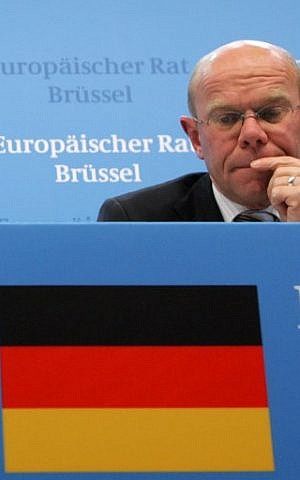
And Steg had vowed in the top-selling Bild daily that “what happened should never have happened, I regret it very much.”
He admitted that he had been informed in advance of the US monkey experiment but insisted he prevented a plan to carry these tests out on humans.
The German government has called a special meeting with the affected car companies to ask them to explain themselves.
In Brussels, European Commission spokesman Margaritis Schinas said the EU was “shocked” and took note of Berlin’s vow to investigate the matter, adding that “we hope that they will.”
Greenpeace slammed “a fraudulent auto industry and an idle German government” behind the scandal and called Steg a “scapegoat.” The NGO said nitrogen dioxide emitted by diesel vehicles led to 10,000 premature deaths in Germany each year.
The EU Commission has summoned Germany and eight other EU countries to explain how they plan to lower toxic emissions to meet the bloc’s air quality standards if they want to avoid action before the European Court of Justice.
Chancellor Angela Merkel has strongly condemned the latest controversy to engulf the nation’s powerful auto industry.
“These tests on monkeys or even humans are in no way ethically justified,” said Merkel’s spokesman Steffen Seibert on Monday. “The indignation felt by many people is completely understandable.”
No harm?
All three German car makers have scrambled to distance themselves from the research body in question — the now defunct European Research Group on Environment and Health in the Transport Sector (EUGT) — and promised to launch internal investigations.
Mueller said that “we are in the process of scrutinizing the work of the EUGT, which was dissolved in 2017, and drawing all the necessary conclusions from it.”
“Mr. Steg has declared he was taking full responsibility. I respect that,” he said.
Steg had, in his comments to Bild, also addressed the German tests conducted in an institute in Aachen in 2013 and 2014, stressing that the volunteers had been exposed to “much lower levels than those found in many workplaces” and that no-one suffered any harm.
Although it was the EUGT that commissioned both tests, the organization itself was financed by the trio of car giants hoping its research would defend diesel’s green reputation.
The car companies decided in late 2016 to dissolve the EUGT, which shut its doors last year.
Amid the controversy, Berlin’s Tageszeitung daily said that “while these experiments are doubtless scandalous, the bigger scandal is the experiment the car industry has been conducting on the wider population for decades.”
“While the monkeys and human volunteers only had to inhale exhaust fumes for a few hours, people with the misfortune to walk along arterial roads have been breathing in levels of nitrogen oxide far higher than EU limits for years.” the newspaper said.










The Times of Israel Community.