

With abrupt closure of IBA, English news staff never even got to say goodbye
While daily broadcast was perceived as an interloper, it offered a significant public service to English speakers in Israel
 Add ToI as a Preferred Source on Google
Jessica Steinberg, The Times of Israel's culture and lifestyles editor, covers the Sabra scene from south to north and back to the center

Each day at 4 p.m., Jeff and Hilary Dritz were usually in one place: in front of the television tuned to Channel 33, watching the daily broadcast of the IBA news in English.
But no longer. With the abrupt closure of the Israel Broadcasting Authority two weeks ago, the English news was canceled and English-speaking immigrants like the Dritzes, who moved to Israel when they were already in their sixties and had a hard time become proficient in Hebrew, were left without any comparable replacement.
“Our only link as to what is happening domestically in Israel is the current IBA news on TV in the afternoons and the two daily news broadcasts on Radio Reka,” wrote the Dritzes in a letter shortly before the closure. “With the impending closure of the IBA we understand that the new proposed broadcasting authority will have no English broadcasts at all, which will leave the English-speaking community without any reliable newscasts available to it.”
The broadcasting authority came to a dramatic end when anchor Geula Even’s evening IBA Hebrew broadcast was interrupted by final news of the closure on May 9, after which dozens of IBA employees were immediately absorbed into Kan, the government’s new media company based in Modiin.
“Everyone was notified by WhatsApp,” said Efrat Battat, the head of the IBA’s English news department. “Nobody gets it. Geula Even bursting out in tears and now she’s on Kan?”
Even, an IBA news anchor, was informed about the immediate closure while in the middle of her evening news show. She was rehired, however, by the new state broadcaster, Kan, and is now back reading the news. The IBA’s English TV department, by contrast, no longer exists.
https://youtu.be/t3JltRxMsTQ
With the abrupt shuttering of the English news, there has been no one to explain the complicated broadcasting saga to thousands of English-speaking viewers, who depended on the daily show to explain the vagaries of Israeli news in their native language.
“We offered a true source of news from Israel,” said Battat, who worked for the English news for 23 years, in various capacities. “It was unbiased and not twisted; it was in an accurate form that people trusted. It wasn’t CNN or BBC, it offered a local angle.”
The English news was established following the 1990 Gulf War, when the head of the IBA Arabic department realized the need to present the Israeli angle of news in English, to all the non-Hebrew speakers in Israel. It had its origins in the Palestine Broadcasting Service, launched in 1936, which offered English language bulletins as well as broadcasts in Hebrew and Arabic.
The IBA Hebrew news broadcasters, however, were never happy with the English language interloper. They perceived it as a show that took up time slots and budgets they wanted for themselves.
There were always battles over the need for English news, said Knesset member Nachman Shai, who chaired the broadcasting authority at one time, and lobbied hard for years to keep it going.
“It’s the unwanted stepchild of the family,” said Shai. “They made a joke of it. It doesn’t really make sense that we don’t have it now, when we have tens of thousands of English speakers and tourists and diplomats and foreign press and Palestinians, but they [the Hebrew news department] just don’t care.”

At its height, the English news located a prime-time new spot, featured on Channel One at eight p.m., and had an additional half-hour show called “Closeup,” with in-depth analysis in English, produced by a staff of eleven.
But it was continually moved around, to six p.m. and then five p.m., from Channel One to Channel 33, a far lower spot on the television channel totem pole.
Three years ago, the English news was given “the really crazy hour” of 4 p.m., said Battat, which made it more difficult for people to watch, yet viewers would persevere and record it, or follow it online.

It was around the same time that the public broadcasting law — proposed by Knesset members Yair Lapid and then Communication Minister Gilad Erdan — asked to shut down the Israel Broadcasting Authority for good. The law cited the illnesses of the IBA, the overspending and inflated salaries, and the lack of viewers watching the channel.
“They wanted to reform it,” said Battat. “But instead of reforming it, they decided to just do away with it and build a new corporation.”
The new corporation, decided the government ministers, would be Kan, a streamlined, more efficient public broadcasting company.
When Battat took over the English news in 2015, she lacked manpower but knew she still had demand from viewers. She campaigned in the Knesset, lobbying with the help of Nachman Shai and Eli Groner, a former reporter who now heads the Prime Minister’s Office, to build a budget and continue operating.
Battat knew that the English news department, and the IBA in general, were in danger of being shut down. Yet it didn’t seem that it would actually happen.

“We never thought they’d really kill English news,” said Arieh O’Sullivan, one of Battat’s IBA colleagues who lobbied with her. “When they wrote the law, they wrote that there had to be English language news, but they only mentioned radio.”
O’Sullivan wasn’t cowed. He tried to get into the mindset of the Kan executives, meeting with several deputies to try and convince them that English news was imperative.
“It actually once made money,” he said. “The English news was sold to 120 cable stations in the US, to almost every Jewish TV station, and a lot of evangelicals and to India and Middle East TV.”
Several years ago, the authority decided to stop charging those international customers for the English news, perhaps for the ulterior motive of ultimately closing the department, surmised O’Sullivan.
“Nobody inside cared,” he said. “They moved our slot, they slowly killed us, moving us from 5 p.m. to 4 p.m. and then to Channel 33. They couldn’t think about the English news. We were too small for them to think about.”
O’Sullivan and Battat began a letter-writing campaign, and received hundreds of letters that they passed on to the PM’s office. O’Sullivan also spoke at the Knesset, begging Likud MK David Bitan, who had spearheaded a bill to retain the set-to-be-closed Israel Broadcasting Authority, to include the words “English television news” into the law, before he realized they just weren’t going to do it.
No one cared about the English news, said Nachman Shai, and the powers at the IBA knew they were exonerated by the new law.
“It’s a service we provide, a public service, but no one was interested in it,” said Battat. “And that really angered our viewers. They were infuriated by it. They would write, ‘English is the second most spoken language after Chinese in the world.’”
The dates for shuttering of the IBA kept on being announced, and then repeatedly postponed over the last year and a half.
This spring, when it seemed that closure was imminent, Battat planned a farewell show, with previous IBA English anchors as guests. She was at a bat mitzvah on May 9 when she received the Whatsapp message that the IBA had been closed, effective immediately. That last show never aired.
As of Wednesday, May 10, the IBA English news staff found packing boxes in their offices.
“We felt like criminals, like just get your stuff and get out of here,” said Battat. “You devote your life to something, and it goes down and nobody really knows the reason.”
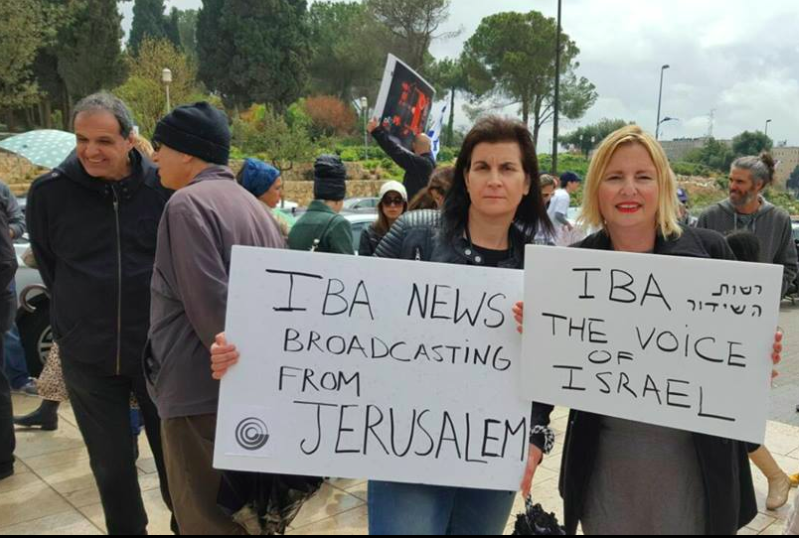
When asked if English news would be reinstated at the new Kan broadcasting corporation, the appointed spokesperson had no comment.
O’Sullivan went to Kan, where he was given a production job for the English news on the radio, but said it wouldn’t work for him, given the low pay and long hours at night.
The Arabic news department has remained in the new broadcasting corporation, said Battat, “pretty much copied and pasted to Kan.”
Battat chose not to interview at Kan, adding that she isn’t sure she wants to be a part of it.
For these long-time staffers, nothing was like the IBA.
“It was something little,” said Battat, “a small service that was appreciated. The budget to produce it was so small, and we had such vision, that’s where I feel frustrated. We didn’t even get to make a formal farewell to our viewers.”










The Times of Israel Community.