

With Gaza ceasefire, Biden can claim success for ‘arm around Israel’ approach
White House was accused by Dem. progressives, allies abroad of lacking urgency and coddling Israel, but latest escalation was brought to a close after a relatively short 11 days

 Add ToI as a Preferred Source on Google
With each day that passed in the latest Gaza conflict, the Biden administration came under increasing pressure from within the Democratic Party and from allies abroad who demanded the US cease shielding Israel from criticism and play a more active role in bringing an end to the violence.
It’s not that the White House wasn’t interested in de-escalation, but it had a starkly different approach to obtaining it.
Once heavy rocket fire from Gaza commenced on May 10, the Biden administration shelved its statements criticizing Israeli actions in Jerusalem and replaced them with ones highlighting Israel’s right to defend itself and panning those making a “false equivalence” between the Jewish state and the Hamas terror group.
Meanwhile, senior US officials took to the phones, holding over 80 conversations with Israeli and Palestinian leaders along with other relevant players in the region, according to the White House.
“The understanding from [US President Joe] Biden, [Secretary of State] Tony [Blinken], [National Security Adviser Jake [Sullivan] and others was that publicly criticizing Israel would only have led to it digging in its heels and prolonging the conflict,” said a former US official familiar with the administration’s ceasefire efforts.
“Instead, they focused on marathon calls with relevant actors behind closed doors, while ignoring much of the background noise from well-intentioned but ineffective critics,” the former official added.
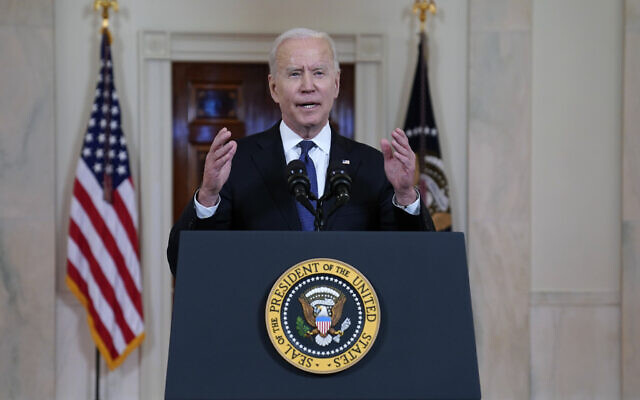
Biden referred to his administration’s efforts as “quiet diplomacy” in a Thursday speech after the ceasefire was reached.
Former US ambassador to Israel and special envoy for Israeli-Palestinian negotiations Martin Indyk dubbed it the “arm around Israel” approach in a post-ceasefire tweet celebrating its effectiveness.
Keeping friends close
The strategy was consistent with Biden’s broader approach to Israel since entering office. “There’s been a recognition that the two governments won’t always see eye to eye, but on the issue of Iran, for example, the US has avoided public spats with the Netanyahu government,” said the well-informed former official, who highlighted the bilateral working-group established to keep cooperation on the nuclear talks as close as possible.
One current US official clarified that the Biden administration is still voicing its objections when necessary both behind closed doors and even in public statements, albeit gingerly.
He pointed to the White House’s frustration with the IDF strike last Saturday on a media tower in Gaza, where Israel said Hamas offices were also located. “They put out a statement expressing concern over the safety of journalists, but in phone calls were very pointed in their demands for answers.”

“Had the administration started publicly calling them out in the middle of a war, the Israelis would have completely shut down,” the US official said, requesting anonymity to speak candidly.
“So they said what was necessary behind closed doors to get the point across, while publicly continuing to insist that Israel has a right to defend itself — knowing that they’d take heat for it within the party,” the official added.
“It’s hard to imagine that any overt pressure on Israel… would have been able to stop the fighting any sooner,” said Hussein Ibish from the Arab Gulf States Institute in Washington.
“It’s easy to see how more or less public pressure could have worked less effectively, by either putting no restraints on Israel or provoking the Israelis to prove their independence by extending the fighting for a few days over Washington’s objections,” he added.
Speak softly
The other part of the “quiet diplomacy” strategy was recognizing limitations and focusing efforts to where the US could be helpful, said the former official familiar with the efforts.
“It wasn’t like the administration was dying to get too involved anyways, but leaning on Egypt was more than just an excuse,” the ex-official explained.
The government in Cairo has extensive experience brokering ceasefires between Israel and Hamas over the past decade, due to its ties with both leaderships, and it was indeed Egypt that succeeded in mediating an agreement, amid parallel efforts by the UN and other countries.

“The Biden administration recognized that Egypt was the main game in town and that their job [in DC] was to patiently, but firmly nudge Israel in that direction,” the ex-official argued.
In the meantime, the White House sought to scuttle other efforts by international actors, which it worried would isolate Israel and lead to Jerusalem doubling down against ceasefire efforts.
Three times the US mission to the UN blocked the Security Council from passing joint statements calling for an immediate ceasefire. The mission also hinted that it would have opposed a French-backed resolution to the same effect, even though that text condemned Hamas rocket fire, unlike the other statements Washington nixed.
A Security Council diplomat told The Times of Israel earlier this week that the wording of the resolutions was not why the US refused to back them.
“They told us they could not support any expression from the council at this time,” the diplomat said.

“Despite the bombings, rocket attacks and civilian casualties, the US has other priorities than supporting the council speaking out,” the diplomat said.
The White House response also enraged the increasingly popular “Squad” of progressives in Biden’s own party.
Rep. Rashida Tlaib insisted on Twitter that “apartheid-in-chief Netanyahu will not listen to anyone asking nicely.”
Tlaib also joined Reps. Alexandria Ocasio-Cortez and Mark Pocan, in the rather unprecedented step of introducing a resolution aimed at blocking the $735 million sale of precision-guided missiles to Israel, which is being backed by Reps. Ilhan Omar, Cori Bush, Ayanna Pressley, Betty McCollum, Andre Carson and Pramila Jayapal. A Senate version of the resolution was submitted Thursday by Sen. Bernie Sanders, though neither are expected to pass due to overwhelming support for Israel in both houses.
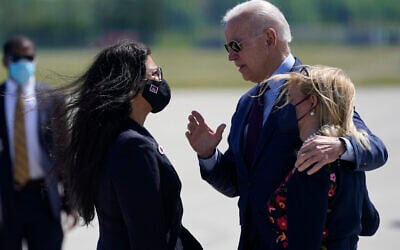
But similar to his handling of Israel, Biden has avoided public quarrels with his more left-wing critics. Speaking at an event to promote his infrastructure plan in Dearborn, Biden warmly addressed Tlaib, who sat in the audience, saying he admired her passion and would pray that her Palestinian grandmother and other family are well in the West Bank. “You’re a fighter and God thank you for being a fighter.”
Meanwhile, at the UN, the American administration stood firm in its position, with an official at the US mission telling The Times of Israel earlier this week, “As we have communicated consistently to council members over the last week, the US is engaging in intense diplomatic efforts at the highest levels to try to bring an end to this conflict. The US has a role in ensuring any council statement supports these efforts.”
France was still planning on moving forward with its resolution, but it ultimately proved unnecessary as the ceasefire went into place before the council could meet for a fifth time since the conflict started.
It might not be possible to gauge the extent of the role the Biden administration played in the agreement struck Thursday between Israel and Hamas, but the cessation of hostilities after 11 days is far less than the 51 it took to end the last war in 2014.
But let’s not get carried away
While crediting the Biden administration for the “arm around Israel” strategy’s ability to bring a relatively quick end to the violence, Ibish noted that quicker engagement from the US may have been able to help prevent it in the first place.
“The Biden administration bungled the weeks leading up to the violence very badly,” the AGSIW scholar argued, saying that Washington had received repeated warnings from Egypt, Jordan and others “that a tinderbox was smoking in Jerusalem” over the looming evictions of Palestinian families in the Sheikh Jarrah neighborhood and the aggressive policing tactics against Palestinians at Damascus Gate and at the Temple Mount. Nonetheless, it took until three days before the conflict started on May 10 before the White House weighed in significantly.
Pouring additional cold water over efforts to give the US too much credit, Ibish noted that the handful of Gaza conflicts over the years have “followed a very familiar three-act script, and the outcome [of this one] is pretty much what the previous ones were, with the US and Egypt playing the same roles.”

“So, yes, Biden could have done worse and Israel might have persisted for a couple of days to spite him. But in the end [both sides] were done fighting anyway, [and Israel] clearly doesn’t want Hamas to fall from power,” he argued.
Ibish went on to suggest that the “arm around Israel” would be the continued preference of the Biden administration “as long as Hamas, a designated foreign terrorist organization, is on the other side.”
But on issues such as settlements, where the choice becomes one between competing Israeli and US interests in the region, he predicted, that Biden strategy of embrace is much less likely to apply.










The Times of Israel Community.