

Freedom or infiltration?
The controversial Infiltrator Law is struck down, which strikes a chord with all the papers
 Add ToI as a Preferred Source on Google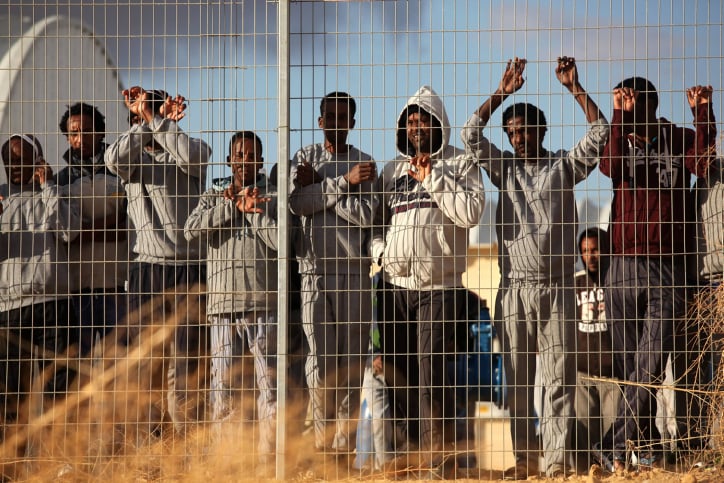
Back in January 2014, African migrants staged huge protests across the country and all the papers staked out their positions on the issue. With Monday’s dramatic ruling by the High Court of Justice to strike down key parts of the “Infiltrator Law” and close the Holot detention center, those positions are back on the front pages.
Haaretz gives the ruling two full pages of coverage, including four opinion pieces. The paper notes that the court ordered the Holot detention center closed within 90 days, and ruled it illegal for illegal migrants to be held more than 60 days (which is the current timeframe under current immigration laws). Haaretz quotes Judge Uzi Fogelman who said the law “seriously and deeply harms basic human rights.”
The justices had particularly harsh words for the detention center itself, which calls itself a “open facility,” meaning inmates must physically check in three times a day but are otherwise free to leave. Saying that it was far away from any city or town, inmates really had no choice but to stay there all day long and that it was in essence a closed facility and therefore violated “the minimum dignified life to which everyone is entitled.”
Included in its four opinion pieces is a piece by Mutasim Ali, a community activist from Sudan, who said he wasn’t surprised by the ruling. “I believe in the Israeli justice system…there is no such thing in Egypt or any of the neighboring states.” He goes on to say that the ruling wasn’t in favor of African migrants, but for all of Israel. “Beyond the High Court ruling, it’s the citizens we have to live with. All our struggle aims to achieve is at the end of the day there will be fair policies that protect our rights as human beings, as well as the rights of Israeli residents and the State of Israel.”
Israel Hayom goes negative with its reporting of the court decision, as evidenced by its front-page headline, “The storm after the decision.” The paper quotes outgoing Interior Minister Gidon Sa’ar, who said of the decision, “The High Court’s ruling is wrong and leaves Israel without the tools to deal with the phenomenon of illegal infiltration.”
Columnist Haim Shein seems to agree with the outgoing minister. He writes that Jewish history, full with pain and suffering, has affected Israel immigration policy. But immigration policy doesn’t apply in this case. “The fact is that these are not refugees but tens of thousands of infiltrators who entered illegally, with the assistance of criminal elements in the Sinai, and who brazenly and crudely violated the sovereignty of the State of Israel.” He goes on to write, “Israel is not supposed to solve the plight of Africa,” and argues that Israel’s policies are actually much more humane than other Western countries.
Shein’s colleague, Dan Margalit takes a different tone than Shein, writing that the decision was a good one for Israel. Margalit starts out attacking Ehud Olmert for doing nothing about the issue, and praising Netanyahu for doing something to solve the problem. Margalit points to building the border fence with Egypt as a good policy move that has stopped the flow of migrants in the past year. While Holot may be closed, he says there is nothing preventing the government from trying to convince migrants to return to their home countries. “While the pressure will be less efficient in the absence of a detention camp, it is preferable to prolonged detention, which continues to harm the Israel’s reputation in the world.”
Over in Yedioth Ahronoth, the paper tries to be a balance between the two sides, but labels the High Court “the Infiltrators’ High Court.” The paper gives a breakdown of the numbers, showing that since January only 21 “infiltrators” entered Israel and the population totals less than 50,000 people. Included in its coverage are two stories from both sides of the debate.
“We feel like human beings,” is the headline on the reaction of African migrants, who say the court decision has given them hope. Omer, an asylum seeker from Eritrea who has been living in Israel for three years, told the paper, “Israel needed to understand that we are human beings. Today is a very significant day. This is the first time that I feel like I am in a democratic state.”
“The High Court is spitting in our face,” is the headline for the article about the anger in south Tel Aviv, where a large concentration of African migrants live. Shlomo Maslawi, leader of the Ganei Hatikvah Neighborhood Association, said, “The High Court revealed its insensitivity and accepted the appeals of human rights organizations. Are we not human beings too? Now why would the infiltrators ever leave?” Gila, another resident of south Tel Aviv, said, “This was heaven here before the Eritreans and Sudanese arrived.”








The Times of Israel Community.