

Ultra-Orthodox protesters clash with police, block roads over arrest of draft evader
Police reportedly use batons and stun grenades to disperse demonstrators; dozens of protesters and officers injured during demonstration
 Add ToI as a Preferred Source on Google
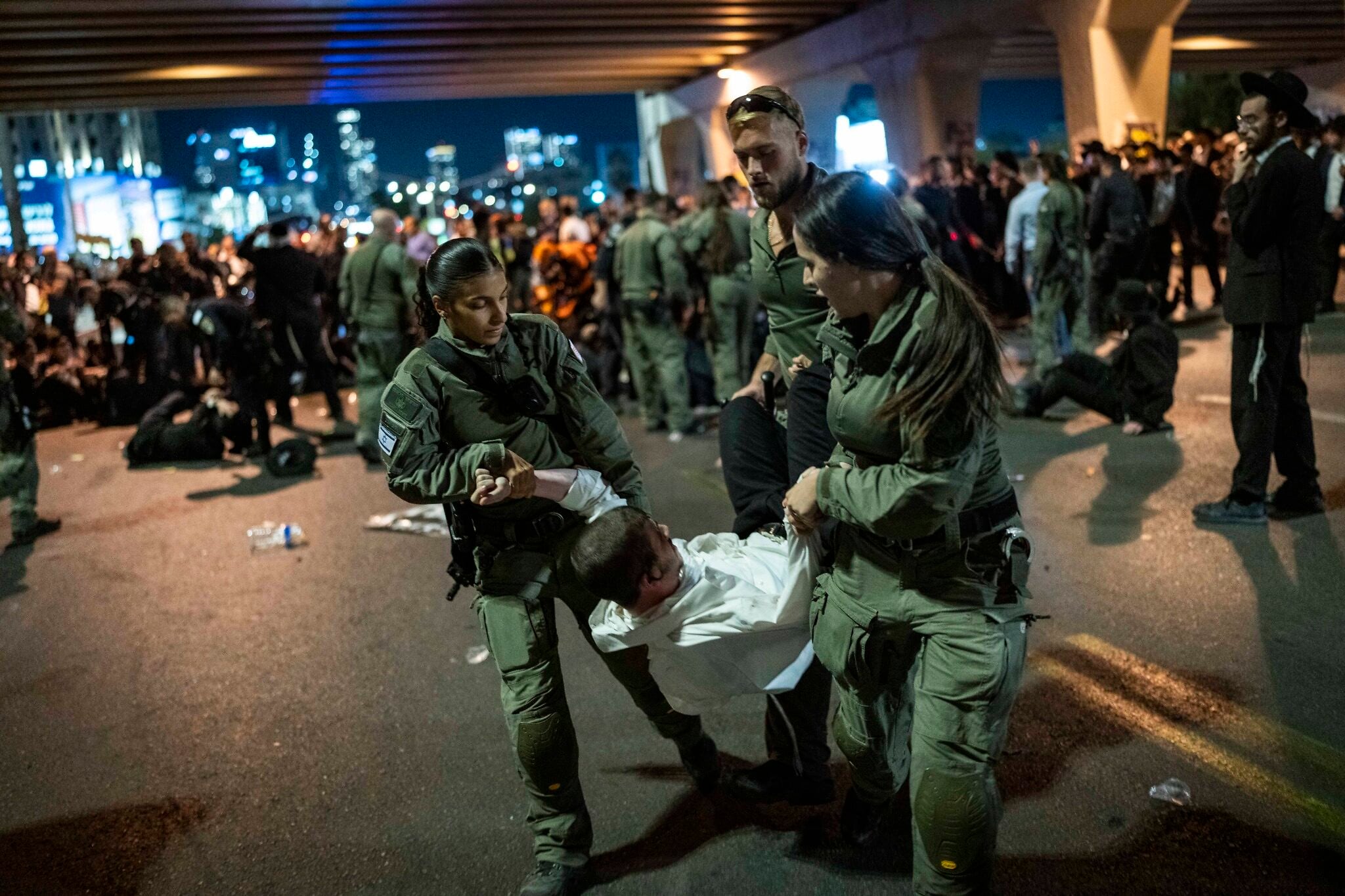
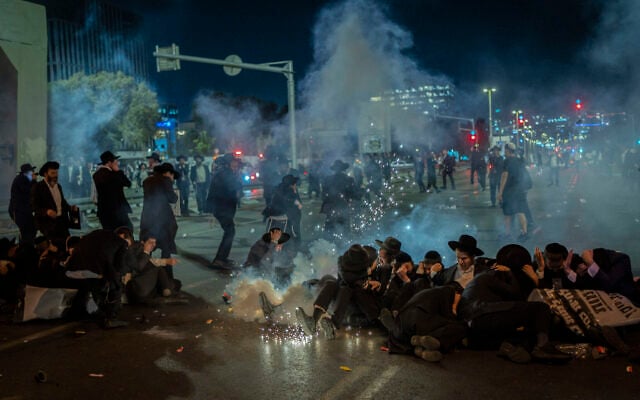
Route 4 has reopened in both directions after hundreds of Haredi men rioted against the arrest of a draft evader near Bnei Brak, where they clashed with cops, “terrorized passersby” and assaulted journalists, police said in a statement.
Three people were arrested on suspicion of attacking police and disrupting order, the statement said, adding that three police officers were wounded, two of whom were hospitalized.
Rioters also threw a stone at i24 reporter Shany Weitzman, hitting her in the head, and attacked i24 photojournalist Nadav Abbas with a metal rod, according to police and the outlet.
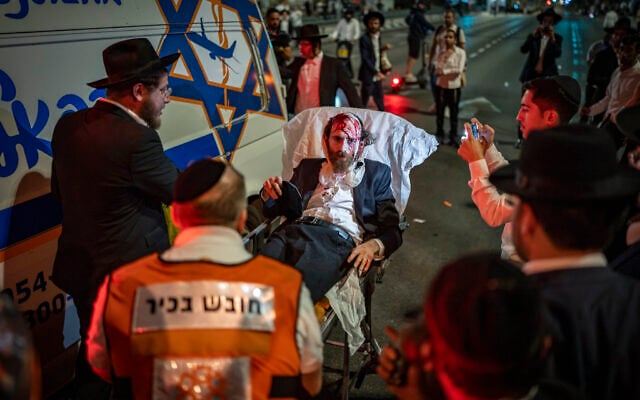
Meanwhile, the United Hatzalah ambulance service said it treated over 30 people — both protesters and police — for moderate and light wounds as a result of the demonstration.
Eight of the wounded people were hospitalized, the ambulance service says.
Ynet reported that an officer was struck by a stone during clashes with the protesters. Police reportedly used batons and stun grenades to disperse the demonstrators.
Channel 12 reported that the demonstration was organized by the Jerusalem Faction, an extremist ultra-Orthodox group that has regularly hosted protests against military conscription and against the arrest of draft evaders.
The student at the center of Thursday’s protest has been identified by Ynet as Alon Smadja, a resident of Jerusalem. Smadja was reportedly detained after he did not report for military service.
The protesters sat on the road, holding signs that read: “Better to die as an ultra-Orthodox Jew than live as a secular Jew,” “We will die rather than enlist” and “Israel is an antisemitic country,” Ynet reported.
תיעוד: פינויים אלימים בהפגנת החרדים בכביש 4, המשטרה משתמשת ברימוני הלם@daniel_grovais https://t.co/qYItNFhEp5 pic.twitter.com/Hc0ZdsMOIF
— כאן חדשות (@kann_news) October 29, 2026
Police closed northbound Route 4 at the Aluf Sadeh interchange ahead of the protest, while demonstrators blocked the Geha interchange beneath the highway.
Protesters also blocked railway tracks near Petah Tikva, Ynet reported. Police had recommended that the public use alternative routes and avoid the areas during the demonstration.
“Israel Police views the right to protest as a cornerstone of a democratic state and permits demonstrations as long as they are conducted within the law,” police said in a statement. “At the same time, police will not permit disturbances of any kind, interference with freedom of movement or any behavior that could endanger public safety.”
Jerusalem Faction slams Ben Gvir
Jerusalem Faction sources accused National Security Minister Itamar Ben Gvir of “using the police to take revenge for the election results,” according to Channel 12. “We will settle accounts with everyone responsible for this. Haredi blood is not cheap,” they said.
The current governing coalition, in which Ben Gvir is a member, lost its majority in Tuesday’s election.
In response, Ben Gvir criticized Police Commissioner Daniel Levy, accusing him of trying to win favor with a potential incoming government, according to the Kan public broadcaster.
He accused Levy of turning ultra-Orthodox protesters into his “punching bag.”
United Torah Judaism chair MK Yaakov Asher also condemned the police response, according to Channel 12, saying a man with disabilities had been injured.
“Although we oppose blocking roads, we cannot remain silent in the face of the disturbing footage showing protesters, including a young man with special needs, lying on the ground, bruised and bleeding,” he said.
“Such behavior crosses a red line and cannot be ignored,” Asher said. “The officers acted unlawfully and with severe violence.”
The High Court of Justice has repeatedly pressed the government to enforce Haredi enlistment after its 2024 ruling that there was no legal basis for blanket exemptions from the draft for yeshiva students. In July, the court froze legislation passed by Prime Minister Benjamin Netanyahu’s coalition that would have barred the arrest of Haredi draft dodgers for seven months.
The issue of Haredi draft exemptions has been a major source of political and social tension, as the IDF has repeatedly said it faces an urgent manpower deficit amid the multifront war of recent years, and resentment has grown among Israelis who perform mandatory and reserve service. Many have served hundreds of days in the last three years.
The IDF has created programs to accommodate Haredi soldiers, but many still oppose service, and the community’s leaders seek legislation to continue the broad exemptions that have been granted for decades.
The ultra-Orthodox community has historically shunned army service, claiming that military life is at odds with their religious culture and practices. Haredi protest rallies, which sometimes turn violent, have been held at various locations around the country.

The Times of Israel Community.