

Hamas said to obtain cash for salaries in Gaza
Not immediately clear how Gaza rulers obtained the money, a central issue in the lead-up to current conflict

 Add ToI as a Preferred Source on Google
Avi Issacharoff, The Times of Israel's Middle East analyst, fills the same role for Walla, the leading portal in Israel. He is also a guest commentator on many different radio shows and current affairs programs on television. Until 2012, he was a reporter and commentator on Arab affairs for the Haaretz newspaper. He also lectures on modern Palestinian history at Tel Aviv University, and is currently writing a script for an action-drama series for the Israeli satellite Television "YES." Born in Jerusalem, he graduated cum laude from Ben Gurion University with a B.A. in Middle Eastern studies and then earned his M.A. from Tel Aviv University on the same subject, also cum laude. A fluent Arabic speaker, Avi was the Middle East Affairs correspondent for Israeli Public Radio covering the Israeli-Palestinian conflict, the war in Iraq and the Arab countries between the years 2003-2006. Avi directed and edited short documentary films on Israeli television programs dealing with the Middle East. In 2002 he won the "best reporter" award for the "Israel Radio” for his coverage of the second intifada. In 2004, together with Amos Harel, he wrote "The Seventh War - How we won and why we lost the war with the Palestinians." A year later the book won an award from the Institute for Strategic Studies for containing the best research on security affairs in Israel. In 2008, Issacharoff and Harel published their second book, entitled "34 Days - The Story of the Second Lebanon War," which won the same prize.
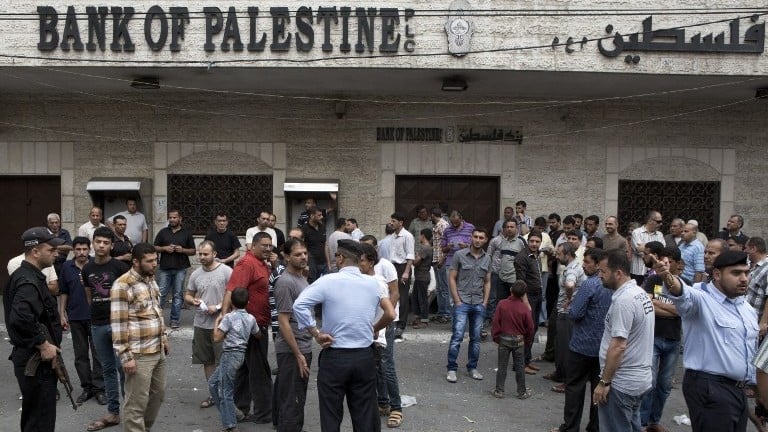
Hamas has managed to bring millions of dollars into the Gaza Strip to pay the salaries of thousands of workers, a Gaza-based news agency reported on Sunday, after two months in which no such payments were made.
According to the Palestinian Sawa news agency, salaries were paid to all members of Hamas’s military wing, and the salaries of government officials in the Strip were expected to be paid as well. It was not immediately clear how Hamas managed to transfer the money into the Strip and/or whether the move was intended to help quell unrest in the Palestinian enclave, as a step toward a possible lasting ceasefire.
Payment of the salaries has been one of the key demands by Hamas for a ceasefire in the ongoing conflict with Israel. Egypt has been engaged in trying to broker an end to Operation Protective Edge, which Israel launched on July 8 to halt rocket fire from the Gaza Strip and to destroy a network of tunnels, dug by Hamas under the border and used to launch attacks inside Israeli territory.
The unpaid salaries of Hamas members have also been the focus of a major dispute between Fatah and Hamas, and were a significant factor prompting the recent escalation in Gaza.
The salary crisis, which has plagued Hamas for months, compounded the most severe financial shortfall in the organization’s history, caused by significant loss of revenue following the destruction of smuggling tunnels under the Egyptian border.
In mid-July the United States blocked the transfer of Qatari funds earmarked for the salaries of civil servants hired by Hamas in Gaza.
A diplomatic source in the Gulf state, speaking on condition of anonymity, said at the time that Qatar had transferred hundreds of millions of dollars to the Arab Bank for the salaries of some 44,000 Hamas civil servants. Those civil servants — employed by Hamas in Gaza since its takeover of the Strip in 2007 – were rendered jobless by the unity agreement with Fatah in May.
Elhanan Miller contributed to this report.






The Times of Israel Community.